
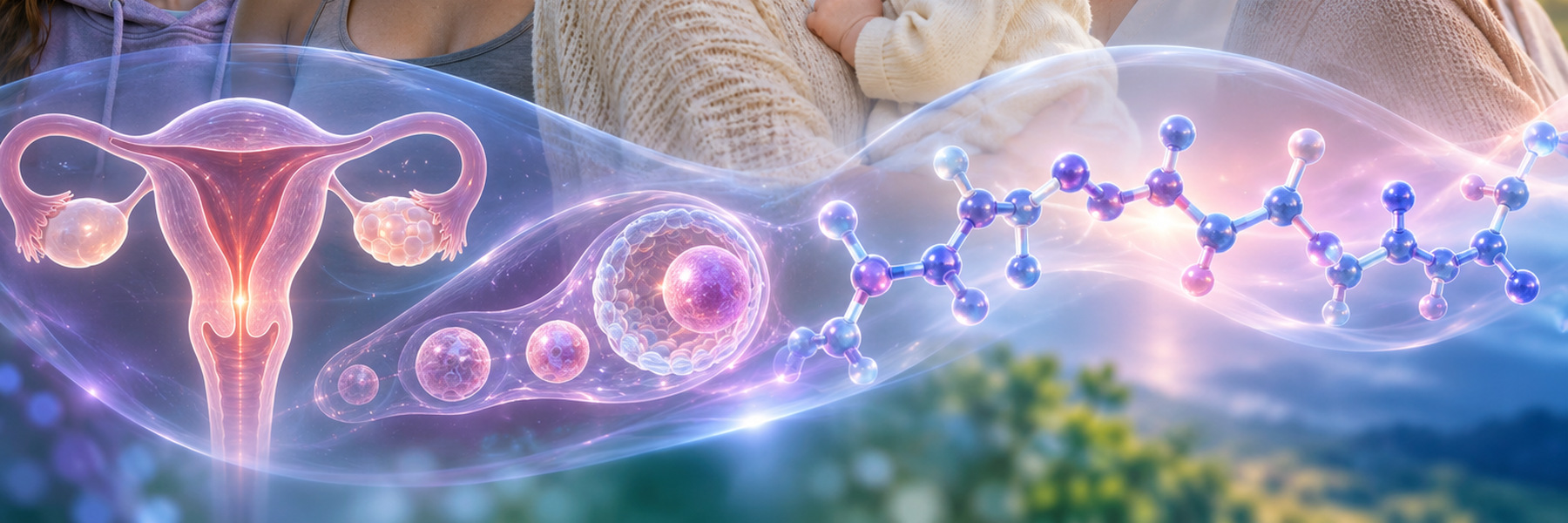
From the signals that coordinate ovulation to the neuropeptide pathways involved in menopause, peptide science is helping researchers understand women’s health across adulthood. Some peptide-based medicines already play essential roles in fertility and childbirth, while other discoveries are opening more targeted avenues for research.

1. The Big Picture: Hormonal Health Changes, but It Is Never One Number
Women’s hormonal health is often discussed as if estrogen alone controls everything. In reality, reproductive and endocrine health depends on coordinated communication among the brain, pituitary gland, ovaries, uterus, metabolic tissues, and, during pregnancy, the placenta. These relationships change naturally during puberty, reproductive adulthood, pregnancy and postpartum recovery, perimenopause, and menopause.
An irregular menstrual cycle, difficulty conceiving, endometriosis-related pain, hot flashes, and changes in sexual desire are not interchangeable hormonal problems. A person can have normal estrogen levels and still experience an ovulatory disorder, or enter menopause with troublesome symptoms even though the hormonal change itself is a normal biological transition. Not everyone seeks pregnancy, and reproductive goals are only one part of women’s health.
Peptides are particularly relevant because many of the body’s endocrine messengers are themselves peptide or protein hormones. Kisspeptin helps stimulate the brain’s reproductive hormone network. GnRH controls pituitary release of LH and FSH. hCG can reproduce a key LH-like signal used in fertility treatment. Oxytocin has established roles in childbirth and postpartum care. Research into neurokinin B has even led to nonhormonal medicines for menopausal hot flashes.
The differences in evidence matter. Recombinant FSH, hCG, oxytocin, and selected GnRH analogues have defined clinical applications. Kisspeptin-54 has promising human fertility studies but remains experimental. Other ideas, such as using peptide products to “reset” women’s hormones, reverse ovarian aging, or restore fertility after menopause, are not established human treatments.
The opportunity is exciting because more precise understanding may eventually mean better choices at each stage of life, guided by the person’s goals and biology rather than by a promise of universal “hormone optimization.”
2. The Biological Pathways: How Reproductive Hormones Communicate
The Hypothalamus–Pituitary–Ovary Axis
The hypothalamus releases gonadotropin-releasing hormone (GnRH) in pulses. The pituitary responds with follicle-stimulating hormone (FSH) and luteinizing hormone (LH). In the ovaries, FSH supports follicle development and estrogen production; a mid-cycle LH surge supports final egg maturation and ovulation. After ovulation, the corpus luteum produces progesterone that helps prepare the endometrium for a possible pregnancy.
Kisspeptin acts upstream of GnRH. The timing of these signals matters: a rhythmic pulse may stimulate the system, while sustained exposure to certain long-acting GnRH agonists eventually suppresses it. This is why medicines within the same general hormonal pathway can be used for such different purposes as fertility treatment or management of endometriosis.
Ovarian Reserve Is Not the Same as Fertility
Women are born with a finite pool of ovarian follicles. Anti-Müllerian hormone (AMH), produced by cells in small ovarian follicles, can help fertility specialists estimate likely ovarian response during stimulation. It does not provide a reliable stand-alone prediction of whether an otherwise fertile woman will conceive naturally, or exactly when menopause will occur. Age, ovarian health, sperm-related factors, tubal anatomy, and many other variables also matter.
A laboratory marker is not a treatment. No peptide discussed here has demonstrated the ability to replenish a depleted human ovarian follicle reserve or reverse natural menopause.
Pregnancy, Childbirth, and Lactation Use Different Signals
After implantation, placental hCG helps maintain the corpus luteum early in pregnancy. Oxytocin, made in the hypothalamus and released from the posterior pituitary, stimulates uterine contractions and milk ejection. Prolactin, another protein hormone, supports milk production.
A medicine that helps trigger ovulation in a fertility clinic is not necessarily safe or appropriate during pregnancy. Equally, the approved use of oxytocin in obstetrics does not prove claims about oxytocin nasal sprays for emotional bonding or libido.
Perimenopause and Menopause: A Changing Brain–Ovary Conversation
During perimenopause, ovarian hormone patterns become less predictable. After menopause, ovarian production of estradiol and progesterone falls substantially, while pituitary FSH levels generally rise. The transition can involve hot flashes, sleep disruption, genitourinary symptoms, and changes in bone health, but experiences vary considerably.
A group of hypothalamic KNDy neurons, named for kisspeptin, neurokinin B, and dynorphin, helps connect reproductive hormone feedback with temperature regulation. This has led to the development of medicines that block neurokinin receptors to reduce menopausal hot flashes. Those medicines are non-peptide small molecules that target a peptide-signaling pathway.
Hormones, Sexual Function, and Metabolic Health Are Related but Distinct
Sexual desire, genital arousal, ovarian function, and fertility are overlapping yet different processes. Metabolic conditions, including insulin resistance in some women with polycystic ovary syndrome (PCOS), may also affect menstrual regularity. These connections require targeted evaluation, rather than assuming one compound can correct all symptoms.
3. Compounds Researchers Are Exploring
Kisspeptin: An Upstream Signal with Promising IVF Research
Explore Kisspeptin-10 on Peptide Perspectives.
Kisspeptin is a natural peptide family involved in activating the GnRH system. It is especially important for triggering reproductive hormone responses associated with puberty and ovulation. Researchers have studied kisspeptin-54 as an alternative way of inducing the LH surge that prompts final egg maturation during in vitro fertilization (IVF).
In a 2015 Phase 2 study of 60 women at high risk of ovarian hyperstimulation syndrome, egg maturation occurred in 95% of participants following kisspeptin-54 treatment, with no moderate, severe, or critical OHSS observed in the study. A later 62-person randomized study found a higher proportion reaching a prespecified egg-yield threshold with an additional kisspeptin-54 exposure. These are encouraging early results, not proof of superior live-birth outcomes across fertility populations.
Research opportunity: A more physiologic, shorter-acting signal might help specialists tailor egg maturation while reducing OHSS risk in selected IVF cycles.
Limitations: Kisspeptin-54 is not FDA-approved for infertility, menstrual-cycle optimization, or menopause. Its results cannot be assumed to apply to kisspeptin-10 products. Major guidelines have not endorsed kisspeptin for routine infertility care.
Oxytocin: Established Obstetric Medicine, More Uncertain Wellness Claims
Explore Oxytocin on Peptide Perspectives.
Oxytocin is a naturally occurring nine-amino-acid hormone with well-established physiological effects on the uterus and milk ejection. Pharmaceutical oxytocin is routinely used in carefully monitored obstetric settings when there is a medical reason to induce or strengthen labor and to manage postpartum bleeding.
That is a powerful example of a peptide already providing tangible clinical benefit. However, its reputation as a “bonding hormone” can lead to overgeneralization. Experimental studies of intranasal oxytocin for social, mood, or sexual outcomes have yielded inconsistent findings and do not establish general wellness indications.
Research opportunity: Oxytocin highlights how a naturally occurring peptide can have clearly validated effects in one organ system while raising still-unresolved questions about brain signaling and social context.
Limitations: Oxytocin can cause dangerous uterine overstimulation or water-balance complications under inappropriate conditions. Hospital obstetric use is not equivalent to self-administered research nasal sprays or injections.
GnRH and Gonadorelin: When the Timing of a Signal Changes Its Purpose
Explore Gonadorelin on Peptide Perspectives.
Gonadorelin is synthetic native GnRH. Its biological role is to instruct the pituitary to release LH and FSH. In selected patients with functional hypothalamic amenorrhea who are seeking pregnancy, specialist-delivered pulsatile GnRH can help restore ovulatory signaling when the pituitary and ovaries remain responsive. The Endocrine Society guideline recommends addressing the underlying energy imbalance and discusses pulsatile GnRH as a fertility option after evaluation.
GnRH agonists, including leuprolide and certain fertility-trigger protocols, demonstrate a different effect. Brief use may stimulate a pituitary LH surge, while prolonged stimulation produces suppression of gonadotropins. Specific leuprolide formulations are FDA-approved for endometriosis-related pain and certain fibroid-related situations.
Research opportunity: GnRH-based medicine shows that hormone timing and delivery can be as important as the chemical structure of the signal.
Limitations: Prolonged GnRH suppression can cause hot flashes, low estrogen symptoms, and bone loss; products and indications vary. A casual dose of gonadorelin does not reproduce a specialist pulsatile protocol.
GnRH Antagonists: Preventing a Premature LH Surge
Read the official Cetrotide (cetrorelix) prescribing information.
Cetrorelix and ganirelix are GnRH receptor antagonists used in selected assisted-reproduction protocols. Instead of first stimulating and then suppressing the receptor, they block GnRH signaling promptly, helping prevent a premature LH surge while ovarian follicles are being stimulated and monitored.
This matters because premature ovulation can disrupt egg retrieval and IVF planning. Fertility medicine already uses peptide-receptor pharmacology to control the timing of these events more precisely.
Research opportunity: Antagonist protocols create an environment in which a fertility team can choose a suitable final maturation trigger based on the patient’s ovarian response and OHSS risk.
Limitations: These are FDA-approved medicines for specific fertility uses, not treatments for generalized “hormonal imbalance,” menopause, or ovarian rejuvenation. Specialist monitoring is essential.
hCG: An Established Trigger for Ovulation and Early Pregnancy Signaling
Explore hCG on Peptide Perspectives.
Human chorionic gonadotropin (hCG) is a placental glycoprotein hormone that activates the same receptor family as LH. During pregnancy it supports the corpus luteum in early gestation. In fertility medicine, pharmaceutical hCG products can provide an LH-like signal that triggers final follicular maturation and ovulation after appropriate stimulation.
The evidence for these uses is established, but hCG’s prolonged action is also a concern in women susceptible to ovarian hyperstimulation syndrome (OHSS). Choosing between an hCG trigger, a GnRH-agonist trigger, or other approaches depends on the treatment protocol and clinical risk.
Research opportunity: hCG provides a reference point against which newer approaches such as kisspeptin triggers are evaluated.
Limitations: hCG is not a general fertility booster, a menopause therapy, or an anti-aging hormone. It is not effective for weight loss, and inappropriate use can create serious complications.
FSH and LH-Based Medicines: Directly Supporting Follicular Development
Review the Gonal-f (follitropin alfa) label.
FSH and LH are glycoprotein hormones produced by the pituitary. In reproductive care, recombinant FSH, combined FSH/LH activity, and selected related preparations are used to encourage ovarian follicle development in appropriately evaluated patients and as part of assisted reproductive technology.
Unlike a broad “hormone-balancing” approach, the intention is specific and measurable: stimulate follicle growth, monitor the response using ultrasound and hormone measurements, and manage the timing of maturation and egg retrieval.
Research opportunity: Improving gonadotropin selection and monitoring may help fertility specialists tailor treatment while minimizing unnecessary stimulation.
Limitations: Follicle response is not the same as live birth. Risks include multiple pregnancy and OHSS, and these medications do not reverse age-related decline in egg quality or primary ovarian insufficiency.
Neurokinin B and KNDy Neurons: A Menopause Breakthrough from Peptide Biology
Explore the 2025 FDA-approved elinzanetant label.
Neurokinin B is an endogenous peptide that signals through neurokinin receptors. Within the hypothalamus, KNDy neurons integrate ovarian steroid feedback and participate in temperature regulation. After estrogen declines, altered KNDy activity can contribute to vasomotor symptoms, including hot flashes and night sweats.
The remarkable clinical development is that fezolinetant (an NK3 receptor antagonist) and elinzanetant (an NK1/NK3 receptor antagonist) are now FDA-approved nonhormonal medicines for moderate-to-severe menopausal hot flashes. Neither is itself a peptide, but both emerged from understanding a peptide-based neural pathway.
Research opportunity: This is one of the clearest examples of peptide biology leading to a useful midlife treatment that does not require replacing estrogen.
Limitations: These drugs treat hot flashes, not ovarian aging, fertility, or every menopausal symptom. Fezolinetant carries a boxed warning for rare serious liver injury and requires liver monitoring. Elinzanetant has separate warnings, including possible liver enzyme elevations and central-nervous-system effects; treatment decisions are individualized.
PT-141 (Bremelanotide): Sexual Desire Is Distinct from Fertility
Explore PT-141 on Peptide Perspectives.
Bremelanotide (PT-141) is a synthetic melanocortin receptor agonist. Its place in women’s hormonal health is not ovarian stimulation or progesterone production. Instead, it acts through neural pathways involved in sexual motivation and desire.
A pharmaceutical bremelanotide product, Vyleesi, is FDA-approved for acquired, generalized hypoactive sexual desire disorder (HSDD) in premenopausal women under defined circumstances. This is a real, narrow indication demonstrating how peptide-receptor science may address a problem distinct from fertility or menopause symptoms.
Research opportunity: Better understanding of central sexual signaling could lead to treatments matched to a specific cause of distressing low desire.
Limitations: Vyleesi is not indicated for postmenopausal women, sexual performance enhancement, or fertility treatment. Nausea and transient blood-pressure increases are important, and it is contraindicated in uncontrolled hypertension or known cardiovascular disease.
4. Comparing the Compounds
| Compound or pathway | Main mechanism | Women’s health application or research interest | Evidence / U.S. status | Key limitation |
|---|---|---|---|---|
| Kisspeptin | Activates KISS1R upstream of GnRH | Experimental egg maturation and LH-surge control in IVF | Small Phase 2 human trials; investigational | Kisspeptin-54 data do not validate kisspeptin-10; live-birth evidence incomplete |
| Oxytocin | Uterine oxytocin receptors; milk ejection and central signaling | Labor and postpartum bleeding; experimental social signaling | FDA-approved obstetric formulations | Brain, libido, and bonding claims not established by obstetric evidence |
| Gonadorelin / GnRH agonists | Pituitary GnRH receptors, with pulse- versus exposure-dependent effects | Specialized ovulation induction; endometriosis and fibroid management with selected products | Established clinical applications; product-specific approvals | Sustained agonism can suppress estrogen and reduce bone density |
| GnRH antagonists | Block GnRH receptor signaling | Prevent premature LH surges during ovarian stimulation | FDA-approved fertility medicines | Not ovarian rejuvenation; specialist oversight required |
| hCG | LH-like receptor stimulation | Final oocyte maturation, ovulation and early-pregnancy signaling | Established approved fertility uses | OHSS risk; not a general fertility or anti-aging booster |
| FSH / LH preparations | Ovarian follicle stimulation | Ovulation induction and IVF | FDA-approved products and extensive human use | Does not reverse primary ovarian insufficiency or egg aging |
| Neurokinin B / KNDy pathway | Hypothalamic neurokinin signaling and thermoregulation | Menopausal hot flashes | Approved non-peptide receptor antagonists | Does not restore estrogen or fertility; monitoring and contraindications |
| PT-141 / bremelanotide | Central melanocortin signaling | Defined low-desire disorder in premenopausal women | FDA-approved product with narrow indication | Not an arousal, menopause, or fertility treatment for everyone |
The evidence ladder matters: An FDA-approved fertility drug, a Phase 2 egg-maturation study, and a laboratory finding about ovarian aging are not equivalent. Even when a hormone concentration rises, researchers still need to ask whether the intervention improves live births, symptom relief, safety, function, or quality of life.

5. Where the Science Is Heading
More Physiologic IVF Triggers and Fewer Complications
Kisspeptin-54 is intriguing because it may recruit the body’s own upstream GnRH–LH machinery to produce an egg-maturation signal. The next step is larger, direct comparisons with established triggers, measuring live birth, OHSS, neonatal outcomes, and patient-centered experience rather than egg counts alone.
Better Diagnosis Before Changing Hormones
A missing or irregular period can reflect pregnancy, thyroid disease, PCOS, primary ovarian insufficiency, medication effects, or inadequate energy availability. The right response depends on the cause. Pulsatile GnRH, for example, may address hypothalamic signaling deficiency in selected people, but would not reverse primary ovarian failure.
Ovarian Aging Research Without Premature “Rejuvenation” Claims
Scientists are studying ovarian-cell signaling, follicle development, and the molecular changes that accompany aging. AMH and related pathways provide useful research tools, but there is no validated peptide protocol that creates new human eggs, resets egg age, or reverses menopause.
Ovarian reserve tests should be interpreted with age, clinical history, and ultrasound findings. A low or high AMH level should not be treated as a diagnosis or a personal fertility forecast in isolation.
Nonhormonal Menopause Care as a Model of Precision Science
The neurokinin B breakthrough illustrates what successful translation can look like: researchers identified a specific neuronal pathway, developed targeted molecules, and tested them against hot-flash outcomes in randomized trials. The results are especially relevant for people who cannot or prefer not to use menopausal hormone therapy. They do not make hormone therapy obsolete; the options have different benefits and risks.
Expanding Women’s Health Beyond Reproduction
Future endocrine research should also consider bone health, sleep, cardiovascular risk, metabolic conditions, genitourinary health, and sexual well-being. A treatment that helps a fertility goal may not be suitable for menopausal symptoms, and a medicine for hot flashes may not address vaginal dryness or osteoporosis prevention.
For women considering pregnancy, product-specific safety matters. For example, semaglutide is an approved metabolic medicine, not an infertility medicine, and current U.S. prescribing information advises stopping it at least two months before a planned pregnancy. Experimental peptides should not be presumed pregnancy-safe because they are naturally occurring or short-chain molecules.
Measuring the Outcomes That Matter
Future studies need careful monitoring of ovulation, mature oocyte yield, live births, OHSS, pregnancy outcomes, bone health, menstrual symptoms, hot flashes, sexual distress, and quality of life, as appropriate to the therapy. Better molecular markers may guide research, but do not replace meaningful results in people.
6. Explore the Compounds and Research
Peptide Perspectives compound profiles:
- Kisspeptin-10: Upstream reproductive signaling
- Oxytocin: Labor physiology and neural signaling
- Gonadorelin: GnRH pulses and reproductive hormones
- hCG: LH-like signaling and fertility applications
- PT-141: Melanocortin signaling and sexual desire
- Semaglutide: Metabolic signaling and pregnancy planning considerations
Related clinical and scientific resources:
- Kisspeptin-54 in women at risk of OHSS, 2015 Phase 2 trial
- Second kisspeptin-54 exposure and egg maturation, 2017 trial
- Endocrine Society guideline on functional hypothalamic amenorrhea
- Gonal-f FDA prescribing information
- Cetrotide prescribing information
- Oxytocin (Pitocin) prescribing information
- Neurokinin-targeted menopause treatment: elinzanetant
- FDA safety warning for fezolinetant
- ACOG on the interpretation of AMH
Peptide Perspectives directory URLs are provided for further exploration. Individual public profile availability could not be independently confirmed during this article update; check links before publishing.
The Bigger Possibility
Women’s hormonal health is not one system to “fix.” It is a series of changing biological conversations involving the brain, ovaries, uterus, metabolism, and other tissues. The most promising peptide science helps us understand those conversations with greater precision.
We already have major clinical successes with FSH, hCG, oxytocin, and GnRH-based medicines. Kisspeptin points toward a possible future of more carefully tailored fertility triggers. Neurokinin research demonstrates that a natural peptide pathway can inspire approved nonhormonal menopause treatment. Other exploratory discoveries may eventually improve how we diagnose and treat specific conditions, but they need the same rigorous human evidence.
The future is not about holding hormones at one “ideal” level throughout life. It is about supporting health, autonomy, and meaningful choices at each stage.
Peptide Perspectives publishes educational research information, not individualized medical advice. Fertility hormones, GnRH medicines, and oxytocin require indication-specific clinical supervision. Kisspeptin remains investigational for IVF; products sold for research use may not have verified human safety, sterility, or identity. This article is not a treatment protocol. Persistent menstrual changes, infertility concerns, menopausal symptoms, pelvic pain, or pregnancy-related symptoms deserve appropriate medical evaluation.