
Peptide Perspectives | Stacking & Synergy Series | Research goal: Mood & Stress Management

Stress is not simply a problem to eliminate. It is a biological response that helps us notice challenges, mobilize energy, pay attention, and adapt. The difficulty arises when threat responses remain activated long after the challenge has passed, or when anxiety, poor sleep, and impaired concentration begin to disrupt daily life.
Scientists are exploring whether neuropeptides can influence different parts of this system, including inhibitory neurotransmission, neural plasticity, social responses, and sleep-related regulation. That interest has encouraged community discussions of combinations such as Selank plus Semax and Selank plus DSIP. Yet a plausible combination of pathways is not evidence that a multi-peptide stack works. None of the four proposed combinations has demonstrated efficacy or long-term safety in controlled human combination trials.
The more useful question is not simply, Can an intervention make someone feel calmer? It is, Can it help someone recover from stress, remain engaged, sleep adequately, and function well over time without creating new problems?
1. The Big Picture: Calm Is Not the Same as Resilience
Imagine two people preparing for the same difficult presentation. Both experience increased heart rate, vigilance, and worry. One responds by breathing slowly, organizing the task, and proceeding. The other feels overwhelmed and struggles to recover afterward. The difference is not necessarily the amount of initial stress. It may be their ability to regulate the response and return to baseline.
Reducing stress signaling might lower subjective tension or physiological arousal in the moment. Improving stress resilience means maintaining or recovering cognitive, emotional, and physical functioning across repeated challenges. Sedation can reduce alertness without improving resilience; increased focus can even worsen anxiety in some circumstances.
This distinction matters when evaluating proposed stacks combining a calming compound and a cognitively activating one. Their effects might complement each other, cancel each other, or produce unexpected interactions. No reliable human evidence yet establishes which outcome occurs with the combinations reviewed here.
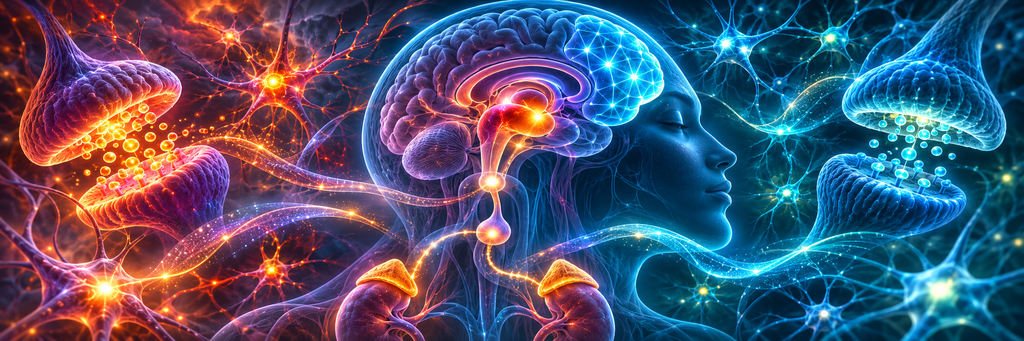
2. The Biological Pathways: How the Brain and Body Respond to Stress
The HPA axis and cortisol
When the brain perceives a challenge, hypothalamic signals activate the pituitary and adrenal glands. Cortisol helps mobilize fuel and regulate the response. Cortisol is necessary, not a toxin to suppress indiscriminately. Research must distinguish an appropriate temporary rise from persistently disrupted regulation.
Sympathetic arousal and recovery
The autonomic nervous system adjusts heart rate, breathing, circulation, and vigilance. Recovery depends partly on shifting out of sustained high-alert states. Heart-rate variability can provide useful physiological context in research, but a single consumer wearable reading does not diagnose stress resilience.
GABA, glutamate, and monoamines
GABA-mediated signaling contributes to inhibitory control, whereas glutamate participates in excitatory transmission and learning. Serotonin, dopamine, and norepinephrine also influence mood, vigilance, and attention. Altering one signal does not guarantee a favorable whole-brain outcome.
Neuroplasticity and threat learning
The prefrontal cortex, amygdala, hippocampus, and connected circuits influence emotion regulation, fear learning, memory, and cognitive flexibility. Neurotrophic signaling such as BDNF is of interest, but increasing a molecular marker is not the same as improving anxiety symptoms or functional resilience.
Sleep and social context
Insufficient sleep can heighten emotional reactivity and impair concentration. Social safety, perceived support, and prior experience shape threat responses. Oxytocin research illustrates why context matters: a peptide associated with social bonding does not simply produce calm or trust in every person and situation.
3. The Research Stacks: Four Combinations Under Investigation
Stack 1: Selank + Semax
Scientific rationale. Selank is a synthetic tuftsin-derived peptide investigated for anxiety-related and neuromodulatory effects. Preclinical studies describe changes in GABA-related and other signaling systems. Semax is an ACTH-fragment-derived peptide more often discussed in relation to cognition, neurotrophic signaling, and neurological injury research.
The theoretical appeal is a combination of calmer stress-related processing and maintained attention. This is often described online as “calm focus.”
Evidence and limits. Selank has a small, geographically concentrated clinical literature involving anxiety symptoms; some studies used active comparators rather than placebo and independent replication is limited. Semax has human research in selected neurological settings, but that does not establish benefits for everyday stress or healthy-adult cognition. There are no convincing controlled human combination trials showing that Selank plus Semax improves calm focus, resilience, or daily functioning.
Overlapping risks. Any psychological activation, fatigue, sleep changes, headache, or unexpected anxiety would be difficult to attribute when both are introduced together. Nasal preparation quality and unapproved-product safety remain important uncertainties.
Research verdict: A conceptually interesting pairing, not a validated stress-treatment stack.
Stack 2: Selank + Oxytocin
Scientific rationale. Selank-associated research emphasizes anxiety-related pathways, while oxytocin influences social salience, bonding, and responses to interpersonal context. A hypothesis is that the combination could influence both internal anxiety and social stress.
Evidence and limits. Oxytocin has considerably more human experimental research than most peptides in this article, particularly intranasal studies of social processing. However, results vary across participants, tasks, and contexts. A 2025 systematic review of 16 fMRI-focused randomized trials reported mixed clinical implications, and a 2026 meta-analysis of 42 double-blind trials found no significant overall symptom benefit across mental disorders. These findings do not validate pairing oxytocin with Selank.
Overlapping risks. Oxytocin can alter sensitivity to social cues rather than universally enhance social comfort. Pregnancy-related reproductive effects, cardiovascular considerations, and interactions with psychiatric or other medications require medical assessment. Self-directed use of research formulations is not equivalent to a studied clinical protocol.
Research verdict: Interesting for carefully designed social-stress experiments, with major context-dependent and safety questions.
Stack 3: Selank + DSIP
Scientific rationale. This pairing proposes two linked objectives: anxiety-related regulation during wakefulness and improved sleep or nighttime recovery. DSIP (delta sleep-inducing peptide) has a long history of exploratory sleep studies.
Evidence and limits. DSIP studies in small human samples date mainly to the 1980s and early 1990s. In a double-blind study of 16 people with chronic insomnia, some objective measures improved slightly, but investigators judged the effects weak and unlikely to offer major therapeutic benefit. There is no controlled evidence that combining DSIP with Selank enhances sleep, next-day function, or stress adaptation.
Overlapping risks. Multiple neuroactive substances may complicate assessment of drowsiness, cognition, sleep timing, next-day fatigue, and interactions with sedating medicines or alcohol. Feeling sleepier should not be mistaken for more restorative sleep.
Research verdict: A sleep-and-stress hypothesis without validated human combination outcomes.
Stack 4: Semax + DSIP
Scientific rationale. This proposed pairing attempts to connect daytime cognitive signaling with nighttime recovery. In principle, sleep and learning are interdependent, but the proposed peptides have not been shown to synchronize these systems in humans.
Evidence and limits. Separate mechanistic or early clinical findings cannot establish whether combining them improves attention, memory consolidation, sleep architecture, or resilience. Timing, duration, and potential opposing effects are unknown.
Overlapping risks. A cognitively activating effect, if present, might interfere with settling into sleep, while a sedating effect could undermine attention. Neither effect is predictable from community descriptions.
Research verdict: Highly theoretical; not a demonstrated cognitive-recovery stack.
Additional comparison: Selank + L-theanine
This is not a two-peptide stack, but it provides a useful research comparison. L-theanine has randomized human trials examining perceived stress and attention, unlike the absence of direct trials for most peptide pairs. There is no established additive benefit from combining L-theanine with Selank, and the better human evidence for one ingredient cannot be transferred to the combination.
4. Comparing the Proposed Combinations
| Proposed combination | Complementary hypothesis | Direct human combination evidence | Important uncertainty |
|---|---|---|---|
| Selank + Semax | Anxiety-related regulation plus cognition | None established | Activation versus calm; unapproved product quality |
| Selank + Oxytocin | Anxiety pathways plus social processing | None established | Context-dependent social effects and systemic safety |
| Selank + DSIP | Daytime emotional regulation plus sleep | None established | Sedation, timing, and uncertain sleep benefit |
| Semax + DSIP | Cognitive signaling plus nighttime recovery | None established | Potentially competing arousal effects |
| Selank + L-theanine | Experimental peptide plus studied relaxation-related supplement | No direct efficacy trial established | No demonstrated synergy; possible additive effects |
Evidence interpretation: “None established” refers to convincing controlled trials of the stated pairing, not to an absence of all research on the individual ingredients. No stack in this table should be presented as a proven treatment for anxiety, depression, insomnia, or chronic stress.
5. Complementary Supplements: Which Have Human Evidence?
Many supplements have been investigated directly in humans. They should still be evaluated by preparation, population, measured outcome, and safety rather than assumed to be interchangeable with peptides.
L-theanine
A 2026 meta-analysis of 31 randomized trials involving 1,168 participants found a relatively robust short-term attention signal but only a modest, bias-sensitive reduction in acute stress. Anxiety results were inconsistent. A small 2024 28-day randomized trial reported improvements in perceived stress, sleep quality, and attention, but its 30-person sample and commercial involvement limit confidence in generalization.
Practical research role: Short-term attention and perceived-stress outcomes, not established treatment of an anxiety disorder or proof of peptide synergy.
Magnesium glycinate
Magnesium is necessary for neuromuscular function and normal physiological signaling. Supplementation may be most relevant when dietary intake is inadequate. Human studies of mood and anxiety are mixed, with variation by magnesium status, formulation, and co-supplement use. There is not strong evidence that magnesium glycinate specifically produces superior anxiety relief compared with other well-tolerated magnesium forms.
Practical research role: Correcting low intake; possible adjunctive benefits in selected people. Excess supplemental magnesium can cause diarrhea and may accumulate in kidney impairment. It can also interfere with absorption of certain medications.
Glycine
Glycine is an amino acid involved in inhibitory and excitatory neurotransmission. Small human studies suggest possible benefits for subjective sleep quality and how alert people feel after waking. This does not demonstrate reductions in chronic anxiety or better long-term resilience.
Practical research role: Sleep-related investigation, especially where disturbed sleep contributes to next-day stress.
Ashwagandha
Small randomized trials of selected standardized extracts show potentially useful reductions in perceived stress and improvements in some sleep outcomes. However, extracts differ substantially and long-term safety remains uncertain. Rare liver injury and possible thyroid effects are meaningful concerns. The NIH cautions about use in pregnancy, certain thyroid or autoimmune conditions, and with some sedative, blood-pressure, diabetes, and other medications.
Practical research role: Better-studied than most experimental peptide stacks for short-term stress symptoms, but inappropriate to regard as universally low-risk.
Phosphatidylserine
Phosphatidylserine is a cell-membrane phospholipid studied for its potential effects on stress-related neuroendocrine responses. Some small exercise-stress studies observed lower cortisol responses, while others were negative. Lower cortisol during a laboratory challenge is not proof of improved emotional resilience or clinical anxiety outcomes.
Practical research role: Preliminary stress-biomarker research; limited consistent mental-health outcome evidence.
Other supportive options
An adequate diet, regular movement, appropriately timed caffeine, and adequate sleep often deserve more attention than additional capsules. Omega-3 fatty acids have condition-specific mental-health research, but should not be promoted as guaranteed stress-relief agents. Vitamin B12, iron, and vitamin D assessment may be relevant when deficiency or related symptoms are suspected. Adding a supplement without a plausible deficiency or target may contribute more complexity than benefit.
| Intervention | Relevant human evidence | Most realistic expectation | Key limitation |
|---|---|---|---|
| L-theanine | Randomized trials and meta-analysis | Modest attention and possible perceived-stress benefits | Stress effect uncertain; anxiety results inconsistent |
| Magnesium | Human trials, heterogeneous findings | Correct low intake; possible selective adjunct | No proven advantage for glycinate in anxiety |
| Glycine | Small sleep studies | Possible subjective sleep/recovery benefits | Not proven for chronic stress resilience |
| Ashwagandha | Small trials of specific extracts | Possible short-term perceived-stress reduction | Liver, thyroid, pregnancy and interaction concerns |
| Phosphatidylserine | Small mixed challenge studies | Possible stress-biomarker effects | Cortisol changes ≠ improved mental health |
| Exercise, sleep and psychotherapy | Broad clinical evidence | Better functioning and adaptive coping | Requires personalization and sustained practice |

6. Special Focus: Reducing Stress Signals Versus Building Resilience
A compound could lower a stress score during a controlled task while failing to improve sleep, work performance, relationships, or longer-term coping. A person may even feel less anxious because they are sedated, without becoming more capable of handling the underlying challenge.
To show genuine resilience, research must evaluate more than one biological marker. Meaningful outcomes could include symptom scales, recovery after standardized stressors, sleep quality, attention under pressure, daily functioning, adverse events, and durable effects after treatment stops.
The most informative trials of a calming-plus-stimulating stack would randomly assign participants to placebo, each agent separately, and the combination. This four-arm design would test whether the combination performs better than its components, whether benefits persist, and whether harms accumulate. Researchers would need careful product characterization and systematic monitoring of sleep, mood, blood pressure, cognition, and medication interactions.
A key challenge is that less arousal is not automatically better. Some alertness supports performance and learning. Improving flexibility, recovery, and agency may be more valuable than chronically suppressing normal stress responses.
7. Risks, Interactions, and Research Quality
Combining neuroactive peptides can introduce unforeseen interactions. Selank, Semax, and DSIP do not have established U.S. FDA-approved indications for stress or anxiety, and consumer research preparations may differ substantially in identity, purity, concentration, and delivery. Oxytocin has legitimate medical uses in particular clinical settings, but these do not establish safety for unsupervised intranasal use or pairing with another peptide.
Additional considerations include:
- Stacking sedating agents: DSIP, glycine, magnesium, ashwagandha, other sleep aids, alcohol, and prescription sedatives could create difficult-to-predict effects on alertness, balance, and next-day function.
- Mood and activation: People with anxiety, bipolar-spectrum symptoms, panic, or sleep disruption may respond unpredictably to experimental neuroactive substances.
- Social effects: Oxytocin is not a universal empathy or relaxation enhancer. Social context and individual circumstances can alter responses.
- Medication interactions: Psychiatric medicines, blood-pressure drugs, thyroid drugs, anticonvulsants, and immunomodulating medicines merit specific clinician/pharmacist review before adding supplements or experimental substances.
- Product and delivery risks: Unregulated nasal formulations and injectable preparations may introduce contamination, variable dosing, immunogenicity, or local irritation. Peptide mechanisms alone do not establish an appropriate dose or route.
- Avoiding misattribution: Starting several agents simultaneously makes it difficult to identify causes of insomnia, unusual dreams, irritability, dizziness, headache, or changes in mood.
For persistent anxiety, depression, trauma-related symptoms, or insomnia, evidence-based assessment and treatment should remain the foundation. Cognitive behavioral therapy and other established approaches should not be delayed or replaced by experimental stacks.
8. Where the Science Is Heading
The next wave of research can become more precise by asking which biological target fits which symptom. An intervention for immediate tension may differ from one designed to improve sleep, threat learning, attention under pressure, or long-term adaptation.
Promising research opportunities include validated stress-challenge tasks, objective sleep measures, longitudinal daily functioning, and more rigorous investigation of how social context changes oxytocin responses. Better trials of Selank and Semax as individual agents would also be necessary before drawing conclusions about their combinations.
Rather than assuming four complementary molecular theories produce four additive benefits, researchers can test whether a carefully chosen intervention achieves a meaningful result with the fewest adverse effects.
9. Explore the Compounds
- Selank: Anxiety-related and neuroregulatory research
- Semax: Cognitive and neurotrophic research
- Oxytocin: Social and neuroendocrine signaling
- DSIP: Sleep-related peptide research
Directory links use the site’s established peptide-page pattern; verify that each destination is published before posting.
Selected Research and Further Reading
- 2026 meta-analysis of 31 randomized L-theanine trials.
- 2024 randomized L-theanine stress trial.
- 2025 review of intranasal oxytocin, anxiety and neuroimaging.
- 2026 meta-analysis of intranasal oxytocin trials.
- DSIP placebo-controlled study in chronic insomnia.
- NIH Office of Dietary Supplements: Ashwagandha and stress.
- Phosphatidylserine and exercise-induced cortisol: a small controlled trial.
The Bigger Possibility
The future of stress research may involve interventions that support the right kind of response at the right time, rather than trying to eliminate stress altogether. Peptides remain intriguing research tools for probing that biology, while selected supplements and established behavioral approaches have more direct evidence for particular outcomes.
The goal is not to feel nothing when life becomes demanding. It is to remain engaged, respond effectively, and recover well. Until carefully controlled trials demonstrate otherwise, combining experimental neuropeptides should remain a research question, not a proven route to calm, focus, or emotional resilience.
Educational disclaimer: This article discusses scientific hypotheses and emerging evidence, not individualized medical treatment or an established peptide protocol. None of the proposed peptide combinations has demonstrated clinical efficacy for stress, anxiety, or emotional resilience. Consult qualified clinicians for mental-health symptoms, drug interactions, and supplement safety.