
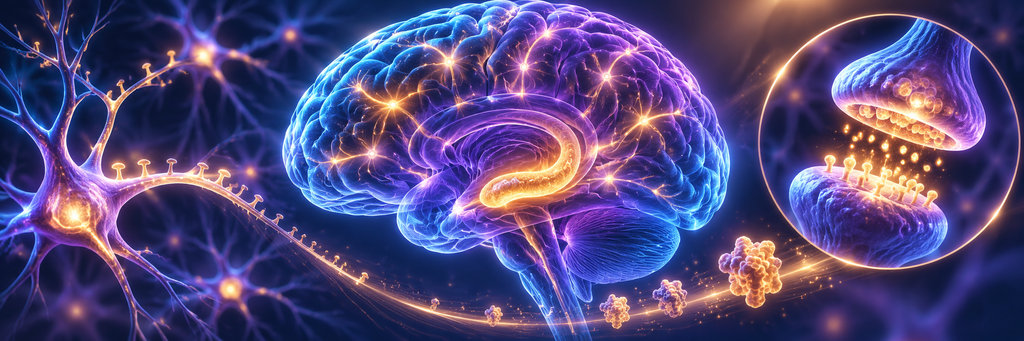
Our brains are constantly learning, adapting, and responding to stress. Emerging peptide research is asking whether we can better understand the signals that build connections, support neurons, and protect cognitive function over time.
1. The Big Picture: What Does a Healthier Brain Really Mean?
Memory and focus are not controlled by a single chemical or one isolated brain region. Remembering a conversation, concentrating on a difficult problem, or recovering after a neurological injury requires networks of neurons to communicate, adjust their connections, and maintain the energy and cellular health that keep those networks functioning.
These abilities matter across a lifetime. Some people want to understand ordinary age-related changes in attention or recall. Others face much more serious challenges, including stroke, traumatic brain injury, or neurodegenerative diseases. In either setting, researchers are looking beyond temporarily increasing alertness and asking a deeper question: Can brain cells become more adaptable and resilient?
Peptides are attracting interest because many naturally occurring peptides help cells communicate. Synthetic peptides and peptide-inspired molecules may provide tools for studying growth factors, cellular stress responses, neurotransmitter regulation, and the ability of neural circuits to adapt. The possibilities are exciting, but this field also demands careful distinctions. Changes in a rat’s memory test, a brain scan, or a laboratory growth-factor measurement do not automatically prove better memory in people.
Among the most discussed research subjects are Semax, Selank, Dihexa, Cerebrolysin, P21, and Noopept. Each approaches cognition differently. Two additional candidates, Humanin and Pinealon, broaden the picture toward mitochondrial stress responses and experimental cellular protection.
The goal is not to choose a “brain peptide stack.” It is to understand the biological mechanisms being investigated and where the clinical evidence stands.
2. The Biological Pathways: How the Brain Learns, Adapts, and Protects Itself
Neuroplasticity: Strengthening Connections
Neuroplasticity is the brain’s ability to change the effectiveness and organization of its connections. Some changes happen rapidly as synapses become stronger or weaker. Others involve slower structural changes in dendrites and neural circuits. This is the biology behind learning, rehabilitation, and adaptation.
Researchers measure aspects of plasticity with synaptic proteins, dendritic spines, electrophysiology, brain imaging, and behavioral tests. These measurements are useful, but more synapses or more activity is not automatically better. Healthy networks also need precise timing, selective pruning, and stable signaling.
Semax, Noopept, P21, and Dihexa have all been examined through different plasticity-related hypotheses, with very different levels of evidence.
Neurotrophic Signaling: Supporting Neurons
Neurotrophic factors are proteins that help neurons survive, differentiate, and adapt. Two often discussed examples are brain-derived neurotrophic factor (BDNF) and nerve growth factor (NGF). BDNF binds the TrkB receptor and participates in activity-dependent synaptic plasticity. Another research pathway involves ciliary neurotrophic factor (CNTF), which has inspired experimental peptide mimetics such as P021.
A change in BDNF measured in an animal’s hippocampus is a meaningful mechanistic clue. But BDNF is not a universal “memory score,” and circulating BDNF in blood has not been validated as a substitute for clinical cognitive testing.
Neurotransmitter and Stress Regulation: The Conditions for Focus
Attention and memory depend on the interplay of glutamate, GABA, dopamine, acetylcholine, and other signaling systems. Stress and anxiety can also interfere with concentration, working memory, and sleep.
Selank is particularly relevant here because its clinical literature focuses more on anxiety-related outcomes than on objectively measured memory improvement. Understanding emotional regulation may ultimately improve cognitive care, but feeling calmer is not the same scientific outcome as reversing neurodegeneration.
Neuroprotection: Helping Cells Survive Injury
Neurons are unusually sensitive to interrupted blood flow, excessive excitatory signaling, mitochondrial dysfunction, and inflammatory injury. Neuroprotection research examines ways of reducing damage while preserving normal cellular housekeeping, including appropriate programmed cell death.
Cerebrolysin, Semax, Humanin, and Pinealon have been studied in neuroprotection-related contexts. The challenge is determining which cellular effects translate into preserved function after real-world neurological disease.
Neurogenesis and Repair: An Important but Separate Goal
Neurogenesis means creating new neurons. It is distinct from making existing synapses more effective. Laboratory models can examine both, particularly in the hippocampus. How much new-neuron formation occurs in the adult human brain, and how it contributes to cognitive recovery, remains an active field of research.
P021 is especially interesting as an experimental neurotrophic mimetic, but mouse neurogenesis findings do not establish that the same intervention restores memory in people.
3. Compounds Researchers Are Exploring
Semax: Neurotrophic Signals and Brain Adaptation
Semax is a synthetic heptapeptide derived from a fragment of adrenocorticotropic hormone (ACTH). It was developed in Russia and has been investigated in relation to neurological recovery and cognition.
An especially interesting result comes from a 2006 rat hippocampus study reporting changes in BDNF protein, TrkB activation, and related gene expression after Semax exposure. Additional rat stroke-model research has examined inflammatory and recovery-related proteins. In humans, a small functional MRI study involving Semax and Selank found short-term changes in resting-state brain connectivity; it did not establish better memory or sustained focus.
Why it matters: Semax provides a way to study links among neurotrophic signaling, brain network adaptation, and injury responses. Reports of clinical use in Russia do not substitute for large, independently replicated trials meeting modern international standards. It is not FDA-approved in the United States.
Selank: Stress Regulation and Cognitive Resilience
Selank is a synthetic tuftsin-derived heptapeptide. Its most developed research theme is anxiety-related signaling, with additional experimental interest in GABA-associated pathways, other neurotransmitter systems, immune signaling, and neuroplasticity.
A 2008 study of 62 patients with generalized anxiety or neurasthenia compared Selank with medazepam and reported encouraging anxiety-related effects. But the trial was small and does not establish that Selank matches an approved medication, avoids dependence, or improves memory in healthy adults.
Why it matters: Focus is not independent of emotional state. Selank raises a useful research question: could carefully targeting stress-related signaling help preserve attention without major sedation? Its human cognition evidence remains thin, long-term safety is uncertain, and it is not FDA-approved.
Dihexa: A Synapse-Formation Hypothesis with Major Uncertainties
Dihexa is a synthetic peptidomimetic derived from angiotensin IV research, rather than a conventional naturally occurring peptide. Researchers initially proposed that it could influence synapse formation through the hepatocyte growth factor (HGF) and c-Met signaling system.
That hypothesis is fascinating because synaptic connectivity underlies learning and recovery. However, it requires an essential update: three foundational papers in the Dihexa-related research series were retracted in April 2025, including the report used to support the HGF/c-Met mechanism. Another influential paper remains under a published notice of concern. Read the retraction record.
There are no established human clinical trials of Dihexa. The HGF/c-Met pathway also participates in growth processes relevant to cancer biology, creating a theoretical safety concern that has not been resolved by long-term studies.
Why it matters: Synapse-targeted therapies remain an important frontier, but Dihexa itself should currently be treated as a particularly uncertain research lead, not a demonstrated cognitive enhancer.
Cerebrolysin: The Most Extensive Human Clinical Literature in This Group
Cerebrolysin is a porcine brain-derived mixture of small peptides and amino acids, not one precisely defined peptide sequence. It has been studied clinically in stroke, brain injury, and cognitive disorders, and is used medically in some countries outside the United States.
Researchers have proposed neurotrophic and neuroprotective effects, but the clinical story is mixed. A 2025 meta-analysis of 14 randomized trials reported an improvement in one early neurological severity score after ischemic stroke, without a clear statistically significant improvement in functional independence. A Cochrane review found no convincing reduction in mortality and reported an increase in nonfatal serious adverse events in some Cerebrolysin trials.
Why it matters: Cerebrolysin shows what happens when a neurotrophic concept enters large human studies. It deserves serious attention, but outcomes vary by study design and endpoint. It is not FDA-approved in the United States, and current data do not justify calling it an established memory-restoration treatment.
P21 (P021): A Neurotrophic Mimetics Approach
P21, also described in published research as P021, is a synthetic peptidergic compound derived from the CNTF research program. Scientists study it in models involving hippocampal neurogenesis, BDNF-related signaling, synaptic proteins, and Alzheimer’s-like pathology.
In one long-term transgenic mouse study, P021 treatment was associated with changes in tau-related pathology and improvements in selected learning and synaptic measures. Another mouse study examined early-life treatment and later Alzheimer’s-related outcomes.
Why it matters: P021 illustrates the potential of designing small molecules around larger neurotrophic proteins. But these are animal experiments, not evidence of prevention or treatment of Alzheimer’s disease in humans. Human exposure, effective dosing, and long-term safety remain unestablished.
Noopept: A Dipeptide-Derived Nootropic Under Investigation
Noopept, also called omberacetam, is a dipeptide-derived synthetic compound studied for memory, learning, and neuronal protection. It should not be grouped uncritically with endogenous neuropeptides.
A 2008 rat study reported increased hippocampal expression of BDNF and NGF-related messenger RNA. A 2011 open prospective study involving 60 stroke patients reported cognitive-test improvements, but its design does not provide the certainty of a rigorous blinded placebo-controlled trial.
Why it matters: Noopept connects cognitive testing with a plausible neurotrophic mechanism. The clinical evidence is nevertheless limited and does not establish general-purpose memory enhancement or dementia prevention. It is not FDA-approved in the United States.
Humanin: Mitochondrial Stress Signaling and Neuronal Survival
Humanin is a mitochondria-derived peptide investigated for cellular stress responses, apoptosis-related signaling, and survival of vulnerable cells. Its neurological interest lies particularly in experimental models of neuronal injury and Alzheimer’s-associated biology.
A 2025 research review examined proposed molecular links between Humanin and Alzheimer’s-related processes. Such mechanistic findings suggest directions for developing tissue-targeted therapies, but Humanin has not been shown in clinical trials to prevent dementia or improve cognition in humans.
Why it matters: Brain protection may depend as much on healthy mitochondrial signaling as on synapse formation. Humanin adds that cellular-resilience perspective, with questions about unwanted cell-survival effects and long-term safety still open.
Pinealon: A Small Peptide Studied for Cellular Protection
Pinealon, or EDR (Glu-Asp-Arg), is a three-amino-acid peptide associated with Khavinson bioregulator research. It has been investigated in cell and animal models of oxidative stress, neuronal injury, altered signaling, and learning.
Experimental results have included changes in reactive-oxygen-species measures, ERK1/2 signaling, and certain memory-related outcomes in rodents. Its small size and proposed effects on cell signaling make it interesting as a mechanistic research tool.
Why it matters: Pinealon illustrates how short peptides might influence several pathways simultaneously. However, claims of clinically meaningful gene reprogramming, brain rejuvenation, or restored memory are not demonstrated by high-quality human trials. It remains an investigational compound, not an FDA-approved treatment.
4. Comparing the Compounds
| Compound | Main pathway / mechanism | Primary research interest | Evidence level | Important limitations |
|---|---|---|---|---|
| Semax | BDNF/TrkB-associated signaling; neural stress responses | Plasticity, stroke-model biology, cognition | Animal studies; limited human studies and brain imaging | No well-established benefit for healthy-person memory; incomplete long-term safety |
| Selank | Stress-related, GABA-associated and immune-neural signaling | Anxiety, attention under stress | Small human anxiety comparisons; preclinical cognitive research | Human memory improvements unproven; no FDA approval |
| Dihexa | Proposed HGF/c-Met synaptogenesis pathway, now disputed | Synapse formation, experimental memory | Preclinical claims with key retractions | No human trials; uncertain mechanism; unresolved growth-pathway safety questions |
| Cerebrolysin | Complex peptide mixture; proposed neurotrophic effects | Stroke recovery and cognitive disorders | Multiple human randomized trials and meta-analyses | Mixed functional outcomes; some nonfatal serious adverse-event signals; not FDA-approved |
| P21 / P021 | CNTF-derived neurotrophic mimic; BDNF-related effects | Neurogenesis, synaptic function, Alzheimer’s-like models | Preclinical animal research | No demonstrated human cognitive benefit or safety profile |
| Noopept | Dipeptide-derived compound; BDNF/NGF-related hypotheses | Learning, memory, neuronal protection | Animal work; small/open human studies | Limited trial quality; no reliable healthy-person efficacy evidence |
| Humanin | Mitochondrial cell-survival and stress-response signaling | Neuronal protection and aging biology | Mainly cell/animal and mechanistic research | No validated human dementia or cognition benefit |
| Pinealon | Experimental redox and intracellular signaling | Neuroprotection, oxidative stress, learning models | Cell/animal; limited preliminary human reports | No robust controlled human cognitive outcome evidence |
How to interpret the table: Preclinical means real experimental evidence in cells or animals, not “no evidence.” It also does not mean clinical benefit has been demonstrated. Human observational data, brain imaging changes, symptom scales, and randomized trials answer different questions. These compounds are not FDA-approved for general memory enhancement, focus, or prevention of neurodegeneration.
5. Where the Science Is Heading
The next era of brain-health research may be less about a single compound that “boosts cognition” and more about matching specific biology to a clearly defined problem.
Precision Neuroplasticity
Scientists are learning how to measure synaptic health more reliably. Future trials may combine imaging, standardized cognitive assessments, and markers of neural injury to determine whether an intervention produces meaningful, durable improvement rather than a fleeting laboratory signal.
Neurotrophic Pathways with Better Safety Controls
BDNF, CNTF, HGF, and related growth-factor systems are compelling precisely because they can influence neuronal adaptation. Yet growth signaling must be well regulated. More is not always better, and researchers must distinguish healthy repair from unwanted proliferation or abnormal connectivity.
Neuroprotection After Specific Injuries
Stroke and traumatic brain injury are distinct from ordinary concentration problems. Cerebrolysin’s mixed trial results demonstrate why functional recovery, adverse events, and follow-up duration matter more than improvements in only one neurological score. The field needs larger, independent trials that measure outcomes meaningful to patients.
Brain–Body Connections
Sleep, physical activity, cardiovascular health, mood, and metabolic status all affect brain function. Humanin and other mitochondrial-derived peptides bring cellular energy and resilience into this conversation. Meanwhile, Selank reminds researchers that reducing distress may improve day-to-day cognitive functioning without necessarily changing the underlying rate of neurodegeneration.
Better Human Evidence and Trustworthy Molecules
For some compounds, the most important next experiment is not another animal study. It is high-quality identity, purity, pharmacokinetics, dose-finding, and safety research in humans. Dihexa’s retractions underscore why scientific corrections must be incorporated into public information rather than ignored.
The most promising future would distinguish three outcomes clearly: helping healthy people perform better, helping patients recover from brain injury, and slowing a specific neurodegenerative disease. A therapy may succeed in one of those areas and not the others.

6. Explore the Compounds
Go deeper with the individual Peptide Perspectives research profiles:
- Semax — BDNF/TrkB signaling and experimental neuroprotection.
- Selank — Stress regulation, anxiety research, and cognitive resilience.
- Dihexa — Synapse-formation hypotheses and the current evidence limitations.
- Cerebrolysin — Human trials in stroke and neurological recovery.
- P21 (P021) — CNTF-inspired neurotrophic and neurogenesis research.
- Noopept — Dipeptide-derived learning and memory research.
- Humanin — Mitochondrial signaling and neuronal survival.
- Pinealon — Short-peptide cellular stress and neuroprotection studies.
The Bigger Possibility
The human brain does more than store memories. It continuously changes its connections, manages stress, and protects an intricate network of living cells. Peptide science is helping researchers examine those processes with increasing precision.
The future may bring more targeted ways to support rehabilitation, identify vulnerability earlier, and protect neurological function. Getting there will require independent studies, careful safety evaluation, and clinical outcomes that matter to real people. That is the scientific opportunity worth following.
Peptide Perspectives publishes educational research information, not individualized treatment advice. Unapproved research compounds are not substitutes for evaluation of persistent memory changes, suspected stroke, brain injury, or other neurological symptoms. Some products sold as research peptides may lack verified identity, purity, or appropriate human safety testing.