
Peptide Perspectives | Stacking & Synergy Series | Research goal: Men’s Health & Testosterone
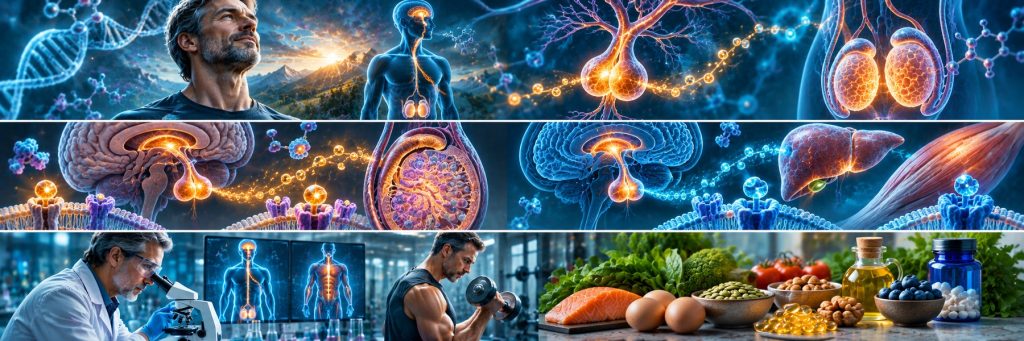
1. The Big Picture: Vitality Is Not One Hormone
Testosterone helps maintain sexual function, muscle and bone health, red blood cell production, and many aspects of male reproductive physiology. Yet symptoms commonly blamed on low testosterone, including fatigue, declining motivation, poor sleep, and reduced exercise performance, can also reflect insufficient sleep, medications, obesity, chronic illness, depression, or inadequate nutrition.
That is why the most useful question is not simply Which peptide raises testosterone? It is Where in the hormonal system is a problem occurring, and what outcome matters: testosterone, fertility, sexual function, strength, or well-being?
Peptides and peptide-like hormones act at different levels of the endocrine network. Kisspeptin can stimulate reproductive signaling upstream in the hypothalamus; hCG can act directly at LH receptors in the testes; and CJC-1295 and ipamorelin primarily affect the growth hormone (GH) axis rather than the reproductive axis. Because these pathways differ, putting them into one “stack” does not automatically create synergy.
The Endocrine Society recommends diagnosing hypogonadism only when characteristic signs or symptoms accompany consistently low testosterone, confirmed by two separate early-morning measurements, followed by evaluation of its cause. Endocrine Society testosterone guideline.
Research perspective: The most promising combination is the one chosen for a diagnosed physiological problem, especially when fertility is a goal. None of the community peptide combinations below is validated as a general anti-aging or testosterone-enhancement program.
2. The Biology: Two Hormone Axes With Different Jobs
The hypothalamic–pituitary–gonadal (HPG) axis
The hypothalamus releases pulsatile gonadotropin-releasing hormone (GnRH). The pituitary responds by releasing luteinizing hormone (LH) and follicle-stimulating hormone (FSH). LH stimulates Leydig cells in the testes to make testosterone; FSH, together with high intratesticular testosterone, supports Sertoli-cell function and sperm development.
Kisspeptin regulates the neurons that initiate GnRH signaling. hCG, a hormone with LH-like activity, bypasses the hypothalamus and pituitary to stimulate the testicular LH receptor. These actions are related but not identical.
Feedback matters. Testosterone and estradiol can suppress hypothalamic and pituitary signaling. Consequently, taking external testosterone may normalize blood testosterone yet reduce LH, FSH, intratesticular testosterone, and sperm production. Raising serum testosterone is not the same as preserving fertility.
The hypothalamic–pituitary–growth hormone axis
A separate network regulates GH. Growth hormone-releasing hormone (GHRH) promotes GH release, whereas somatostatin inhibits it. Ghrelin-receptor agonists can also stimulate GH. GH acts on tissues directly and stimulates IGF-1 production, especially in the liver.
CJC-1295 is a GHRH analogue, and ipamorelin is a ghrelin-receptor agonist. Their main proposed overlap is in GH secretion. Increased GH or IGF-1 should not be interpreted as increased LH, FSH, or testosterone. Testosterone and GH influence body composition through distinct systems, and one cannot substitute for the other.

Why age matters, but does not dictate treatment
With aging, body composition, medications, sleep, chronic disease, and sex hormone-binding globulin (SHBG) may change. Testosterone measurements can vary between mornings and during acute illness. The correct evaluation distinguishes primary hypogonadism (testicular impairment, often elevated LH/FSH) from secondary hypogonadism (hypothalamic or pituitary dysfunction, often low or inappropriately normal LH/FSH). These categories lead to different treatment possibilities.
3. Peptide and Hormonal Stacks Under Investigation
Stack 1: hCG + Kisspeptin
Proposed logic: Stimulate upstream GnRH/LH/FSH signaling with kisspeptin while using hCG to activate testicular LH receptors directly.
Evidence: hCG has a recognized clinical role in selected forms of male hypogonadotropic hypogonadism and fertility treatment. A small randomized 2026 study of kisspeptin-10 reported increases in LH, FSH and testosterone in healthy men under specific research protocols, supporting biological activity rather than establishing long-term therapy. Kisspeptin human study.
Limitations: No well-established randomized trial demonstrates that combining kisspeptin with hCG improves fertility, symptoms, or long-term testosterone outcomes beyond appropriately selected standard treatment. hCG may increase estradiol, fluid retention, and breast tenderness; repeated reproductive-axis stimulation can alter hormonal feedback. Because it is possible to raise testosterone without improving sperm count, semen analysis and fertility goals matter.
Verdict: Interesting upstream/downstream hypothesis, but not a validated general-purpose stack.
Stack 2: hCG + GnRH-related therapy
Proposed logic: Restore missing pituitary signals in men with a defined hypothalamic/pituitary disorder while directly stimulating testicular function.
Evidence: Specialist treatment for hypogonadotropic hypogonadism may involve gonadotropins, usually hCG with FSH when needed, or pulsatile GnRH in selected cases where the pituitary can respond. These are established categories of medical care, not a routine recommendation to give hCG and GnRH simultaneously. The AUA/ASRM male infertility guideline highlights gonadotropins or pulsatile GnRH for appropriate patients.
Limitations: Pulsatile GnRH requires particular delivery and an intact responsive pituitary; continuous exposure or GnRH agonists used in other regimens can suppress gonadotropin release after initial stimulation. A man with primary testicular failure may not respond the same way as one with hypothalamic deficiency. Treatment selection is a diagnosis-dependent endocrinology decision, not a stack for healthy aging.
Verdict: Medically meaningful only for specific diagnoses, with hormone and fertility monitoring.
Stack 3: CJC-1295 + Ipamorelin
Proposed logic: Combine GHRH-receptor and ghrelin-receptor signaling to promote GH pulses.
Evidence: Small human studies of CJC-1295 alone observed elevations in GH and IGF-1. That is a hormone biomarker finding, not a demonstration of increased testosterone, muscle strength, vitality, or healthspan. CJC-1295 trial. No robust controlled trial establishes the efficacy or safety of this exact combination for male hormonal health.
Limitations: The combination may increase GH-related adverse effects, including fluid retention, edema, joint symptoms, and altered glucose handling. The FDA has identified safety-information gaps for compounded CJC-1295 and ipamorelin, including immunogenicity and peptide impurities, and has reported serious adverse-event concerns in certain contexts. FDA safety information.
Verdict: A GH-axis research concept, not a testosterone-raising stack.
Stack 4: Kisspeptin + CJC-1295
Proposed logic: Target reproductive hormone signaling and GH signaling in parallel.
Evidence: Both axes are biologically real, and each has research tools that modify its hormone measurements. But no controlled human studies establish that this pairing raises testosterone more effectively, improves fertility, or produces better body composition than condition-specific treatment.
Limitations: Hormonally active compounds are not independently additive simply because they affect separate receptors. The metabolic consequences of elevated IGF-1, reproductive feedback effects, unknown long-term exposure, and potentially misleading changes in hormone laboratory tests are substantial uncertainties.
Verdict: Highly speculative, with no demonstrated clinical advantage.
Stack 5: hCG + FSH (Clinical Fertility Comparator)
Why it matters: This is an evidence-based clinical comparator, rather than a popular research-peptide stack. hCG stimulates testicular testosterone production; FSH provides a distinct signal needed for Sertoli-cell support and spermatogenesis.
Evidence: In men with hypogonadotropic hypogonadism, gonadotropin therapy can initiate sperm production and enable pregnancy in some cases. The clinical results depend on the underlying disorder, baseline testicular development, and treatment response. AUA/ASRM guideline.
Verdict: One of the most useful examples of genuinely complementary hormone signaling, but a specialist-managed fertility intervention, not a vitality supplement.
Stack 6: Selective estrogen receptor modulators (SERMs) or aromatase inhibitors alongside hCG
In selected infertile men with low testosterone, clinicians may consider hCG, SERMs, aromatase inhibitors, or specific combinations. These are prescription endocrine treatment options, not peptides or evidence of a universal stacking advantage. Their benefits depend on estradiol, LH/FSH, fertility plans, and the underlying diagnosis; possible risks include visual symptoms, thrombotic events with some agents, and excessive estrogen suppression affecting bone health. The AUA/ASRM guideline grades the evidence for this strategy as conditional and recognizes limited data in many infertility scenarios.
4. Comparing the Pathways and Evidence
| Compound or combination | Main biological target | Does it directly influence testosterone? | Evidence level | Main limitation |
|---|---|---|---|---|
| hCG | Testicular LH receptor | Yes, in responsive testes | Established in selected fertility/hypogonadism care | Not appropriate for all causes; estradiol and fluid-related effects |
| Kisspeptin | Hypothalamic GnRH network | Indirectly, in small human physiology studies | Early human research | No established long-term clinical regimen |
| Pulsatile GnRH | Pituitary LH/FSH release | Indirectly in selected diagnoses | Established specialist approach | Requires responsive pituitary and appropriate delivery |
| hCG + FSH | Testicular testosterone + spermatogenesis | Yes, in selected hypogonadotropic cases | Clinical fertility evidence | Requires individualized specialist monitoring |
| CJC-1295 | GHRH/GH/IGF-1 | Not established | Small human endocrine studies | GH changes do not prove testosterone or vitality benefit |
| Ipamorelin | Ghrelin/GH pathway | Not established | Limited human research | Safety and formulation uncertainties |
| CJC-1295 + ipamorelin | Overlapping GH secretagogue activity | No demonstrated effect | Unvalidated stack | More GH exposure may mean more adverse effects |
| Kisspeptin + CJC-1295 | HPG plus GH axes | Unproven as a stack | Speculative | No controlled combination outcome data |
| hCG + kisspeptin | Testes and upstream HPG signaling | Possible mechanistic overlap | Unvalidated stack | No established added fertility or symptom benefit |
5. Supplements: Supporting Health Versus Boosting Testosterone
The most credible role of supplements is often correcting a deficiency or improving general physiological function, not artificially driving testosterone above a healthy baseline.
Zinc. Essential to reproductive and immune biology. Significant deficiency can impair gonadal function, and restoring adequate zinc intake is appropriate. High-dose zinc in someone already sufficient has not been reliably shown to improve testosterone, and excess can cause nausea and copper deficiency.
Vitamin D. Important for bone, muscle, and general health. A 2026 systematic review of randomized trials found no reproducible improvement in total testosterone or androgen bioavailability markers from supplementation across studied adult populations. Correct deficiency, but avoid presenting vitamin D as proven testosterone therapy. 2026 meta-analysis.
Magnesium. Needed for normal muscular and metabolic function. Deficiency may undermine health, but trials do not establish reliable testosterone enhancement in magnesium-replete men. Excess supplemental magnesium can cause diarrhea and requires caution with kidney impairment.
Creatine monohydrate. Has a strong evidence base for strength-training performance and lean-mass outcomes in appropriate populations. It is not a consistently demonstrated testosterone booster. This distinction makes creatine more compelling for functional goals than many hormonal “boosters.”
Ashwagandha. Small trials suggest some benefits for stress or sleep and sometimes testosterone-related endpoints, but results are heterogeneous and cannot establish treatment for hypogonadism. NIH notes potential liver injury, thyroid effects, and interactions with blood-pressure, diabetes, sedative, or immune-modifying medications. NIH fact sheet.
Boron. Appears in short exploratory hormone studies, but high-quality replication showing meaningful testosterone or fertility benefits is lacking. It is not an established hormonal treatment, and high intakes may be harmful.
Protein and sufficient dietary energy. Adequate energy and protein support recovery, muscle, and reproductive physiology. Severe energy restriction and overtraining can impair hormone signaling even when a person is otherwise active.
Omega-3 fats. Useful as part of a cardiometabolic and nutrient-dense diet, but not a reliable direct testosterone-raising supplement. Fish intake and appropriate clinical indications should guide use.
Sleep, resistance training, and management of excess visceral fat. These are not supplements but are more defensible foundations for vitality than experimental endocrine stacks. Sleep apnea assessment, medication review, and addressing metabolic health may matter as much as any isolated laboratory value.

6. Special Focus: Why More Growth Hormone Does Not Mean More Testosterone
It is tempting to group GH, IGF-1, LH, FSH, and testosterone as interchangeable “anabolic hormones.” They are not.
The reproductive axis governs testicular hormone production and sperm development. The growth hormone axis influences growth, tissue metabolism, and IGF-1 signaling. Both can affect body composition, but increasing GH is not equivalent to correcting reproductive hypogonadism. GH-raising agents may change laboratory biomarkers without improving libido, erectile function, sperm count, testosterone deficiency symptoms, or long-term health.
Some interventions can even pull reproductive function in the wrong direction. External testosterone suppresses LH/FSH through feedback and may dramatically impair sperm production. GnRH agonists can initially stimulate and subsequently suppress gonadotropins when delivered continuously. Combining multiple hormonal agents can obscure these mechanisms, complicate interpretation of tests, and increase adverse effects.
This is why treatment aimed at fertility must be distinguished from treatment aimed at symptomatic testosterone deficiency in men who are not seeking fertility.
7. Safety, Monitoring, and Realistic Expectations
Before attributing fatigue, low motivation, or reduced libido to testosterone, clinicians typically review symptoms, medications, weight changes, alcohol and substance use, sleep quality, and comorbidities. Confirmed low morning testosterone should prompt assessment of LH and FSH; prolactin, SHBG/free testosterone, estradiol or other tests may be appropriate according to the presentation. A semen analysis is essential when fertility is the outcome.
Risks to examine when layering hormonal compounds:
- Fertility suppression: Exogenous testosterone or inappropriate hormonal feedback manipulation may reduce sperm production.
- Estradiol imbalance: hCG and other interventions can change testosterone aromatization, potentially contributing to breast tenderness or other effects.
- GH/IGF-1 exposure: Fluid retention, joint symptoms and changes in glucose metabolism may accompany GH-directed interventions without proven testosterone benefit.
- Peptide formulation risks: Identity, impurities, sterility, immunogenicity, and uncertain exposure are important issues for nonapproved peptide products.
- Clinical context: Untreated severe obstructive sleep apnea, elevated hematocrit, prostate or breast cancer concerns, recent cardiovascular events, and fertility plans can materially change the suitability of testosterone therapy.
The U.S. FDA specifically identifies significant safety-information gaps for compounded CJC-1295, ipamorelin, and kisspeptin-10, including peptide impurities or potential immunogenicity, with certain reported adverse-event concerns. FDA compounding safety table.
No proposed combination in this article should be treated as a validated home-use dosing protocol.
8. Where the Science Is Heading
Future trials could explore whether upstream kisspeptin signaling can help selected men with specific reproductive-axis dysfunctions, whether endocrine interventions preserve fertility while improving symptoms, and which biologically meaningful outcomes matter most beyond transient testosterone changes.
The most useful research would compare single agents and combinations in randomized trials, using repeated hormone measurements, semen parameters, reproductive outcomes, symptom scales, metabolic markers, and sustained safety follow-up. A temporary rise in LH, testosterone, GH, or IGF-1 is only one part of the evidence.
The larger opportunity is precision endocrine care, matching a proven mechanism to the actual cause of a patient’s hormonal problem instead of assuming that stimulating more pathways will produce a better result.
9. Explore the Compound Profiles
- hCG and reproductive hormone research (search the Peptide Directory for hCG)
- Kisspeptin
- CJC-1295
- Ipamorelin
- GnRH-related compounds and Triptorelin
- Sermorelin
- Tesamorelin
Individual compound URLs should be checked on the live website before publishing; a profile link does not establish the compound’s clinical effectiveness.
Selected References
- Endocrine Society: Testosterone Therapy in Men With Hypogonadism.
- AUA/ASRM: Diagnosis and Treatment of Infertility in Men, Part II.
- Kisspeptin-10 human physiology trial, 2026.
- CJC-1295 and GH/IGF-1 secretion in healthy adults.
- FDA: Safety risks of certain compounded peptides.
- Vitamin D and testosterone meta-analysis, 2026.
- NIH Office of Dietary Supplements: Ashwagandha.
Medical disclaimer: Peptide Perspectives is an educational research resource. It does not provide individualized medical advice, prescribe hormone therapy, or endorse self-administration of investigational peptides. Diagnosing or treating low testosterone and male infertility requires medical evaluation, and preserving fertility may require a very different approach from testosterone replacement.