
Research goal: Kidney & Urinary Health | Peptide Perspectives Stacking & Synergy Series
Kidney protection is more complex than improving one laboratory number. The kidneys filter blood, reclaim water and nutrients, regulate electrolytes and blood pressure, participate in red-blood-cell production, and respond continuously to changes in glucose, circulation, and inflammation. Their tiny filtering units and energy-hungry tubular cells are especially vulnerable when several stressors converge.
That complexity creates an intriguing scientific question: Could protecting mitochondria while influencing inflammatory and metabolic signals eventually reduce kidney injury? Investigational compounds such as ARA-290, SS-31, MOTS-C, and Humanin address different pieces of that question. Researchers are beginning to understand their biology, but the popular pairings discussed below have not been validated as treatments for chronic kidney disease (CKD), acute kidney injury, or urinary disorders.
The practical comparison is important. There are already treatments with large human trials showing that they slow kidney disease progression. The strongest contemporary evidence involves appropriately selected SGLT2 inhibitors, renin–angiotensin system medications, and, in certain people with type 2 diabetes and CKD, semaglutide. Any experimental “kidney stack” must ultimately demonstrate outcomes at least as meaningful as these established approaches.
1. The Big Picture: Why Kidneys Need More Than Antioxidants
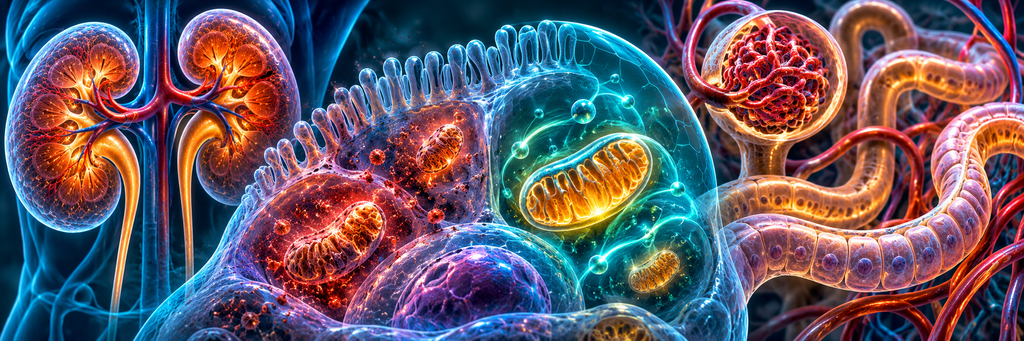
A kidney contains roughly a million filtering units, or nephrons. The glomerulus filters plasma; the tubules reabsorb much of the filtered fluid and carefully regulate salts, acids, and nutrients. Tubular reabsorption demands enormous cellular energy, which makes mitochondrial health central to renal function.
Injury can develop from diabetes, high blood pressure, reduced blood flow, autoimmune disease, infection, obstruction, medication toxicity, or genetic disorders. Diabetes and hypertension are major causes of CKD, but an abnormal kidney test is not a diagnosis by itself.
Five interconnected research targets are especially relevant:
- Glomerular pressure and vascular health: chronic pressure can damage filtration structures and increase urinary albumin.
- Mitochondrial energy: inadequate ATP and mitochondrial injury can harm tubular cells.
- Oxidative stress: reactive oxygen species contribute to damage when cellular defenses are overwhelmed.
- Inflammatory and fibrotic signaling: persistent injury can encourage scarring, making recovery harder.
- Metabolic regulation: glucose control, weight, insulin resistance, and blood pressure all influence renal risk.
These pathways overlap. That means a combination might theoretically cover different forms of stress, but it also means mechanisms cannot simply be added together like independent benefits. A compound that changes oxidative-stress markers may have no meaningful effect on long-term kidney function.
2. Understanding the Biology: Kidney Filtration, Energy, and Inflammation
Mitochondria and tubular energy
Kidney tubules use mitochondria to generate ATP for active transport. Ischemia, high glucose exposure, toxins, and inflammation can disrupt mitochondrial membranes, energy production, and cellular signaling. SS-31 (elamipretide) is studied for interactions with cardiolipin and the inner mitochondrial membrane, while MOTS-C is researched as a mitochondrial-derived signaling peptide connected with metabolic adaptation. Their proposed roles are different, but successful co-treatment has not been demonstrated in human renal trials.
Tissue-protection signaling
ARA-290, also called cibinetide, was developed from a tissue-protective region of erythropoietin. Animal renal ischemia/reperfusion studies have reported less injury and inflammation after ARA-290 exposure. Importantly, this does not establish that the peptide improves chronic diabetic or hypertensive kidney disease in people, nor does it define a safe clinical regimen.
Humanin and cellular stress
Humanin is another mitochondria-associated peptide studied for responses to cellular stress and survival pathways. Experimental research has generated ideas about how it may influence metabolic injury and cell survival. But kidney-specific human efficacy and long-term safety remain unestablished. Protecting cells from programmed death is not automatically beneficial in every biological circumstance.
Blood pressure, albumin leakage, and kidney workload
The glomeruli work under carefully regulated pressure. Persistent high blood pressure and diabetes can disrupt this process. SGLT2 inhibitors are clinically meaningful partly because they alter kidney sodium-glucose handling and glomerular dynamics, rather than merely changing antioxidant biomarkers. This is one reason kidney-outcome trials matter more than isolated measures of oxidative stress.
3. Peptide Stacks Researchers Are Exploring
Stack 1: ARA-290 + SS-31
Research hypothesis: combine tissue-protective and inflammatory signaling with mitochondrial membrane protection.
ARA-290 has been evaluated in animal renal ischemia/reperfusion studies, including rat and pig experiments reporting improved selected kidney-injury measures. SS-31 has preclinical renal research and a very small randomized human pilot study during renal-artery revascularization. That pilot reported encouraging signals involving renal oxygenation, blood flow, and kidney-function measures, but involved only 14 participants and cannot establish benefit for general CKD.
The appeal of pairing them is that one approach targets cellular responses to injury while the other targets mitochondrial integrity. However, no controlled clinical study has shown that ARA-290 plus SS-31 is safer or more effective than either alone. The timing, exposure, interactions, and effect on different kidney diseases are unknown.
Explore ARA-290 | Explore SS-31 in the peptide directory
Stack 2: SS-31 + MOTS-C
Research hypothesis: pair mitochondrial membrane support with wider metabolic and stress-response signaling.
SS-31 has the more direct human renal research signal. MOTS-C has substantial mechanistic interest, and an emerging 2026 study reported improvements in kidney-related endpoints in experimental diabetic nephropathy models through pathways involving lipid handling, lipophagy, and tubular senescence. These were laboratory and animal findings, not proof of a human kidney treatment.
This stack is scientifically interesting because the mechanisms may be complementary. But “mitochondrial” does not mean “universally kidney-protective.” The doses, pharmacokinetics, and disease contexts that matter for experimental animals may differ markedly from people with impaired renal function.
Explore MOTS-C | Explore SS-31 in the peptide directory
Stack 3: ARA-290 + MOTS-C
Research hypothesis: protect stressed tissues while influencing glucose-related and mitochondrial-derived signaling.
ARA-290 research centers on injury-response pathways, whereas MOTS-C is examined for metabolic signaling. In a future study, researchers might ask whether a metabolic intervention can reduce the conditions that produce cellular damage while a second treatment mitigates downstream injury.
But this is a speculative combination. Neither a validated dosing strategy nor a human renal benefit is available for the pairing. Unlike common CKD medications, there is no reliable evidence that it reduces urinary albumin, delays dialysis, or prevents clinically important declines in eGFR.
Explore ARA-290 | Explore MOTS-C
Stack 4: SS-31 + Humanin
Research hypothesis: influence different aspects of mitochondrial stress and cell-survival signaling.
SS-31 is investigated for mitochondrial membrane biology; Humanin has been studied for protective stress responses. Combining them might seem appealing, particularly in energy-intensive renal tubules. Yet no human kidney study has established the additive benefit, safety, or long-term consequences of this pairing.
One complication deserves attention: not all cell-survival signals are protective in all settings. Humanin-related effects on apoptosis raise questions about contexts such as cancer and other conditions where damaged-cell removal is important. This reinforces the importance of targeted clinical research rather than using a broad “anti-aging” assumption.
Explore Humanin | Explore SS-31 in the peptide directory
Stack 5: MOTS-C + Humanin
Research hypothesis: examine two endogenous mitochondrial-derived signaling systems that may affect metabolism, inflammation, and cell stress.
This is a useful comparator because both compounds arise from mitochondria-related biology, but their mechanisms are not interchangeable. Investigators could study how they affect tubular lipid accumulation, metabolic stress, and recovery from injury. However, no kidney-protection benefit has been demonstrated for this specific combination in human trials, and there may be overlapping uncertainties around systemic metabolism and cellular survival.
Explore MOTS-C | Explore Humanin
An important comparator: Experimental peptides alongside proven renal care
The most promising real-world form of multi-pathway kidney protection is not currently an experimental peptide stack. It is individualized, guideline-supported care combining blood-pressure management, renin–angiotensin system blockade when indicated, SGLT2 inhibition in eligible patients, lipid and diabetes management, and appropriate diet. In selected people with type 2 diabetes and CKD, a GLP-1 receptor agonist with demonstrated outcomes may add benefit.
Investigational peptides should not displace these therapies, and adding them to established medicines introduces unknown interactions and complicates interpretation of kidney-test changes.
4. Comparing the Research Combinations
| Approach | Biological interest | Human kidney evidence | Principal limitation |
|---|---|---|---|
| ARA-290 + SS-31 | Injury response + mitochondrial membranes | No combination trials; limited SS-31 pilot data | Unknown additive effects, exposure, and safety |
| SS-31 + MOTS-C | Mitochondrial structure + metabolic signaling | No combination outcomes trials | MOTS-C renal evidence is largely preclinical |
| ARA-290 + MOTS-C | Tissue protection + metabolic regulation | None for the pairing | Highly speculative |
| SS-31 + Humanin | Membrane function + cellular survival | None for the pairing | No established long-term safety or renal benefit |
| MOTS-C + Humanin | Mitochondrial-derived signaling | None for the pairing | Mechanisms and systemic effects uncertain |
| Semaglutide in eligible T2D + CKD | GLP-1 metabolic and cardiorenal effects | Large randomized kidney-outcomes trial | Only appropriate for selected patients; known adverse effects |
| SGLT2 inhibitors in eligible CKD | Kidney tubular and hemodynamic pathways | Multiple large outcome trials | Screening, monitoring, and contraindications matter |
5. What Clinically Proven Kidney Protection Looks Like
Semaglutide: from metabolic treatment to kidney outcomes
The 2024 FLOW trial enrolled adults with type 2 diabetes and CKD and found that semaglutide lowered the risk of its primary kidney and cardiovascular-death composite by 24% relative to placebo. The study also found a slower average eGFR decline. In January 2025, the FDA added a kidney-risk-reduction indication for Ozempic in adults with type 2 diabetes and CKD.
This is much more meaningful evidence than a cell-culture change in oxidative stress. However, the result does not mean that semaglutide treats every type of kidney disease or that every GLP-1 medication has identical renal indications. Significant nausea, vomiting, or diarrhea can cause dehydration and contribute to acute kidney injury in susceptible patients.
SGLT2 inhibitors: strong benefits that extend beyond glucose
In the EMPA-KIDNEY randomized trial, empagliflozin reduced kidney disease progression or cardiovascular death by 28% relative to placebo over a median of about two years. Benefits were observed in a broad CKD population, including participants without diabetes. Guidelines recommend SGLT2 inhibitors for many eligible adults with CKD, with eligibility depending on eGFR, albuminuria, heart failure, and other clinical considerations.
Dapagliflozin also has robust kidney-outcomes research. An initial modest change in eGFR after starting an SGLT2 inhibitor can reflect expected hemodynamic effects rather than ongoing harm, but clinical monitoring remains essential. SGLT2 drugs also have risks including volume depletion, genital infections, and ketoacidosis in susceptible circumstances.
Other evidence-based layers
ACE inhibitors or ARBs can reduce albuminuria and slow progression in selected patients, especially when hypertension and albuminuria are present. Finerenone has kidney and cardiovascular outcome evidence in certain patients with type 2 diabetes and CKD. These medications may affect potassium and kidney-function labs, so monitoring is part of treatment.
The clinical lesson is not that everyone needs more medication. It is that combining distinct pathways can be effective when rigorously tested and carefully matched to the patient.
6. Complementary Supplements and Nutrition: Where They May Fit
Omega-3 fatty acids
Omega-3s have cardiovascular and triglyceride-related benefits in certain contexts and have been studied in some inflammatory kidney conditions. Their ability to prevent CKD progression broadly is not established. Higher intakes can introduce bleeding or atrial-fibrillation concerns in certain populations. Food-based sources are often a reasonable starting point, while supplements warrant individualized review.
Coenzyme Q10 (CoQ10)
CoQ10 participates in mitochondrial electron transport and is attractive for renal oxidative-stress research. Small studies have measured oxidative or metabolic markers, but convincing evidence that routine CoQ10 supplementation prevents kidney failure or materially slows eGFR decline is lacking. It may also interact with medications, including warfarin.
Vitamin D when deficient
CKD can alter vitamin D activation and calcium-phosphate metabolism. Correcting documented deficiency or addressing CKD mineral-bone disorders may be appropriate, but high-dose vitamin D without monitoring can cause excess calcium and potentially worsen kidney problems. The form and dose should depend on laboratory results and CKD stage.
Dietary protein: enough, but not automatically more
Protein supports muscle and recovery, but very high protein intake may be inappropriate for some people with CKD. Guidelines often use moderate protein targets in non-dialysis CKD, while people receiving dialysis may need substantially more. A kidney dietitian can help preserve lean mass without unnecessary renal workload.
Sodium, potassium, phosphorus, and fluid
For many people, reducing excessive sodium is more valuable than adding supplements. Potassium and phosphorus restrictions are not universal: they depend on blood levels, disease stage, medications, and nutritional status. Products marketed as “electrolytes” or “kidney cleanses” can deliver excessive potassium, magnesium, phosphorus, or sodium, sometimes without obvious warnings.
Other considerations
Correction of iron deficiency, B12 deficiency, inadequate calorie intake, or metabolic acidosis may matter when clinically indicated. Plant-forward eating patterns and blood-pressure management may help, but potassium-containing foods or supplements must be individualized when hyperkalemia is present. Creatine supplements and high muscle mass can raise measured serum creatinine in some circumstances without necessarily indicating kidney damage; however, safety cannot be assumed in established CKD, and clinicians may use cystatin C to clarify filtration estimates.

7. Special Focus: Elevated Creatinine, eGFR, and Albuminuria
A single elevated creatinine value is a signal to investigate, not proof that someone has CKD.
Serum creatinine is a waste product derived largely from muscle metabolism. Its level can be influenced by actual kidney filtration, muscle mass, recent strenuous exercise, dehydration, cooked meat intake, medications, and sometimes creatine supplementation. A sudden rise may indicate acute kidney injury, especially if accompanied by illness or reduced urine output.
Estimated glomerular filtration rate (eGFR) uses creatinine and personal characteristics to estimate filtration. It provides context, but it is not perfectly accurate for every individual. When muscle mass or diet makes creatinine-based estimates unreliable, cystatin C or combined creatinine-cystatin C eGFR can be useful.
Urine albumin-to-creatinine ratio (UACR) asks a different question: whether albumin is leaking into urine. Someone can have apparently preserved eGFR while having clinically important albuminuria. Together, eGFR and UACR provide much more information about kidney risk than either alone.
| UACR category | Urine albumin-to-creatinine ratio | Interpretation |
|---|---|---|
| A1 | Less than 30 mg/g | Normal to mildly increased |
| A2 | 30–300 mg/g | Moderately increased |
| A3 | Greater than 300 mg/g | Severely increased |
For CKD, abnormalities generally need to persist at least three months, unless other established evidence supports chronic disease. Repeat testing, blood pressure, urinalysis, medication review, and sometimes kidney imaging help determine the cause. An isolated eGFR between 60 and 89 does not by itself mean someone has CKD without other evidence of kidney damage.
When to seek urgent evaluation
Sudden major reductions in urine output, severe weakness with illness, shortness of breath, new marked swelling, blood in the urine, severe flank pain, or rapidly worsening laboratory values warrant prompt medical assessment. A significant new creatinine increase, especially with vomiting, diarrhea, dehydration, or medication changes, should not be treated with experimental peptides or over-the-counter “kidney support” stacks.
8. Safety: Why Kidney Disease Changes the Equation
Reduced kidney function can change both drug exposure and supplement risk. Substances eliminated through the kidneys may accumulate. Dehydration, abnormal electrolytes, blood-pressure changes, and interactions can become more consequential. The exact effects of investigational peptide preparations in impaired kidney function are often unknown.
Research peptides also introduce quality-control questions: chemical identity, sterility, contaminants, degradation products, and differences between commercial vials and materials used in published experiments. Even authentic products can have unpredictable pharmacology when combined. No human study establishes safe dosing, frequency, or monitoring for any of the proposed renal peptide stacks.
The National Kidney Foundation warns that herbal products may contain nephrotoxic ingredients or contaminants and may interact with prescription medicines. Examples to review carefully include concentrated herbal “detox” blends, high-dose vitamin C (oxalate concerns in susceptible people), excessive vitamin A, potassium-containing salt substitutes, large-dose magnesium, and poorly characterized injectable products.
People receiving immunosuppressive therapy or living with a transplanted kidney need additional caution because interactions can threaten graft function. An apparently improved subjective sense of energy is not evidence that kidney function has improved.
Do not replace, delay, or alter prescribed kidney treatment based on research-stack claims. Clinical review is essential before starting supplements or investigational compounds, especially if creatinine is rising, eGFR is reduced, or albuminuria is present.
9. Where the Science Is Heading: What Would Prove a Useful Stack?
Future renal peptide research has several reasonable targets: reducing tubular mitochondrial injury after ischemia, limiting inflammatory and fibrotic responses, improving recovery after acute kidney injury, and addressing metabolic stress in diabetes. SS-31’s small human renal revascularization study is a proof-of-concept signal worth investigating further, while ARA-290 and MOTS-C animal studies provide hypotheses for targeted experiments.
A genuine clinical breakthrough would require more than biomarker changes. Researchers would need well-characterized pharmaceutical products, dose-finding studies, safety data in people with different eGFR levels, randomized trials against appropriate standard care, and durable outcomes such as slower eGFR decline, lower sustained albuminuria, fewer episodes of kidney failure, reduced dialysis need, and improved quality of life.
Combination trials would also need to show additional benefit compared with each compound alone, without unacceptable toxicity. Until those studies exist, claims of synergy are hypotheses, not treatment recommendations.
10. Explore the Compounds and Research
- ARA-290 (cibinetide): tissue-protective and inflammatory injury signaling.
- SS-31 (elamipretide): mitochondrial inner-membrane research. Find its profile in the directory.
- MOTS-C: mitochondrial-derived metabolic signaling.
- Humanin: mitochondrial-associated cellular stress research.
- Semaglutide: clinically studied GLP-1 pathway with established outcomes in eligible T2D and CKD populations.
- Peptide Perspectives Directory: explore additional compounds and related stories.
Selected research and clinical resources
- KDIGO, 2024 Clinical Practice Guideline for the Evaluation and Management of CKD: https://kdigo.org/guidelines/ckd-evaluation-and-management/
- Perkovic et al., Effects of Semaglutide on Chronic Kidney Disease in Patients with Type 2 Diabetes (FLOW, 2024): https://www.nejm.org/doi/10.1056/NEJMoa2403347
- Herrington et al., Empagliflozin in Patients with Chronic Kidney Disease (EMPA-KIDNEY): https://www.nejm.org/doi/10.1056/NEJMoa2204233
- Elamipretide pilot study in renal artery stenosis: https://pubmed.ncbi.nlm.nih.gov/28916603/
- ARA-290 kidney ischemia/reperfusion animal study: https://pubmed.ncbi.nlm.nih.gov/24225194/
- MOTS-C diabetic nephropathy preclinical study: https://pubmed.ncbi.nlm.nih.gov/42918312/
- National Kidney Foundation, herbal supplement safety: https://www.kidney.org/kidney-topics/herbal-supplements-and-kidney-disease
Medical and research disclaimer: This article is educational and not individualized medical advice. Most peptides discussed are investigational for kidney health. No proposed peptide stack has established safety or efficacy as a kidney-disease treatment. Supplements and medicines should be reviewed with a qualified clinician, especially when kidney function is reduced.