
Peptide Perspectives | Stacking & Synergy Series | Research goal: Hair Growth & Scalp Health
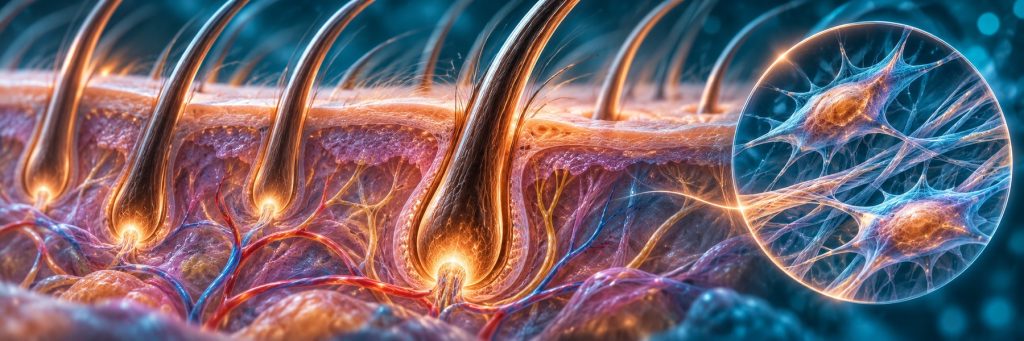
Hair loss is rarely one simple problem. Follicles respond to genetics, hormones, inflammation, nutrition, and signals from neighboring cells. Some people notice gradual thinning at the crown or part; others experience sudden shedding after illness, major stress, or dietary changes. These patterns may look similar, but they require different explanations and often different treatments.
Copper peptides, including AHK-Cu and GHK-Cu, have attracted interest because their laboratory biology connects to cell signaling, the extracellular matrix, and follicle-associated tissue. Cosmetic peptides such as Pal-GHK and Matrixyl raise a related question: could a combination influence both the follicle and its surrounding scalp environment?
The possibilities are intriguing. Yet none of the peptide stacks in this article has demonstrated reliable scalp-hair regrowth in a controlled human combination trial. The strongest benchmark remains established, diagnosis-specific treatment, including minoxidil and finasteride where appropriate. This guide distinguishes what has been observed in cells, isolated follicles, small human studies, and actual clinical hair-loss treatment.
1. The Big Picture: What Does Hair Restoration Really Mean?
The goal might be to grow more hairs, keep existing hairs longer, increase average shaft diameter, reduce breakage, calm an inflamed scalp, or stop excess shedding. These are not interchangeable. A smoother hair shaft can look thicker without adding follicles; a quieter scalp may feel better without reversing androgen-driven miniaturization.
Hair restoration is therefore best framed as matching the intervention to the cause. The main biological targets include the follicle growth cycle, the specialized dermal papilla cells at the follicle base, local androgen signaling, the scalp’s immune and barrier environment, and the nutritional inputs needed for rapidly dividing cells.
Four common situations that should not be confused
- Androgenetic alopecia (pattern hair loss): genetically susceptible follicles progressively miniaturize, often under the influence of dihydrotestosterone (DHT). Men and women can both be affected.
- Telogen effluvium: an increased proportion of hairs enters the shedding stage after a trigger such as illness, significant weight change, medication changes, or physiologic stress.
- Deficiency-associated shedding: inadequate iron, protein, zinc, or other nutrients may contribute in selected people. Testing and correction matter more than taking every supplement.
- Inflammatory and scarring disorders: conditions such as alopecia areata, psoriasis, seborrheic dermatitis, or scarring alopecias may require targeted dermatologic care; some can cause permanent follicle loss.
Rapid hair loss, painful or scarred areas, bald patches, or persistent scalp redness deserve prompt evaluation rather than experimental cosmetic stacking.
2. The Biology: How Follicles Grow, Rest, and Respond
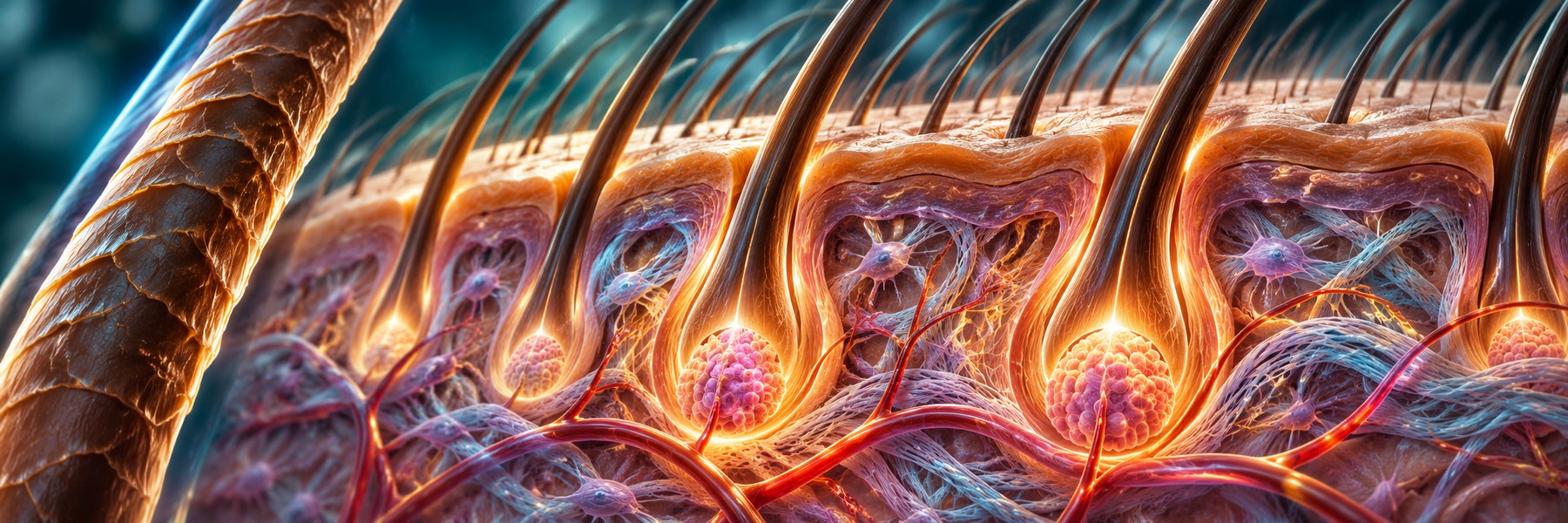
A hair follicle is a miniature organ that repeatedly changes structure. During anagen, active growth, matrix cells proliferate and the hair shaft lengthens. Catagen is a brief regression phase. Telogen is the resting phase, followed by exogen, shedding of the old shaft. These phases occur asynchronously across the scalp.
The dermal papilla at the follicle base helps coordinate the surrounding epithelial stem cells, pigment-producing cells, local matrix, and blood supply. Wnt/β-catenin, Sonic hedgehog, BMP, growth-factor networks, and androgen-receptor signaling influence this complex cycle. Crucially, activating a pathway in a dish does not establish safe, sustained growth in a living scalp.
The scalp’s extracellular matrix contains collagen, proteoglycans, and other structural components. Inflammation, sebaceous activity, ultraviolet exposure, and irritation may alter the surrounding environment, but better matrix signaling does not necessarily correct DHT-sensitive miniaturization.
What is special about copper peptides?
AHK-Cu is alanyl-histidyl-lysine bound to copper; GHK-Cu is glycyl-histidyl-lysine bound to copper. Their first amino acid differs, so their evidence cannot be treated as identical. Both are distinct from Pal-GHK, a palmitoylated derivative that changes the molecule’s physicochemical behavior. Ingredient labels may also use related names without identifying the exact copper-loaded complex.
A 2007 study of AHK-Cu found that isolated human scalp follicles grew longer in organ culture and cultured dermal papilla cells proliferated more. This is meaningful ex vivo and cell evidence, not a trial of people applying the peptide to balding scalp [1]. A 2026 split-face eyebrow study of GHK-Cu reported improvements in eyebrow hair count and diameter in just 18 participants over 12 weeks. Encouraging, but it does not demonstrate treatment of scalp androgenetic alopecia [2].
3. The Peptide Stacks Researchers Could Examine
The formulations below are research concepts, not validated regimens or instructions for personal use. Topical stability, dose, delivery, copper occupancy, and tolerability are not established merely because a formula contains several named ingredients.
Stack A: AHK-Cu + GHK-Cu
Research rationale: Two related copper-tripeptide complexes may act on follicle-associated cells and the surrounding matrix. AHK-Cu has the most directly hair-focused laboratory study; GHK-Cu has broader skin and matrix research, plus preliminary human eyebrow findings.
Potential advantage: The pairing could reveal whether follicle signaling and surrounding tissue effects are complementary.
Principal limitation: These are closely related copper complexes. Overlap may be greater than synergy, and no controlled study has shown that using both improves scalp density beyond either alone. Formulation chemistry matters: simply doubling up on copper-linked ingredients could increase irritation or exposure without increasing benefit.
Explore: AHK-Cu and GHK-Cu in the Peptide Perspectives directory.
Stack B: GHK-Cu + Pal-GHK
Research rationale: GHK-Cu has copper-dependent skin-related signaling, while Pal-GHK is a fatty-acid-modified peptide used in cosmetic formulations to target extracellular-matrix-associated responses.
Potential advantage: Formulators may seek distinct skin-conditioning and delivery characteristics.
Principal limitation: Pal-GHK is not demonstrated to stimulate scalp hair growth in human clinical trials. Chemically related sequences can produce overlapping effects, and palmitoylation should not be mistaken for proven follicular penetration. Copper chemistry, stability, and excipient interactions need testing.
Stack C: AHK-Cu + Pal-GHK
Research rationale: Pairing the directly studied follicle-oriented AHK-Cu with a cosmetic matrix-signaling peptide might help researchers separate follicle elongation effects from changes in surrounding dermal tissue.
Potential advantage: Mechanisms could be assessed independently in organ-culture models before any human trial.
Principal limitation: There are no human efficacy data supporting this combination; Pal-GHK-specific scalp outcomes are especially uncertain. A formulation that is promising on fibroblast markers may be ineffective for DHT-related miniaturization.
Stack D: GHK-Cu + Matrixyl
Research rationale: Matrixyl is a commercial ingredient family, not a single universal molecule. The original Matrixyl commonly refers to palmitoyl pentapeptide-4; Matrixyl 3000 contains different peptides, including palmitoyl tripeptide-1 and palmitoyl tetrapeptide-7. These cosmetic ingredients are studied chiefly for the appearance of skin rather than validated hair regrowth.
Potential advantage: A well-characterized formulation might support hydration and cosmetic appearance while testing separate follicular endpoints.
Principal limitation: Matrixyl evidence for facial skin cannot be transferred to scalp hair growth. Studies would need a vehicle control, single-ingredient groups, and a combined group to determine whether adding Matrixyl contributes anything measurable.
Stack E: Copper peptide + scalp-barrier support
Research rationale: Instead of combining multiple experimental peptides, a simpler topical concept could pair a single copper peptide with a tolerated moisturizer or barrier-supporting formulation containing ingredients such as glycerin, panthenol, or ceramides.
Potential advantage: Better comfort and adherence, if the vehicle is tolerable, may matter more than maximizing ingredient count.
Principal limitation: Barrier benefits are not proof of follicle regeneration. The active peptide’s added contribution remains untested.
Stack F: Established hair-loss therapy + investigational topical peptide
Research rationale: A properly designed trial could test whether a peptide adds benefit on top of established treatment, such as topical minoxidil, instead of replacing it.
Potential advantage: This asks a clinically meaningful question: does the investigational ingredient improve hair counts, diameter, shedding, or treatment satisfaction beyond standard care?
Principal limitation: There are no adequate trials validating such a stack. Mixing products can change absorption or increase scalp irritation, and any proposed study would need standardized formulations and clinician oversight. This is a research comparator, not a recommendation to compound the ingredients together.
4. Comparing the Peptides and Formulations
| Ingredient or stack | Main research interest | Highest relevant evidence | Important limitation |
|---|---|---|---|
| AHK-Cu | Dermal papilla proliferation and follicle elongation | Human hair follicles ex vivo; cell culture | No published controlled human scalp-growth trial |
| GHK-Cu | Copper-associated matrix and skin signaling | Small 2026 human eyebrow study; other skin research | Eyebrow endpoint does not establish scalp regrowth |
| Pal-GHK | Cosmetic matrix signaling and formulation | Cosmetic/mechanistic evidence | No validated scalp hair-growth efficacy |
| Matrixyl family | Cosmetic extracellular-matrix and skin appearance | Human skin-focused studies of selected ingredients | Not demonstrated to treat alopecia |
| AHK-Cu + GHK-Cu | Related copper-peptide mechanisms | Theoretical pairing | Possible pathway overlap; no stack trials |
| GHK-Cu + Pal-GHK | Copper signaling and lipophilic cosmetic peptide | Theoretical formulation | Uncertain delivery and added effect |
| AHK-Cu + Pal-GHK | Follicle and matrix research | Experimental concept | No human combination efficacy or safety data |
| GHK-Cu + Matrixyl | Scalp tissue appearance and matrix support | Cosmetic formulation concept | Hair-growth benefit not established |
| Topical minoxidil | Hair growth stimulation | Multiple human randomized trials | Continued treatment needed to maintain benefit |
| Oral finasteride, for eligible men | Reduction of DHT formation | Human clinical trials for male pattern loss | Sexual and other adverse effects; pregnancy-related precautions |
The strongest human clinical comparators
Minoxidil is supported by trials in male and female pattern hair loss and can improve or maintain density, although results vary and continuation is required [3,4]. Finasteride, a 5-alpha-reductase inhibitor, has demonstrated hair preservation and regrowth benefits in appropriately selected men with androgenetic alopecia [3]. It addresses an androgen-related mechanism rather than the cosmetic matrix pathways discussed above.
Finasteride can cause sexual adverse effects and is unsuitable during pregnancy; anyone considering it should discuss reproductive plans and risks with a clinician. Oral minoxidil and other antiandrogen options may be used off label under medical supervision in selected patients, and have their own monitoring requirements [4].
5. Complementary Supplements: Where Nutrition Fits
Nutrition can influence hair because follicles contain rapidly dividing cells. But the distinction between correcting an insufficiency and boosting an already adequate nutrient level is fundamental.
| Nutrient or supplement | Why people consider it | What the evidence supports | Important caution |
|---|---|---|---|
| Protein | Keratin building blocks; low intake can contribute to shedding | Adequate protein is foundational, especially after weight loss or restrictive diets | More protein beyond adequate intake has no proven direct regrowth effect |
| Iron | Needed for oxygen delivery and cell metabolism | Correct documented deficiency, particularly when ferritin and other tests support it | Excess iron is harmful; unexplained hair loss does not justify iron automatically |
| Zinc | Cellular growth and protein synthesis | Repletion can matter when deficient | Excess zinc can cause copper deficiency and anemia |
| Vitamin D | Follicle and immune signaling | Correct deficiency for overall health; hair-growth benefit in replete adults uncertain | Avoid high-dose use without indication |
| Biotin | Coenzyme involved in metabolism | Deficiency is uncommon; little evidence for extra biotin without deficiency [5] | High doses can interfere with thyroid and cardiac lab assays |
| Collagen peptides | Amino-acid source and cosmetic skin research | No convincing evidence of scalp hair regrowth | Do not replace complete protein intake |
| Omega-3s | Cell membranes and inflammatory biology | Some small or combination-product studies; no reliable stand-alone regrowth proof | High doses can have adverse effects and medication interactions |
| Saw palmetto | Possible androgen-pathway activity | Small controlled studies suggest modest possible gains for certain extracts [6] | Not equivalent to finasteride; variable preparations and reproductive cautions |
| Vitamin C | Supports collagen synthesis and dietary iron absorption | Helpful for nutritional adequacy; not a hair-growth treatment by itself | Megadoses are not established to help |
| Pumpkin seed oil | Botanical lipid components | Small trials and recent supplement reviews report exploratory benefits | Product-specific findings; not a substitute for diagnosed therapy |
A 2024 systematic review found associations between hair loss and some micronutrient deficiencies, but results were inconsistent and do not support indiscriminate high-dose supplements [7]. A 2026 evidence synthesis of 19 randomized trials found potential benefits from selected standardized supplements but emphasized the need for larger, higher-quality trials [8].
A practical nutrition-first approach includes adequate energy intake, protein, and varied foods, while using blood testing when clinically appropriate. Marked caloric restriction or rapid weight loss can sometimes trigger telogen effluvium, even if a person is eating a generally nutritious diet.

6. The Special Focus: What Is Actually Causing the Hair Loss?
Androgen-related miniaturization
If the problem is pattern hair loss, the follicle becomes progressively smaller under genetically mediated and androgen-related influences. The clinical evidence for minoxidil and, in appropriate men, finasteride is substantially stronger than for copper peptide stacks. A scalp serum may condition skin but does not automatically address DHT-sensitive follicular miniaturization. When hair loss is advanced, transplantation may be considered after professional assessment.
Nutritional deficiency or physiologic shedding
If hair is shedding after illness, significant weight change, childbirth, restricted food intake, or iron deficiency, the central goal is to identify and address the trigger. An elaborate peptide mixture might distract from the correct diagnosis. The follicle often needs time to cycle back toward anagen, and new visible growth is slow.
Inflammation and scalp disease
Itching, scaling, pain, redness, or bald patches can indicate an inflammatory or autoimmune condition. Management may require antifungal, anti-inflammatory, immune-directed, or other medical care. Scarring alopecias warrant prompt specialist evaluation because follicle destruction can become permanent. Reducing redness is a different endpoint from reversing genetic hair loss.
7. Where Hair-Restoration Research Could Go Next
The most informative study would not merely compare before-and-after photographs from a complicated serum. A robust randomized human trial should include a vehicle-only control, separate peptide arms, a combination arm, sufficient follow-up, and measurement of hair density, terminal-hair counts, shaft diameter, hair shedding, and patient-reported outcomes. Participants should be stratified by actual diagnosis, such as male pattern hair loss versus female pattern hair loss.
For copper peptides, researchers also need chemical identity and topical delivery data. A label reading “2% peptide” does not reveal copper occupancy, free copper levels, intact-complex stability, or follicle exposure. Testing whether multiple peptides reach relevant tissues is a prerequisite to evaluating synergy.
The 2026 eyebrow GHK-Cu study is an interesting signal for future work, but it is small. The AHK-Cu follicle study provides a biologically relevant starting point rather than clinical proof. Moving from those findings to a safe and effective scalp formulation will require careful trial design [1,2].
Safety: More peptides are not automatically better
Multiple copper-peptide formulas can overlap mechanistically. The common risks of topical products include irritation, allergic contact dermatitis, product contamination, formulation incompatibility, and misleading identity or concentration claims. Injecting or microneedling unapproved research peptides introduces additional risks and is not supported by hair-restoration trials. Avoid using experimental preparations on broken or inflamed scalp without medical guidance.
Finasteride has pregnancy-related and sexual-side-effect precautions; minoxidil can irritate the scalp and is not advised during pregnancy or breastfeeding without medical advice. High-dose biotin can distort laboratory testing, excess zinc can provoke copper deficiency, and some botanicals may interact with medications. Diagnosis-specific treatment is more meaningful than the number of compounds in a stack.
8. Explore the Compounds
The following links open the Peptide Perspectives searchable directory, where the individual profiles can be located. The corresponding individual page slugs could not be independently verified during preparation of this article.
- AHK-Cu, follicle-focused copper-tripeptide research
- GHK-Cu, copper-tripeptide skin and matrix signaling
- Pal-GHK, palmitoylated cosmetic tripeptide
- Matrixyl family, cosmetic signal peptides
The bottom line
The most promising peptide research is mechanistically interesting, not yet clinically decisive. AHK-Cu has direct follicle laboratory findings; GHK-Cu now has a small eyebrow study; Pal-GHK and Matrixyl are more appropriately described as cosmetic signaling ingredients than established scalp-regrowth therapies. There is no reliable proof that combining them restores hair more effectively than using one, or that they outperform minoxidil or finasteride for pattern hair loss. The clearest path forward is to diagnose the cause, correct deficiencies when present, use appropriate evidence-based treatments, and study peptide additions with well-controlled trials.
Educational research content only. Not medical advice or a recommendation to use unapproved peptide preparations. Consult a qualified dermatologist or healthcare professional for persistent, sudden, painful, or patchy hair loss, and before starting medications or supplements.
References and further reading
- Pyo HK et al. The effect of tripeptide-copper complex on human hair growth in vitro (AHK-Cu). Archives of Pharmacal Research (2007). https://pubmed.ncbi.nlm.nih.gov/17703734/
- 2026 split-face study of 2% GHK-Cu serum for eyebrow hypotrichosis, n=18. https://so09.tci-thaijo.org/index.php/PMR/article/view/9318
- American Academy of Family Physicians. Hair Loss: Diagnosis and Treatment (2024). https://www.aafp.org/afp/2024/0900/hair-loss
- American Academy of Dermatology. Hair loss: Diagnosis and treatment. https://www.aad.org/public/diseases/hair-loss/treatment/diagnosis-treat
- NIH Office of Dietary Supplements. Biotin fact sheet. https://ods.od.nih.gov/factsheets/biotin-consumer/
- Saw palmetto trial, 180-day outcomes (2026). https://pubmed.ncbi.nlm.nih.gov/41652806/
- Micronutrients and Androgenetic Alopecia: A Systematic Review (2024). https://pubmed.ncbi.nlm.nih.gov/39440586/
- Dietary supplements for androgenetic alopecia: network meta-analysis (2026). https://pubmed.ncbi.nlm.nih.gov/41561175/