
Peptide Stacking & Synergy Series | Research goal: Gut & Digestive Health
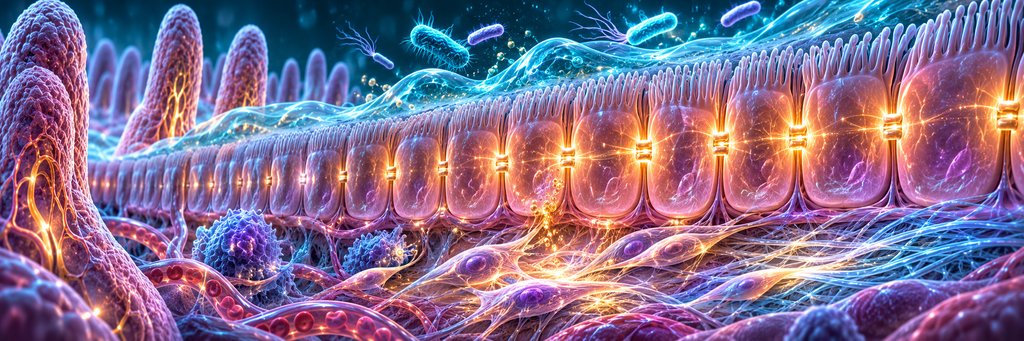
The intestine is more than a digestive tube. It is a selectively permeable barrier, a home for trillions of microbes, an immune surveillance system, and an organ connected to the brain through nerves and signaling molecules. Scientists investigating gastrointestinal recovery increasingly ask whether tissue protection, inflammatory regulation, microbial metabolism, and nutrition can be addressed together.
The idea behind a “gut repair stack” is compelling: one intervention could influence epithelial injury, another inflammatory signaling, and another the organisms and nutrients interacting with the intestinal lining. But complementary pathways do not prove that a combination works. None of the peptide stacks in this article has established clinical efficacy for irritable bowel syndrome (IBS), inflammatory bowel disease (IBD), celiac disease, or general “leaky gut.” We can be curious about experimental peptides while giving stronger weight to clinical diagnostics and interventions supported by human trials.
1. The Big Picture: What Does Gut Repair Actually Mean?
Digestive complaints are often grouped together, but their biology differs. Crohn’s disease and ulcerative colitis involve chronic immune-mediated inflammation that can injure the lining; IBS affects gut-brain communication, sensitivity, and bowel function without necessarily producing visible inflammation; celiac disease is an immune response to gluten that requires strict dietary treatment; infections, medication effects, intolerances, and nutrient malabsorption have still other causes.
A “healthy barrier” means intestinal cells, tight junctions, protective mucus, immune defenses, and microbiota function together. It does not mean sealing the gut so nothing crosses. Nutrients must still be absorbed while harmful organisms and inflammatory stimuli are appropriately controlled.
Meaningful research outcomes therefore differ: symptom relief, normal stool patterns, endoscopic mucosal healing, reduced fecal calprotectin, remission without steroids, and improved nutritional status are separate endpoints. A change in an animal tissue marker or a commercial permeability panel is not equivalent to one of these clinical outcomes.
2. The Biological Pathways: Four Interconnected Systems
The epithelial barrier and mucus layer
Intestinal epithelial cells renew rapidly. Tight junction proteins regulate movement between cells, while mucus and antimicrobial defenses separate many microbes from the underlying tissue. Inflammation, certain medications, infections, and disease can disturb this system. Investigational peptides are studied for effects on epithelial migration, survival, and barrier-related signaling.
Local inflammatory and immune signaling
Cytokines and pathways such as NF-κB and MAPK coordinate defense and tissue responses. Excessive signaling can contribute to disease, but suppressing inflammation indiscriminately can also interfere with normal immune protection. A useful treatment must be appropriate to the cause and context of inflammation.
Microbiome and fiber-derived metabolites
Microbes ferment certain fibers into short-chain fatty acids such as butyrate, which can support colonic cell metabolism. Microbial communities also influence bile acids, immune maturation, and intestinal signaling. Probiotics and prebiotics are not interchangeable: a probiotic introduces selected organisms, whereas a prebiotic supplies substrates used by existing microbes.
Gut–brain and secretory signaling
The enteric nervous system and peptides such as vasoactive intestinal peptide (VIP) help regulate intestinal movement, blood flow, secretion, and immune communication. These effects illustrate why increasing a supposedly protective signal might also produce diarrhea, low blood pressure, or other unwanted outcomes.
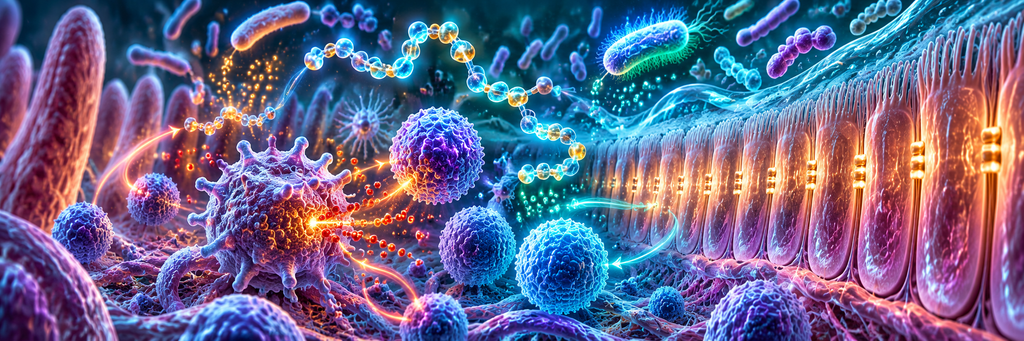
3. The Experimental Peptide Stacks
Stack 1: BPC-157 + KPV
The hypothesis: pair a peptide with preclinical gastrointestinal tissue-protection findings (BPC-157) and a small anti-inflammatory tripeptide (KPV).
BPC-157 has been investigated in experimental gastric lesions, intestinal injury, vascular signaling, and wound-repair models. Animal findings are extensive, but interpretable, controlled human evidence for gut repair is extremely limited. Earlier gastrointestinal development programs do not establish approved efficacy or a validated regimen.
KPV (Lys-Pro-Val), a fragment of alpha-MSH, has more directly characterized intestinal anti-inflammatory experiments. In laboratory work, KPV enters cells through the peptide transporter PepT1, reduces NF-κB/MAPK-associated responses, and decreases inflammation in mouse colitis models. Different chemical derivatives and routes of administration have not been shown to be equivalent.
Why it attracts attention: the mechanisms could address epithelial injury and inflammatory regulation in parallel. The limitation: no controlled human combination trial shows that BPC-157 + KPV improves symptoms, permeability, ulcer healing, or IBD remission. Both may influence inflammatory responses, creating possible overlap rather than guaranteed synergy.
Stack 2: KPV + VIP
The hypothesis: combine KPV-related cellular inflammatory modulation with VIP-associated enteric nerve, epithelial, and immune signaling.
VIP is a naturally occurring neuropeptide acting through VPAC receptors. In mice deficient in VIP, researchers found altered epithelial barrier function, mucus-related changes, and worse experimental colitis; VIP replacement improved some experimental outcomes. This is intriguing physiological evidence, not proof that giving VIP treats human gut disorders.
Why it attracts attention: KPV may affect inflammatory cell signaling while VIP influences secretory, neuroimmune, and barrier processes. The limitation: VIP can also influence blood vessel tone and intestinal secretion. Flushing, hypotension, and diarrhea are relevant concerns, and combining it with another unapproved immune-active peptide has not been tested for safety or benefit.
Directory: KPV · Peptide directory: VIP
Stack 3: BPC-157 + Full-Length Thymosin Beta-4
The hypothesis: pair experimental mucosal tissue protection with thymosin beta-4 (Tβ4), a 43-amino-acid peptide involved in actin regulation and cellular movement.
A 2026 study found that loss of endogenous Tβ4 worsened experimental colitis in mice, while orally administered recombinant full-length Tβ4 improved selected inflammatory and fibrotic outcomes. The researchers implicated mineralocorticoid-receptor-associated signaling. Tissue analysis from people with IBD provided biological context, but the treatment results came from animal models, not a human efficacy trial.
Why it attracts attention: cell migration, matrix remodeling, and inflammatory protection could be relevant to mucosal recovery. The limitation: no trial establishes human benefit from BPC-157 + Tβ4; these pathways may overlap, and intestinal dosing, distribution, and formulation are unresolved.
Critical identity distinction: full-length Tβ4 is not automatically the same as a commercial product called “TB-500.” Some TB-500 products contain shorter thymosin fragments. The 2026 colitis findings with full-length recombinant Tβ4 cannot simply be assigned to a seven-amino-acid fragment or to an unspecified premixed vial.
Directory: BPC-157 · Thymosin Beta-4 (full length)
Stack 4: KPV + Thymosin Alpha-1
The hypothesis: combine local inflammation-related signaling with a peptide studied for systemic immune-cell regulation.
Thymosin alpha-1 (Tα1) has a history of human investigation in selected infectious, oncologic, and immune contexts; availability and regulatory indications differ across countries. That human exposure history does not amount to evidence that it heals the intestine or improves inflammatory bowel disease. Its immune effects can be context-dependent rather than simply “anti-inflammatory.”
Why it attracts attention: KPV research concerns intestinal epithelial and immune signaling, while Tα1 has broader immune-modulatory research. The limitation: no validated human gut protocol or combination efficacy exists. In patients receiving immunosuppressants, biologics, or therapy for autoimmune disease, adding immune-active experimental peptides makes interactions and response interpretation more uncertain.
Directory: KPV · Peptide directory: Thymosin Alpha-1
Stack 5: KPV + Gut-Targeted Delivery Research
Rather than adding another systemic peptide, a particularly interesting direction is improving where KPV is delivered. Animal studies have used modified nanoparticles and other formulations intended to concentrate KPV near inflamed intestinal tissue. This could eventually offer better local activity with less systemic exposure.
This is a formulation strategy, not an established two-peptide stack. It is scientifically compelling because conventional oral, nasal, and injectable preparations cannot be assumed equivalent to specialized experimental systems.
Directory: KPV
Stack 6: VIP + Microbiome-Focused Interventions
VIP’s role in intestinal secretion and immune communication makes its interaction with microbial metabolism a reasonable research question. A defined probiotic strain or fiber intervention could, in principle, modify metabolites or symptoms through a different pathway.
This pairing has not demonstrated clinical synergy. In a person with diarrhea, VIP-related secretion effects and fermentable prebiotic fibers could actually worsen symptoms. The choice of microbial strain, dose, patient diagnosis, and outcomes would all matter in a proper trial.
Directory: Peptide directory: VIP
4. Comparing the Combinations
| Combination | Complementary research rationale | Evidence for components | Combination evidence | Main concern |
|---|---|---|---|---|
| BPC-157 + KPV | Tissue protection plus inflammatory signaling | BPC-157 mostly animal; KPV cells/mice | No established human benefit | Overlapping immune effects; product identity |
| KPV + VIP | Epithelial inflammation plus enteric neuroimmune signaling | KPV cells/mice; VIP physiology and animal colitis | None established | Diarrhea, hypotension, unknown interactions |
| BPC-157 + Tβ4 | Mucosal repair and actin-mediated cell movement | Animal BPC data; 2026 full-length Tβ4 mouse colitis | None established | Fragment confusion; tissue remodeling uncertainty |
| KPV + Tα1 | Local inflammatory pathways and systemic immune regulation | KPV preclinical; Tα1 human studies for other indications | None established | Immune-treatment interactions |
| KPV + targeted delivery | Improve local intestinal exposure | Formulation and animal research | No clinical efficacy | Different formulations are not interchangeable |
| VIP + probiotics/fiber | Neuroimmune signaling and microbial metabolites | VIP preclinical gut research; strain- or fiber-specific human evidence | No VIP-specific synergy | Bloating, diarrhea, altered secretion |
Bottom line: the first four are useful research questions, not proven treatment stacks. A larger number of peptides does not ensure more barrier repair, fewer symptoms, or a safer immune response.
5. Complementary Supplements: Where Human Evidence Is Stronger
Zinc carnosine: a targeted mucosal-repair hypothesis
Zinc-L-carnosine combines zinc with the dipeptide carnosine. A small randomized crossover trial involving ten healthy adults found that it limited an indomethacin-associated increase in small-intestinal permeability. Laboratory work also found effects on epithelial migration. This is interesting human mechanistic evidence, but it does not prove treatment of Crohn’s disease, celiac disease, chronic “leaky gut,” or every form of digestive discomfort. Long-term or excessive zinc intake can lead to copper deficiency, nausea, and other adverse effects.
L-glutamine: unusually relevant to a specific IBS subgroup
Glutamine supplies fuel for rapidly dividing intestinal cells and has a biological role in gut metabolism. In one randomized controlled study of adults with post-infectious diarrhea-predominant IBS and increased intestinal permeability, glutamine improved symptom scores and permeability measures compared with placebo. This finding is encouraging but is not a blanket recommendation for all IBS, IBD, or healthy adults. It requires independent confirmation in broader populations and consideration of individual medical circumstances.
Probiotics: strain, diagnosis, and endpoint matter
Probiotic effectiveness cannot be inferred from a label listing many strains or a high number of colony-forming units. The American Gastroenterological Association supports particular formulations in narrowly defined settings, but recommends probiotics only within clinical trials for several conditions, including IBS and Crohn’s disease. Other professional guidelines interpret IBS evidence somewhat differently. A strain used to prevent antibiotic-associated diarrhea should not be presumed to heal an ulcer or induce IBD remission.
People who are severely immunocompromised, critically ill, or have central venous catheters can face rare but serious infections from live microorganisms; specialist guidance matters.
Prebiotic fiber and psyllium: supportive microbiome ecology
Soluble, gel-forming fiber such as psyllium has human evidence for improving overall IBS symptoms and bowel regularity. Inulin and fructooligosaccharides can increase fermentation, but they can also increase gas, distension, or pain in people sensitive to fermentable carbohydrates. Introducing fiber gradually and choosing it according to symptoms is more sensible than assuming “more prebiotic” is always better.
Additional digestive-support nutrients
Vitamin D, iron, vitamin B12, and folate are important when deficiency is documented, particularly in some malabsorptive or inflammatory conditions. Correction of deficiency supports overall health but is not proof of intestinal regeneration. Adequate protein, hydration, and balanced nutrition support normal epithelial turnover. Peppermint oil has some evidence for selected IBS symptoms but can aggravate reflux. Digestive enzymes can be important when a specific deficiency exists, such as pancreatic enzyme insufficiency or lactose intolerance, but routine multi-enzyme supplements have no general “gut repair” proof. Butyrate-focused strategies remain an active area of research, with formulation-specific and condition-specific uncertainties.
| Support option | Best-supported role | Evidence level | Important limitation |
|---|---|---|---|
| Zinc carnosine | Experimental protection against NSAID-associated permeability | Small randomized human mechanistic study | Not established as general gut-repair therapy; excess zinc risk |
| L-glutamine | Selected postinfectious IBS-D with increased permeability | One notable randomized trial | Results cannot be generalized to all GI disorders |
| Specific probiotics | Some indication- and strain-specific outcomes | Mixed human trials and guidelines | Strain quality, infection risk, uncertain benefit |
| Psyllium | IBS symptom and stool-pattern support | Human trials and guideline support | Can cause bloating; requires fluids |
| Inulin/FOS and other prebiotics | Modifying microbial fermentation | Variable clinical evidence | Can worsen gas and discomfort |
| Vitamin/mineral repletion | Correcting deficiencies | Established where deficient | Not a treatment for inflammatory disease itself |
6. What Would a Better Research Study Look Like?
A good study would recruit people with a clearly defined diagnosis, verify each peptide’s molecular identity and purity, compare single agents with combinations and placebo, and use consistent delivery systems. Investigators should measure pharmacokinetics, adverse effects, interactions with prescription drugs, and objective clinical outcomes rather than only changes in laboratory cytokines.
For IBD, meaningful outcomes might include endoscopic healing, fecal calprotectin, steroid-free remission, and adverse events. For IBS, validated symptom scales and bowel-habit outcomes are more relevant. For celiac disease, gluten exposure must not be replaced by experimental repair claims; existing treatment is a strict gluten-free diet, while new barrier-directed therapies require rigorous trials.
Another promising research direction is local delivery. Modified KPV systems and appropriately characterized full-length Tβ4 formulations might teach scientists how to target injured tissue without indiscriminately altering systemic immunity. But any future use depends on toxicology, pharmacology, and controlled human efficacy studies.
Where the greatest real-world value lies
For someone looking to support digestive health today, the strongest practical approach is not to stack multiple research peptides. It is to identify the underlying disorder; follow evidence-based treatment when indicated; correct documented deficiencies; and consider symptom-appropriate nutrition, soluble fiber, and selected supplements with a clinician or dietitian. With inflammatory disease, delaying appropriate treatment can permit lasting injury even when symptoms temporarily improve.
7. Explore the Compounds and Research
Peptide Perspectives compound profiles
- BPC-157: Gastrointestinal tissue-protection research
- KPV: PepT1 and intestinal inflammation
- Thymosin Beta-4, full length: cellular movement and repair
- Peptide directory: VIP, Thymosin Alpha-1, and additional compounds
Selected published research and clinical guidance
- KPV uptake and mouse-colitis research
- VIP and intestinal barrier research in mice
- 2026 full-length thymosin beta-4 experimental colitis study
- Zinc carnosine human permeability pilot
- Glutamine in selected post-infectious IBS-D
- AGA probiotics guideline
- ACG IBS guideline
The Bigger Possibility
The next chapter of digestive research may be more precise rather than more aggressive: understanding which intestinal process is disrupted, where a compound needs to act, and how it interacts with the microbiome and immune system. KPV transport biology, VIP’s enteric signaling, and thymosin beta-4’s experimental colitis findings create legitimate scientific questions. Translating them into safe treatments will require far more than a plausible list of ingredients.
Peptide Perspectives educational disclaimer: This article discusses published science, hypotheses, and community terminology, not individualized medical advice or dosing recommendations. BPC-157, KPV, VIP, full-length thymosin beta-4, and thymosin alpha-1 are not FDA-approved treatments for IBS, IBD, celiac disease, or routine gut repair. Combining unapproved research products introduces uncertain purity, immune effects, drug interactions, and safety risks. Persistent diarrhea, blood in stool, severe abdominal pain, unexplained weight loss, anemia, or suspected malabsorption warrant medical assessment.