
Hair follicles are miniature, self-renewing organs. By studying how they cycle, respond to inflammation, and communicate with surrounding skin, researchers are uncovering new possibilities for hair and scalp health, including copper peptides, cosmetic signaling peptides, and experimental regenerative molecules.
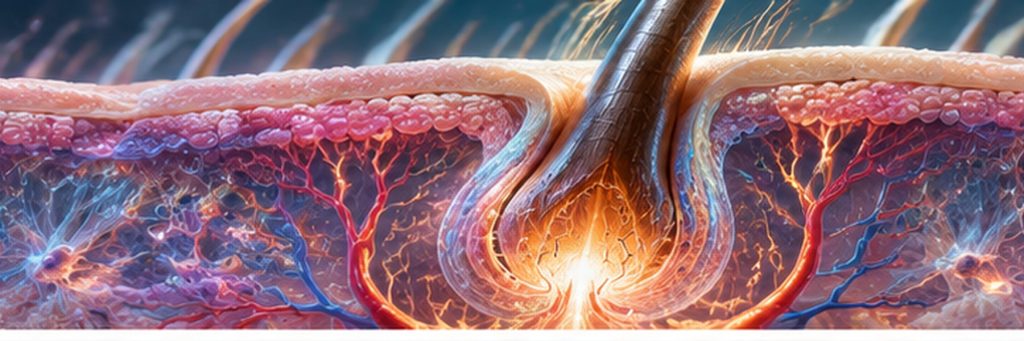
1. The Big Picture: Hair Restoration Is About More Than Growing Strands
Hair loss is common, but it is rarely simple. The health of every visible hair strand depends on a living follicle embedded in the scalp. Some follicles progressively shrink in androgenetic alopecia (pattern hair loss). Others pause their growth after illness, nutritional stress, hormonal changes, or other disruptions. Autoimmune conditions can attack follicles, while inflammatory or scarring disorders can permanently damage them. Identifying the cause matters because one therapy cannot address every pathway.
The exciting shift in hair research is from thinking only about how to make a strand grow faster toward understanding how a follicle stays active, retains its regenerative capacity, and interacts with nearby tissue. That is where peptides enter the picture. Some are being studied for their effects on dermal papilla cells, others for collagen and extracellular matrix support, and still others for pathways involved in inflammation or follicle regeneration.
There is an important benchmark: topical minoxidil and oral finasteride have established human clinical evidence and FDA-approved uses for specific forms of pattern hair loss. None of the experimental peptides discussed here is FDA-approved to regrow scalp hair. Their promise is in the biological questions they help researchers ask, not in a demonstrated ability to replace proven treatment. American Academy of Dermatology.
2. The Biological Pathways: How Hair Follicles Grow, Rest, and Regenerate
The Hair Cycle Is a Repeating Conversation
Most scalp follicles repeatedly move through several stages:
- Anagen, the growth phase: actively dividing cells produce the hair shaft. Scalp anagen can last for years.
- Catagen, the transition phase: the lower follicle regresses and active hair production slows.
- Telogen, the resting phase: the follicle is relatively quiet while a new cycle is prepared.
- Exogen, the shedding process: an older strand is released, sometimes overlapping with a newly growing hair.
Shedding is not automatically a sign of damage. The biological question is whether enough follicles return to productive growth, and whether the hairs they produce remain thick enough to be visible.
Dermal Papilla Cells Help Direct the Follicle
At the base of a follicle, dermal papilla cells exchange signals with neighboring epithelial stem and progenitor cells. Their communication helps determine when a follicle re-enters anagen and how robustly the shaft develops. Researchers study growth-factor signaling, cell survival, and cellular metabolism in this environment. These cells are a central focus of early AHK-Cu research.
Wnt/β-Catenin and Other Growth Signals
The Wnt/β-catenin pathway helps regulate follicle development and cycling. A compound called PTD-DBM was designed to interfere with a protein interaction that restrains this pathway. This represents a fundamentally different strategy from a peptide that supports skin matrix remodeling. Yet stimulating a growth-related signal in a mouse or cultured cell is not proof of safe, lasting human hair restoration.
Hormones, Inflammation, and the Scalp Environment
In genetically susceptible follicles, dihydrotestosterone (DHT) can contribute to gradual miniaturization. Other forms of hair loss may involve immune activity, inflammatory signals, or changes in the scalp environment. Collagen, blood vessels, extracellular matrix proteins, and the scalp barrier all influence the tissue supporting a follicle. Copper-binding and cosmetic signaling peptides are interesting partly because they can affect some of these surrounding processes in laboratory models. Improved skin appearance, however, is not the same endpoint as increased scalp hair density.

3. Compounds Researchers Are Exploring
AHK-Cu: The Most Direct Copper-Peptide Follicle Experiment
Explore AHK-Cu on Peptide Perspectives
AHK-Cu is a copper-binding tripeptide composed of alanine, histidine, and lysine. Its particular appeal is a published laboratory study involving isolated human scalp follicles and cultured dermal papilla cells. Researchers observed increased follicle elongation and cell proliferation, alongside changes in signals associated with cell survival. These are genuine hair-specific biological observations, making AHK-Cu a compelling starting point for research on maintaining active follicles.
The opportunity: Discover whether those follicle-cell effects translate into measurable improvements in hair counts, shaft diameter, or growth-cycle activity with an appropriately formulated topical product.
The boundary: The human follicles were studied outside the body. Controlled trials showing that AHK-Cu regrows hair on living human scalps have not established a clinical benefit, and injectable use lacks a validated safety or efficacy basis.
GHK-Cu: Skin Repair and the Follicle’s Surroundings
Explore GHK-Cu on Peptide Perspectives
GHK-Cu is a related copper tripeptide built from glycine, histidine, and lysine. Its wider research literature explores collagen-related signaling, extracellular matrix remodeling, and aspects of skin repair. Since a follicle exists within a complex network of dermal tissue, this raises a constructive hypothesis: might supporting the surrounding environment improve follicle resilience?
The opportunity: Investigate whether scalp-specific formulations influence tissue quality, inflammatory biomarkers, or meaningful hair outcomes. A small 2026 eyebrow study adds an early cosmetic signal, although eyebrow findings cannot be assumed to apply to scalp regrowth.
The boundary: The often-cited isolated-follicle experiment tested AHK-Cu, not GHK-Cu. Skin-repair findings are not direct evidence of hair regrowth, and a tiny eyebrow study does not establish an approved scalp treatment. Recent evidence review.
Pal-GHK: Designing Peptides for Cosmetic Delivery
Explore PAL-GHK on Peptide Perspectives
Pal-GHK, also called palmitoyl tripeptide-1, adds a lipid-like palmitoyl group to the GHK sequence. This modification is intended to alter how the peptide behaves in topical cosmetic formulations. It does not mean Pal-GHK is the same substance as copper-bound GHK-Cu.
The opportunity: Study whether formulation design can better deliver a skin-signaling peptide to the scalp and support the extracellular matrix around follicles. This makes Pal-GHK especially relevant to cosmetic product innovation.
The boundary: Human studies showing standalone Pal-GHK regrows scalp hair are not established; most evidence relates to skin/cosmetic endpoints or formulation rationale rather than hair counts.
Pal-AHK: A Lipid-Modified Cousin Worth Investigating
Explore PAL-AHK on Peptide Perspectives
Pal-AHK modifies the AHK sequence with a palmitoyl group. The chemical change makes it an interesting candidate for topical formulation research, particularly given the separate follicle experiments with AHK-Cu. However, Pal-AHK is not AHK-Cu, and findings from the copper complex cannot be assumed to carry over unchanged.
The opportunity: Compare delivery, stability, skin compatibility, and follicle-cell responses across carefully characterized AHK-related formulations.
The boundary: Direct controlled clinical evidence for hair regrowth is lacking, and any benefit inferred from AHK-Cu is still a hypothesis.
PTD-DBM: A Regenerative Strategy Targeting Wnt Signaling
Explore PTD-DBM on Peptide Perspectives
PTD-DBM is an experimental cell-penetrating peptide developed to disrupt an inhibitory interaction involving CXXC5 and Dishevelled (Dvl), helping release Wnt/β-catenin signaling. Published preclinical work reports increased follicle-associated markers in laboratory systems and hair-growth-related effects in mouse models, including research into follicle formation after wounding.
The opportunity: Rather than merely improving hair appearance, this line of investigation asks whether molecular control of follicle-regeneration pathways could help revive or regenerate hair-producing structures.
The boundary: Mouse and cell findings do not establish effectiveness or long-term safety in humans. Because Wnt signaling influences many growth processes, precise targeting and comprehensive safety testing are essential. Preclinical review.
Matrixyl: Supporting the Skin Matrix, Not Proven Hair Regrowth
Explore Matrixyl on Peptide Perspectives
Matrixyl commonly refers to palmitoyl pentapeptide-4, a cosmetic peptide associated with collagen-related signaling and improving visible skin aging. Its relevance to hair restoration is indirect: follicles are supported by a specialized extracellular matrix that may influence their structural environment.
The opportunity: Study how dermal matrix quality, elasticity, and scalp aging might intersect with follicle support. Matrixyl also illustrates how topical peptide formulation can move beyond concept into human cosmetic research.
The boundary: Small cosmetic skin studies are not trials of scalp hair restoration. Matrixyl does not have established clinical evidence for increasing hair density. Cosmetic peptide review.
KPV: A Research Direction for Inflammatory Scalp Signaling
Explore KPV on Peptide Perspectives
KPV is a short tripeptide studied for anti-inflammatory signaling in laboratory settings. Because some scalp conditions involve an altered inflammatory environment, investigators may reasonably ask whether selective modulation of those pathways could protect the local tissue around follicles.
The opportunity: Separate beneficial immune regulation from harmful chronic inflammation, and test whether targeted approaches help particular inflammatory scalp conditions.
The boundary: KPV has not been established as a hair-regrowth treatment in controlled human studies. Hair loss caused by scarring inflammatory disease requires prompt professional diagnosis rather than experimental self-treatment.
Rigin: A Cosmetic Peptide for Skin-Environment Questions
Explore Rigin on Peptide Perspectives
Rigin, commonly associated with palmitoyl tetrapeptide-7 in cosmetics, is discussed for its potential influence on inflammatory and skin-aging pathways. It offers another example of a cosmetic ingredient that may be relevant to scalp condition without directly stimulating hair production.
The opportunity: Investigate whether improving the broader skin environment can complement established methods that directly target follicle cycling or hormone-related miniaturization.
The boundary: Hair-growth-specific human evidence remains insufficient. A scalp that feels healthier does not necessarily produce more terminal hairs.
4. Comparing the Compounds
| Compound | Main mechanism or research focus | Potential hair/scalp relevance | Evidence level | Key limitation |
|---|---|---|---|---|
| AHK-Cu | Dermal papilla cell activity and survival | Follicle elongation and growth signaling | Ex vivo human follicles; in vitro cells | No established controlled human scalp-regrowth benefit |
| GHK-Cu | Copper-associated skin remodeling and extracellular matrix | Follicle-supporting dermal environment | Preclinical skin studies; limited small human cosmetic studies | Hair-specific scalp outcomes unproven |
| Pal-GHK | Lipid-modified cosmetic matrix signaling | Topical scalp-formulation potential | Mechanistic/cosmetic | Not equivalent to GHK-Cu; no demonstrated hair regrowth |
| Pal-AHK | Lipid-modified AHK sequence and delivery | Exploratory follicle-targeted formulations | Mechanistic/early cosmetic | AHK-Cu results cannot be transferred directly |
| PTD-DBM | CXXC5–Dvl interaction and Wnt/β-catenin | Experimental follicle regeneration | Cell and animal studies | Human effectiveness and pathway safety unestablished |
| Matrixyl | Collagen/extracellular matrix signaling | Scalp skin structure | Human cosmetic skin research; mechanistic | No direct evidence of scalp regrowth |
| KPV | Inflammation-related signaling | Scalp inflammatory environment | Preclinical; indirect | No proven alopecia treatment benefit |
| Rigin | Cosmetic skin-aging/inflammation pathways | Scalp comfort and skin quality hypotheses | Cosmetic/mechanistic; indirect | Hair density not clinically established |
Evidence checkpoint: These are eight different research proposals, not eight interchangeable hair-loss treatments. Topical minoxidil and oral finasteride remain important FDA-approved evidence benchmarks for appropriate forms of pattern hair loss. Other diagnoses require different management. A peptide included in a cosmetic serum is not thereby an approved treatment for alopecia.
5. Where the Science Is Heading
A New Generation of Follicle-Targeted Formulations
The next challenge is delivery. A peptide that affects isolated follicle cells may never reach those cells in meaningful amounts after ordinary topical application. Scientists need to study stability, penetration, copper speciation, dose-response, and tolerability. Well-designed formulations may turn interesting mechanisms into testable products, but a more concentrated serum is not automatically a better one.
Precision Hair Restoration Instead of One-Size-Fits-All Solutions
Androgen-related miniaturization, stress-related shedding, immune-mediated loss, and permanent scarring are biologically different. The future likely involves identifying which pathway is disrupted and matching a treatment to that cause. Peptides could eventually be examined as adjuncts to established therapy, especially where scalp tissue biology contributes to poor follicle function. Any combined approach needs controlled comparison against established treatment alone.
Learning from AHK-Cu and PTD-DBM
Two especially appealing directions sit at different levels of biology. AHK-Cu asks whether follicle-support cells can be encouraged to survive and function better. PTD-DBM asks whether a regenerative growth pathway can be manipulated to support follicle formation or cycling. The first has a notable human-follicle laboratory model; the second has provocative preclinical pathway and animal findings. Neither yet answers whether a person will grow and keep more scalp hair.
Better Measurements Will Separate Promise from Hype
Future trials should measure hair count per area, terminal hair density, shaft thickness, shedding, standardized photography, patient-reported outcomes, adverse events, and durability of results. Scalp biopsy findings, inflammatory markers, and gene-expression changes can help explain a mechanism, but they are not substitutes for meaningful clinical endpoints.
Safety Needs to Advance Alongside Discovery
Topical products can irritate skin or trigger contact reactions. Unregulated or injectable research preparations introduce additional purity, sterility, dosing, and systemic-exposure concerns. For new peptides, investigators must establish appropriate formulation and long-term safety before making treatment recommendations. Sudden shedding, patchy loss, scalp pain, or signs of scarring deserve an evaluation because delayed diagnosis can reduce the chance of recovery.

6. Explore the Compounds and Research
Peptide Perspectives directory profiles:
- AHK-Cu: Human follicle and dermal papilla laboratory research
- GHK-Cu: Copper peptide, collagen, and tissue remodeling
- Pal-GHK: Lipid-modified topical matrix peptide
- Pal-AHK: Cosmetic delivery and AHK-related research
- PTD-DBM: Wnt signaling and experimental follicle regeneration
- Matrixyl: Skin structure and collagen-related signaling
- KPV: Inflammation-related research
- Rigin: Cosmetic skin signaling
Further reading:
- American Academy of Dermatology: Hair loss diagnosis and treatment
- Review: Short peptides for hair loss, 2026
- Review: Molecular targets in cosmetic science, including PTD-DBM
- Review: GHK-Cu formulation and clinical evidence
- Review: Cosmetic signaling peptides and skin studies
The Bigger Possibility
The future of hair restoration may be less about finding a single ingredient that promises thicker hair and more about rebuilding our understanding of the follicle as a living, responsive organ. AHK-Cu offers an intriguing view of dermal papilla biology. GHK-Cu and palmitoylated peptides open questions about the supporting skin environment and smarter topical delivery. PTD-DBM points toward more ambitious regenerative signaling research. Together, these pathways give scientists new questions, better experimental targets, and genuine reasons to investigate.
The most meaningful breakthrough will be the point at which promising follicle biology becomes safe, repeatable improvements in human hair growth and quality of life. That is a future worth researching carefully.
Peptide Perspectives provides educational research information, not medical advice. Experimental peptides discussed here are not FDA-approved treatments for scalp hair regrowth. Evidence from laboratory studies, animal models, cosmetic skin research, and personal reports should not be confused with controlled human hair-loss trials. Consult a qualified dermatologist to identify the cause of hair loss and evaluate evidence-based options.