
Peptide Perspectives | Stacking & Synergy Series | Research goal: Athletic Performance & Endurance

1. The Big Picture: Endurance Is a Whole-Body Adaptation
Endurance is often described as the ability to keep going. Biologically, it is a coordinated achievement involving the cardiovascular system, skeletal muscle, mitochondria, the nervous system, and the body’s ability to manage fuel and recover between efforts. Researchers have begun investigating peptides that may influence some of these systems, raising an intriguing question: Could targeting cellular energy, metabolic signaling, and tissue recovery simultaneously enhance stamina?
The answer remains largely hypothetical for peptide stacks. MOTS-C, SS-31, Humanin, CJC-1295, ipamorelin, and thymosin beta-4 each have different research histories. Some have substantial animal or mechanistic findings; one, SS-31 (elamipretide), received FDA accelerated approval in 2025 for improving muscle strength in eligible people with the rare mitochondrial disorder Barth syndrome. That approval does not establish benefits in healthy athletes or validate an endurance stack.
The strongest human evidence still supports training adaptations, appropriate carbohydrate intake, hydration, sleep, recovery, and select supplements chosen for the demands of a particular sport. Combining several compounds is not inherently more effective, and it can obscure adverse effects.
2. The Biological Pathways: How the Body Builds Stamina
ATP production and the mitochondria
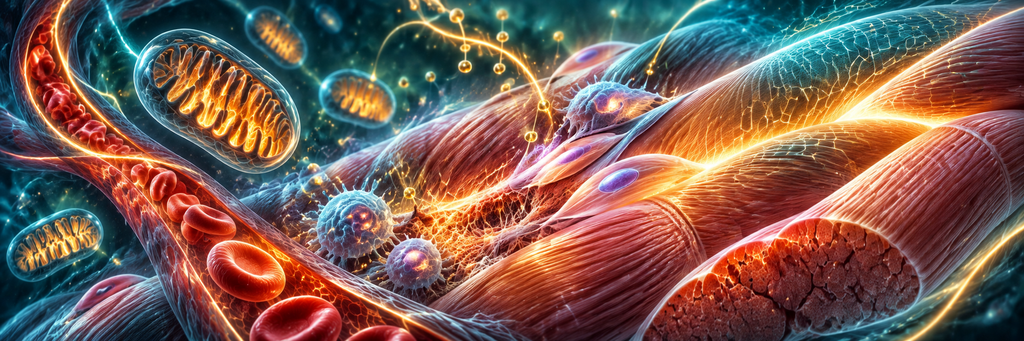
Muscle contraction requires adenosine triphosphate (ATP). During prolonged activity, mitochondria use oxygen and metabolic fuel to replenish much of that ATP. Endurance training can increase mitochondrial content and enzyme capacity, improve capillary networks, and change how muscle uses carbohydrates and fats.
MOTS-C is a mitochondrial-derived signaling peptide implicated in metabolic adaptation. A 2021 study reported increased endogenous MOTS-C after exercise in humans and better exercise performance following administered MOTS-C in mice. These are distinct observations: the study did not demonstrate a performance benefit from dosing humans with MOTS-C.
SS-31, or elamipretide, interacts with cardiolipin-associated mitochondrial membrane biology. It has a narrow approved medical indication for Barth syndrome, not general athletic enhancement.
Humanin is another mitochondrial-derived peptide studied for cellular stress, survival, and metabolic signaling, predominantly in preclinical research.
Oxygen delivery and VO₂max
VO₂max reflects the maximum rate of oxygen uptake and utilization during intense exercise. Cardiac output, hemoglobin and blood volume, microvascular delivery, and muscle oxidative capacity all matter. A compound that changes a mitochondrial marker does not automatically increase VO₂max, race speed, or sustained power.
Metabolic flexibility
Endurance athletes shift between glucose, muscle glycogen, and fat oxidation depending on exercise intensity and available fuel. Interventions that appear to promote fat metabolism in laboratory models may not improve performance, especially when carbohydrate oxidation is needed to sustain higher intensities.
Tissue repair and recovery
Adaptation requires a cycle of training stress and recovery. Tendons, muscles, and connective tissue respond to appropriately programmed loading. Peptides such as thymosin beta-4 are investigated for cell migration and repair processes, but there is no controlled human evidence that adding them to a mitochondrial peptide accelerates sports recovery.
3. Peptide Stacks Researchers and Communities Discuss
Stack 1: MOTS-C + SS-31
Research logic: Combine metabolic stress adaptation and AMPK-associated signaling (MOTS-C) with inner mitochondrial membrane-related protection (SS-31).
This is the most directly complementary mechanistic hypothesis among the proposed stacks. MOTS-C research considers how cells respond to altered energy demand; SS-31 research examines mitochondrial structural and functional biology. In principle, these approaches could address different bottlenecks in muscle energy production.
Evidence: MOTS-C has compelling laboratory and animal studies and observational human exercise-response evidence. SS-31 has human clinical experience in mitochondrial disease and an FDA accelerated approval for a specific Barth syndrome population. Neither compound, alone or together, has established exercise-performance benefits for healthy athletes in controlled combination trials.
Limitations: Extrapolating from rare-disease treatment or mouse endurance data to healthy athletes is not justified. Product quality, injection-related risks, renal considerations, and unknown interaction effects also matter. SS-31’s clinical benefit should not be generalized outside its approved condition.
Stack 2: MOTS-C + Humanin
Research logic: Pair two mitochondrial-derived peptides that appear to participate in stress response and metabolic communication through partly different signaling networks.
MOTS-C is of particular interest for metabolic adaptation. Humanin is studied for cell-survival pathways and resistance to selected cellular stressors. Researchers could explore whether the interaction affects skeletal muscle resilience or recovery from exercise-induced stress.
Evidence: Predominantly mechanistic and preclinical. There are no established human endurance outcomes or validated dosing and safety parameters for this combined approach.
Limitations: Cell survival and stress-signaling effects can be highly context-dependent. More anti-stress signaling is not necessarily better adaptation, and the long-term consequences of administering Humanin remain uncertain.
Stack 3: CJC-1295 + Ipamorelin
Research logic: CJC-1295 is a growth hormone-releasing hormone analogue; ipamorelin activates the ghrelin/growth-hormone secretagogue receptor pathway. The paired concept is to influence GH release through complementary endocrine mechanisms.
Evidence: Small human pharmacology studies have described GH and IGF-1 responses to CJC-1295, while other secretagogue studies examine acute GH release. These changes do not establish improvements in race performance, aerobic capacity, or injury recovery from the combination.
Limitations: Overlapping GH/IGF-1 signaling creates potential for edema, joint symptoms, altered glucose regulation, and endocrine unpredictability. CJC-1295 and ipamorelin are explicitly named in anti-doping prohibitions for GH-releasing factors and secretagogues. Hormone changes are not a substitute for actual endurance measurements.
Stack 4: MOTS-C + Full-Length Thymosin Beta-4 (or a Clearly Identified TB-500 Preparation)
Research logic: Combine metabolic signaling with experimental cell-migration and tissue-response pathways relevant to recovery from training stress.
Evidence: MOTS-C has animal performance research. Thymosin beta-4 has preclinical tissue-repair investigations. No controlled human trial establishes that this particular combination improves stamina or speeds recovery from athletic injuries.
Critical identity distinction: Full-length thymosin beta-4 is a 43-amino-acid peptide. The term TB-500 is used inconsistently by vendors and communities, sometimes referring to shorter fragments and sometimes to preparations marketed as full-length thymosin beta-4. These are not interchangeable research materials, and results from one cannot automatically be applied to the other.
Limitations: This is a highly speculative pairing. Both thymosin beta-4 and its derivatives, including TB-500, are identified on the WADA Prohibited List. Pain relief or perceived readiness does not verify that a tendon or muscle is structurally recovered.
Additional research comparisons: SS-31 + Humanin and MOTS-C + exercise training
SS-31 + Humanin combines distinct mitochondrial stress-related mechanisms but has no demonstrated human athletic synergy. It is a research hypothesis, not a validated performance stack.
MOTS-C + structured exercise is a more useful biological comparison than another injectable pairing. Exercise itself triggers endogenous metabolic and mitochondrial signals, including MOTS-C. Future research could ask whether an exogenous intervention adds anything beyond a matched training program, rather than merely changing biomarkers.
4. Comparing the Proposed Stacks
| Combination | Main pathways | Current evidence | What is not established | Key concern |
|---|---|---|---|---|
| MOTS-C + SS-31 | Metabolic adaptation + mitochondrial membrane biology | Separate preclinical work; SS-31 has a narrow approved indication | Additional endurance benefit in humans | Unknown combination safety; overstating clinical transfer |
| MOTS-C + Humanin | Mitochondrial signaling + cellular stress pathways | Mainly laboratory and animal | Race performance or recovery improvement | Uncertain long-term cell-signaling effects |
| CJC-1295 + Ipamorelin | GHRH + ghrelin/secretagogue receptors | Hormone-response studies, no proven endurance-stack benefit | Faster recovery, VO₂max, stamina | Endocrine adverse effects; anti-doping |
| MOTS-C + Thymosin beta-4 | Energy signaling + tissue response | Separate preclinical research | Faster athlete recovery or injury healing | Fragment identity, quality, anti-doping |
| SS-31 + Humanin | Cardiolipin-associated biology + stress response | Exploratory pathways | Functional synergy in healthy people | Unknown interaction profile |
| Exercise training alone | Mitochondrial biogenesis, cardiovascular adaptation, fuel use | Strong human outcome evidence | N/A; adaptations depend on programming | Overtraining and underfueling if poorly managed |
5. The Supplement Stack: What Actually Has Human Performance Evidence?
Supplements are best selected for the type of endurance activity, not simply combined into the longest possible list.
Creatine monohydrate
Creatine improves phosphocreatine availability for short, high-power efforts and repeated bursts. It is more compelling for interval work, sprint finishes, strength training, and repeated accelerations than for improving steady-state VO₂max. Weight gain from intracellular water may be a consideration in weight-bearing endurance sports. Evidence is stronger for exercise performance than for peptide synergy.
Beta-alanine
Beta-alanine increases muscle carnosine, which contributes to intracellular buffering. It can be useful for sustained high-intensity bouts, often around one to several minutes, or repeated demanding efforts. It is less likely to transform long, comfortable-pace endurance. Tingling is a common tolerability issue.
Beetroot nitrates
Dietary nitrate can increase nitric-oxide-related availability and influence exercise efficiency in some circumstances. Findings vary with training status, dose, exercise duration, oral microbiome factors, and individual response. It may matter more for particular submaximal or time-trial efforts than for elite aerobic capacity. People with low blood pressure or using blood-pressure medications need extra caution.
Electrolytes and fluids
Sodium and fluids can be important when long events, hot conditions, or substantial sweat losses increase dehydration risk. Replacement should reflect actual conditions and needs. Drinking excessively can cause exercise-associated hyponatremia; electrolytes are not a substitute for an appropriate drinking plan.
Citrulline
Citrulline can increase circulating arginine and is investigated for nitric oxide pathways, muscular work, and perceived fatigue. Performance results are inconsistent, particularly for endurance events. It should not be treated as interchangeable with the better-studied dietary nitrate approach. It may add to blood-pressure-lowering effects.
CoQ10
Coenzyme Q10 supports electron transport in mitochondria. This makes it mechanistically appealing, yet trials in otherwise healthy athletes have not consistently demonstrated meaningful endurance improvements. Specific deficiency states or medical contexts may be different.
Carbohydrate fueling and protein
Carbohydrate availability is central to higher-intensity endurance performance. Matching fuel intake to session demands, particularly for long training and racing, is often more consequential than adding a new supplement. Protein supports recovery and muscle maintenance, but additional protein does not replace sufficient carbohydrate during prolonged demanding exercise.
Caffeine, iron and vitamin D when appropriate
Caffeine has meaningful human performance evidence for some endurance events, but can increase anxiety, disrupt sleep, or worsen palpitations. Iron status should be assessed when fatigue, anemia, or low iron availability is suspected; unnecessary iron supplementation can be harmful. Vitamin D is important for general physiology, but supplementation above adequate status is not a proven endurance enhancer.

| Intervention | Most plausible role | Human performance evidence | Main limitation |
|---|---|---|---|
| Structured endurance training | Cardiac, vascular, and mitochondrial adaptation | Strong | Requires progressive programming and recovery |
| Carbohydrate fueling | Supports sustained higher-intensity exercise | Strong in appropriate events | GI tolerance; needs depend on duration |
| Caffeine | Reduced perceived effort / alertness | Strong to moderate, context-dependent | Sleep, anxiety, heart-rate effects |
| Creatine | Repeated high-power output | Strong for repeated power; mixed for pure endurance | Water-weight gain; no reliable VO₂max increase |
| Beta-alanine | Buffering during intense efforts | Moderate for selected short high-intensity work | Less relevant to steady aerobic exercise |
| Beetroot nitrates | Nitric-oxide-associated exercise efficiency | Mixed to moderate | Response varies; blood-pressure concerns |
| Electrolytes | Fluid and sodium replacement when indicated | Established physiological role | Overreplacement or overdrinking can harm |
| Citrulline | Nitric oxide precursor biology | Mixed/limited for endurance | Variable formulations and outcomes |
| CoQ10 | Mitochondrial electron transport | Limited/inconsistent for athlete performance | Mechanism does not prove ergogenic effect |
6. The Special Focus: Can an Exercise Mimetic Replace Training?
An exercise mimetic is an intervention intended to reproduce one or more molecular consequences of physical activity. That idea is scientifically compelling for people who cannot tolerate normal exercise because of serious illness, disability, or specific metabolic disorders. In those circumstances, even a partial recreation of exercise-associated signaling could potentially become clinically useful.
But endurance training is not a single molecular switch. It simultaneously influences stroke volume, vascular function, capillary density, muscle recruitment, mitochondrial capacity, glycogen handling, tendon tolerance, coordination, and psychological pacing. A substance affecting AMPK or mitochondrial stress biology might imitate one narrow signaling feature while leaving most adaptations unchanged.
The MOTS-C story illustrates the difference. Endogenous MOTS-C increases with exercise in humans, and giving MOTS-C to mice improved certain physical-capacity measures. To establish a human exercise-mimetic benefit, researchers would need randomized trials measuring meaningful outcomes such as time-trial performance, aerobic capacity, fatigue resistance, recovery, and quality of life, not simply blood peptide concentrations or molecular markers.
A rigorous combination trial should compare placebo, structured training, the experimental peptide alone, and training plus the peptide. It would also need to determine whether apparent gains persist without exposing participants to disproportionate safety risks.
More pathways are not automatically better. Blunting some stress signals too strongly might even interfere with adaptations driven by repeated exercise stress. Where an experimental pair changes overlapping endocrine or metabolic pathways, researchers must establish interaction safety before claiming synergy.
Competitive-sport and regulatory concerns
The 2026 World Anti-Doping Agency Prohibited List explicitly includes CJC-1295, ipamorelin, and thymosin beta-4 and its derivatives such as TB-500. Other unapproved pharmacological substances may fall within the S0 category or other prohibited classes. Athletes subject to testing should consult their anti-doping organization rather than assume an unnamed experimental peptide is permitted. Supplements also carry contamination risks, so third-party certified products are preferable where eligibility matters.
7. Where the Science Is Heading
The most interesting opportunities lie not in making stacks ever larger, but in finding where a drug can help people whose physiological limitations are not adequately addressed by existing care. Future research could explore mitochondrial therapies for defined disorders, interventions that help medically vulnerable individuals maintain muscle function, and tools that improve recovery without undermining normal adaptation.
For healthy athletes, the bar should be especially high. Future randomized studies should report sport-specific performance, clinically meaningful adverse events, long-term endocrine and metabolic outcomes, and whether any benefits exceed a training-and-nutrition program of equal intensity. Trials must identify exact compounds and formulations, particularly when names such as TB-500 refer to non-equivalent materials.
8. Explore the Compounds
- MOTS-C: Mitochondrial-derived metabolic signaling and exercise adaptation.
- SS-31 / Elamipretide: Mitochondrial inner membrane and cardiolipin-associated biology.
- Humanin: Cellular stress and mitochondrial-derived signaling.
- CJC-1295: Growth hormone-releasing hormone analogue research.
- Ipamorelin: Ghrelin receptor and growth hormone secretion research.
- Thymosin Beta-4: Cellular migration and tissue-remodeling research; distinguish full-length peptide from shorter TB-500 fragments.
Directory URLs follow the site’s established profile structure; check the exact URLs before publishing if any profile has been renamed.
Selected research and guidance
- Reynolds et al. (2021), MOTS-C, exercise, and physical performance.
- U.S. FDA (2025), elamipretide accelerated approval for Barth syndrome.
- NIH Office of Dietary Supplements, Dietary Supplements for Exercise and Athletic Performance.
- Deng et al. (2025), Network meta-analysis of sports supplements and performance.
- WADA, 2026 Prohibited List.
The Bigger Possibility
The future of endurance science may eventually include targeted therapies that improve energy production or support muscle function in specific clinical populations. That possibility deserves careful investigation. But for healthy athletes, actual training builds far more than mitochondrial signaling, and the best-supported performance improvements still come from intelligent programming, adequate fueling, sleep, and judicious use of proven supplements.
Medical and sports-safety disclaimer: This article is for research education only, not an instruction to obtain, combine, or self-administer experimental peptides. None of the proposed peptide stacks has established human endurance efficacy or a validated safety and dosing protocol. Consult qualified clinicians for medical conditions and the relevant anti-doping authority for competitive eligibility.