
From the hypothalamus to the ovaries and testes, fertility depends on precise hormonal communication. Established peptide medicines already support ovulation and sperm production in selected patients, while kisspeptin-based research may offer new ways to reproduce the body’s reproductive rhythms.

1. The Big Picture: Fertility Depends on Signals, Timing, and Healthy Cells
Fertility is often discussed as a question of having enough estrogen or testosterone. In reality, conception depends on an intricate sequence of events: brain signals must reach the pituitary gland, ovaries must develop and release an egg, testes must produce functional sperm, and the reproductive tract must support fertilization and early development. A change in any part of this sequence can alter the outcome.
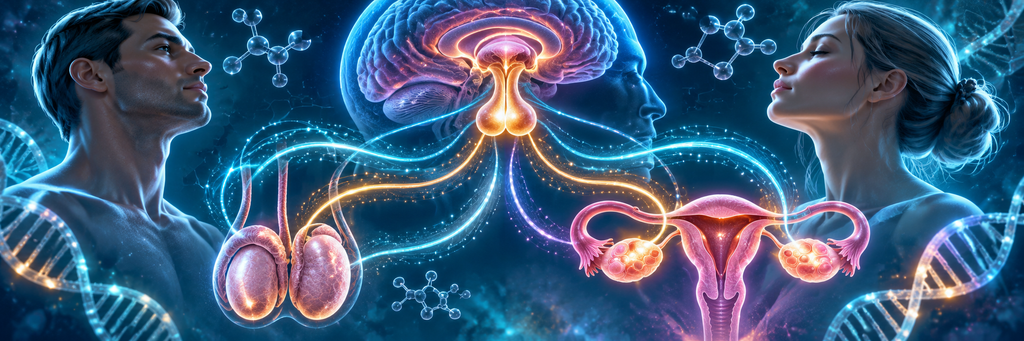
The hypothalamic-pituitary-gonadal (HPG) axis is central to this communication. It relies on small peptide signals such as kisspeptin and gonadotropin-releasing hormone (GnRH), and on larger protein hormones such as luteinizing hormone (LH), follicle-stimulating hormone (FSH), and human chorionic gonadotropin (hCG). Modern fertility medicine already uses several of these molecules, or medicines modeled after them.
The research is encouraging because it offers different ways to address different problems. Recombinant FSH supports follicle growth and, in selected men, sperm development. Pharmaceutical hCG provides an LH-like signal. GnRH analogues help control the timing of ovulation during assisted reproduction, while specialized pulsatile GnRH treatment can restore reproductive signaling in certain hypothalamic disorders. Kisspeptin-54 and experimental MVT-602 act farther upstream and may offer new approaches to controlling reproductive hormone surges.
But higher hormone levels do not automatically mean greater fertility. An LH surge, a mature egg, a better sperm count, a pregnancy, and a live birth are different outcomes. The strongest studies carefully distinguish them. No peptide currently offers a proven way to reverse age-related egg loss, correct every cause of infertility, or guarantee conception.
2. The Biological Pathways: Understanding the HPG Axis
Kisspeptin and GnRH: Starting the Conversation
Neurons in the hypothalamus release kisspeptin, which helps activate GnRH-producing neurons. GnRH travels to the anterior pituitary, where it stimulates the release of LH and FSH. These instructions arrive in pulses, not as a constant stream. Their timing matters because sustained stimulation by certain long-acting GnRH agonists can eventually suppress rather than increase pituitary output.
The Ovaries: Follicles, Ovulation, and Progesterone
In the ovaries, FSH supports follicle growth and estrogen production. LH participates in steroid production and, when an appropriate mid-cycle surge occurs, triggers the final maturation processes associated with ovulation. After ovulation, the corpus luteum produces progesterone that supports the uterine lining. If pregnancy begins, embryonic and placental hCG helps sustain the corpus luteum early on.
Assisted reproduction may separate these steps deliberately: clinicians stimulate follicle development, prevent premature ovulation, and then use a precisely timed signal to mature eggs for retrieval. This is why FSH, GnRH antagonists, hCG, and sometimes GnRH agonist triggers can all appear in the same fertility treatment plan without being interchangeable.
The Testes: Testosterone and Sperm Production Are Different Jobs
In the testes, LH stimulates Leydig cells to make testosterone. FSH acts primarily on Sertoli cells, which support developing sperm. Normal sperm production requires both appropriate local testosterone signaling and Sertoli-cell function, plus healthy reproductive anatomy. A blood testosterone level alone cannot confirm fertility.
A further complication is feedback. External testosterone can suppress LH and FSH, decreasing sperm production even while circulating testosterone increases. That is why fertility-focused evaluation differs from ordinary treatment of testosterone-deficiency symptoms.
Negative Feedback Keeps the System in Balance
Testosterone, estradiol, progesterone, and inhibin B feed information back to the brain and pituitary. These signals help prevent overproduction and coordinate reproductive timing. Hormones are therefore not simple switches that should always be turned upward.
A Diagnosis Determines Which Signal Matters
Fertility difficulties can reflect insufficient hypothalamic signaling, pituitary disorders, primary ovarian or testicular dysfunction, reproductive tract problems, age-related egg changes, genetic conditions, or multiple contributing factors. Tests may include cycle history, ovulation assessment, semen analysis, LH, FSH, testosterone or estradiol as appropriate, prolactin, thyroid studies, and imaging or other investigations when indicated. A measured hormone abnormality must be interpreted in context.
3. Compounds Researchers Are Exploring
Kisspeptin: An Upstream Approach to Egg Maturation
Explore Kisspeptin on Peptide Perspectives.
Kisspeptin activates the KISS1 receptor on reproductive hormone networks, promoting GnRH and then LH release. Unlike hCG, which acts directly on LH-like receptors in the gonads, kisspeptin works farther upstream.
In a 2015 Phase 2 trial of 60 women at high risk of ovarian hyperstimulation syndrome (OHSS), kisspeptin-54 triggered egg maturation in most participants; no moderate or severe OHSS was observed in that small study. A 2017 randomized Phase 2 trial of 62 women found that a second kisspeptin-54 exposure improved the proportion meeting a prespecified mature-egg yield outcome from 45% to 71%.
Research promise: More physiologic triggers could potentially help specialists control egg maturation while managing OHSS risk in selected IVF patients.
Limits: These studies used kisspeptin-54, not commercially marketed kisspeptin-10. They do not establish improved live-birth rates, routine safety across patient groups, or FDA approval. Kisspeptin is investigational for fertility treatment.
hCG: Direct LH-Like Stimulation
Explore hCG on Peptide Perspectives.
Human chorionic gonadotropin (hCG) is a naturally occurring placental glycoprotein hormone that acts at the LH/chorionic gonadotropin receptor. Pharmaceutical preparations have established uses for triggering final follicular maturation in selected fertility protocols and for supporting testicular testosterone production in certain men with hypogonadotropic hypogonadism.
For women undergoing ovarian stimulation, an hCG trigger provides a strong, sustained LH-like signal. In selected men, hCG can stimulate Leydig cells even when pituitary LH production is deficient. It does not replace every action of FSH, so some men require additional FSH treatment to support sperm development.
Research and clinical promise: hCG demonstrates that clinicians can target a specific missing hormonal signal and achieve meaningful reproductive outcomes in suitable patients.
Limits: hCG exposure during ovarian stimulation can contribute to OHSS risk. It is not a general fertility enhancer, a weight-loss medicine, or a substitute for diagnosis. Its effectiveness depends on the ovaries or testes being capable of responding.
Gonadorelin: Restoring the Pulse Rather Than Simply Adding a Hormone
Explore Gonadorelin on Peptide Perspectives.
Gonadorelin is a synthetic version of human GnRH. It stimulates pituitary release of both LH and FSH when administered in an appropriate pattern. In selected people with hypothalamic GnRH deficiency, specialized pump-delivered pulsatile GnRH therapy can induce ovulation or support testosterone and sperm production, provided the pituitary and gonads remain responsive.
This is one of reproductive medicine’s clearest examples of timing as treatment. A pump programmed to reproduce regular pulses is very different from occasional gonadorelin injections or the sustained exposure produced by long-acting agonists.
Research and clinical promise: Physiologic patterns may restore endocrine function in carefully selected hypothalamic disorders rather than directly replacing each downstream hormone.
Limits: Treatment is specialized and not a standard self-directed protocol; prior U.S. gonadorelin products were discontinued. Pulsatile GnRH does not repair primary ovarian or testicular failure, and occasional gonadorelin injections have not been established as a way to preserve fertility during testosterone therapy.
Recombinant FSH and Menotropins: Supporting Follicles and Spermatogenesis
Read the FDA-approved Gonal-f (follitropin alfa) prescribing information.
FSH is a pituitary glycoprotein hormone with established roles in fertility. In women, pharmaceutical FSH stimulates ovarian follicle growth for selected ovulatory disorders and assisted reproduction. In men with certain forms of hypogonadotropic hypogonadism, it can promote spermatogenesis, typically as part of treatment that also provides adequate LH-like stimulation.
Menotropins (hMG) supply FSH and LH activity and are another established tool for controlled ovarian stimulation. Products and indications differ, but the underlying purpose is specific: encourage appropriate follicle or sperm-cell development, not indiscriminately increase hormone levels.
Clinical promise: These therapies have decades of clinical use and demonstrate the practical value of supplying hormones that are missing or insufficient.
Limits: In ovarian stimulation, risks include OHSS and multiple pregnancy; monitoring with ultrasound and hormone testing is important. In men, treatment may take months and does not correct obstructive or primary testicular causes of infertility.
GnRH Antagonists: Preventing Premature Ovulation
Read the official Cetrotide (cetrorelix) prescribing information.
Cetrorelix and ganirelix are peptide-based GnRH receptor antagonists used in selected assisted reproductive protocols. They temporarily block pituitary GnRH signaling, helping prevent an LH surge before follicles are ready for planned egg retrieval.
That may sound like the opposite of fertility enhancement. In fact, it demonstrates how precise reproductive medicine must be: sometimes success requires delaying one step so a later step can occur at the right time.
Clinical promise: Antagonist-based stimulation is a standard strategy in assisted reproduction, and professional guidelines favor antagonist protocols when reducing OHSS risk is an important concern.
Limits: These are not everyday ovulation boosters. They require specialist planning and are contraindicated in specific situations, including pregnancy for certain products.
GnRH Agonists: One Receptor, Two Very Different Outcomes
Explore the ESHRE 2025 ovarian-stimulation guideline.
Leuprolide and triptorelin are GnRH agonists. When used briefly in an appropriate antagonist-based IVF cycle, a GnRH agonist can produce an endogenous LH/FSH surge for final egg maturation. But sustained agonist exposure desensitizes the pituitary, suppressing LH and FSH after an initial stimulation period. This same principle is used in other clinical settings to reduce sex-hormone production.
Clinical promise: Clinicians can use the timing of receptor activation to trigger maturation or suppress hormones for a clearly defined purpose. The 2025 ESHRE guideline recommends a GnRH agonist trigger with a freeze-all strategy for patients at risk of OHSS in appropriate IVF settings.
Limits: Trigger protocols depend on pituitary responsiveness and the broader IVF plan. Long-term GnRH suppression is not a fertility-enhancing treatment and can cause low-estrogen or low-testosterone symptoms and bone-related effects.
Recombinant LH: Supporting the Gonads More Directly
Explore the role of LH and related ovulation triggers in this reproductive physiology review.
Luteinizing hormone directly stimulates ovarian and testicular LH receptors. Pharmaceutical recombinant LH preparations, such as lutropin alfa in jurisdictions where available, have been studied or used in selected female gonadotropin-deficiency and assisted reproduction settings. Their regulatory availability and indications vary by country.
Recombinant LH is biologically different from hCG, even though both can activate the LH/CG receptor. The duration and pattern of receptor stimulation differ, which can affect how they are used during reproductive treatment.
Research promise: LH-specific approaches help explain whether a patient needs more pituitary stimulation, direct gonadal stimulation, or a carefully timed ovulation trigger.
Limits: LH preparations are not universal fertility boosters, and evidence for an additive benefit in every IVF patient is not established. In male hypogonadotropic infertility, clinicians more commonly use hCG as the LH-like component alongside FSH when indicated.
MVT-602: A New Generation of Kisspeptin Receptor Research
Explore the published MVT-602 human clinical studies.
MVT-602 is an investigational synthetic kisspeptin receptor agonist designed to produce more sustained reproductive hormone signaling than some forms of native kisspeptin. It targets the KISS1 receptor upstream of GnRH, rather than replacing LH or FSH directly.
In two randomized early-phase studies published in 2024, involving 24 healthy women without ovarian stimulation and 75 with minimal stimulation, MVT-602 produced dose-dependent LH responses. In the stimulated study, its hormone signal was more prolonged than that of some conventional triggers. These findings are interesting because they bring drug design closer to reproducing an appropriate biological rhythm.
Research promise: A longer-lasting, more controllable kisspeptin signal might eventually provide another approach to oocyte maturation or selected ovulatory disorders.
Limits: These were small, short-term pharmacology and ovulation studies, not trials establishing superior live birth or long-term reproductive safety. MVT-602 is not FDA-approved for infertility or general hormone optimization.
4. Comparing the Compounds
| Compound or pathway | Biological target | Main fertility interest | Evidence and U.S. status | Important limitation |
|---|---|---|---|---|
| Kisspeptin-54 / Kisspeptin-10 | KISS1 receptor upstream of GnRH | Experimental LH surge and egg maturation | Phase 2 human IVF studies for kisspeptin-54; investigational | Cannot transfer results to kisspeptin-10; live-birth benefit unproven |
| hCG | LH/CG receptor in gonads | Final egg maturation and testosterone stimulation in selected men | Established FDA-labeled reproductive uses | OHSS risk; not a replacement for FSH or treatment for all infertility |
| Gonadorelin | Pituitary GnRH receptor | Specialist pulsatile therapy for hypothalamic deficiency | Established human clinical history; U.S. products discontinued | Requires appropriate pulse pattern and responsive pituitary/gonads |
| FSH / menotropins | Ovarian granulosa and testicular Sertoli cells | Follicle development and sperm production | Approved fertility products with substantial clinical evidence | Monitoring needed; no benefit for all causes of gonadal failure |
| GnRH antagonists | Block pituitary GnRH receptor | Prevent premature LH surge during IVF | Approved and guideline-supported | Used to control timing, not enhance general fertility |
| GnRH agonists | Pituitary GnRH receptor, exposure-dependent | Egg maturation trigger; sustained suppression in other indications | Established product-specific clinical uses | A trigger and chronic suppression have opposite goals |
| Recombinant LH | LH/CG receptor | Selected gonadotropin-deficiency and IVF protocols | Human clinical use; availability varies by country | Not routinely useful for all patients; not interchangeable with hCG |
| MVT-602 | Investigational KISS1 receptor agonism | More sustained LH response, ovulation-trigger research | Small randomized Phase 1/2a human trials; not FDA-approved | No confirmed live-birth advantage or long-term safety data |
Evidence perspective: A measurable LH increase, mature oocyte retrieval, sperm appearing in a semen sample, pregnancy, and live birth are separate milestones. They should not be presented as equivalent proof that a new peptide improves fertility.
5. Where the Science Is Heading
More Physiological Ovulation Triggers
The biggest opportunity for kisspeptin-54 and MVT-602 may be more individualized egg-maturation signals that resemble the body’s reproductive timing. Early trials show that the approach is biologically active. Next-generation studies need to compare live births, OHSS, pregnancy complications, and neonatal outcomes with established approaches rather than focusing only on hormone curves.
Protecting Fertility While Treating Hormone Deficiency
In men, a treatment that raises testosterone may or may not preserve sperm production. The AUA/ASRM male infertility guideline advises against exogenous testosterone for men seeking current or future fertility because it can suppress gonadotropins and sperm production. In appropriately diagnosed hypogonadotropic infertility, clinician-guided hCG and FSH strategies can target testicular function instead.
Precision Treatment for the Source of the Problem
A person with hypothalamic GnRH deficiency may benefit from a completely different intervention than someone with primary ovarian insufficiency, obstructed sperm transport, diminished sperm production from testicular damage, or age-associated egg changes. More hormone is not necessarily the right answer. Research into biomarkers, hormone pulsatility, genetic causes, and reproductive imaging may improve treatment matching.
Making Fertility Treatment Safer
OHSS is a potentially serious complication of ovarian stimulation. Professional guidelines increasingly favor individualized gonadotropin regimens and appropriate GnRH antagonist and trigger strategies for people at higher risk. Emerging kisspeptin approaches must meet the same standard: better outcomes without avoidable complications.
Understanding Reproductive Aging Without Overpromising
Scientists are examining follicle biology, ovarian aging, and the signals that control reproductive development. But no peptide has been shown in rigorous human trials to create new eggs, reverse menopause, restore fertility after irreversible primary gonadal failure, or repair all causes of abnormal sperm production. Reproductive biology can advance without turning preliminary discoveries into promises of rejuvenation.
Measure What Matters to Patients
The strongest future trials will assess live birth, time to pregnancy, complications, healthy pregnancies, sperm development, quality of life, and safety, with careful attention to the physical and emotional demands of fertility care. That is how promising peptide science becomes reliable clinical care.

6. Explore the Compounds and Research
Direct Peptide Perspectives profiles:
- Kisspeptin: Reproductive signaling and experimental IVF triggers
- hCG: LH-like stimulation, testosterone and ovulation
- Gonadorelin: Pulsatile GnRH and pituitary hormone control
Clinical and research resources:
- Kisspeptin-54: Phase 2 IVF and OHSS-risk research
- Kisspeptin-54: Randomized second-dose trial
- MVT-602: Randomized early human endocrine studies
- Gonal-f: FDA-approved recombinant FSH information
- Cetrotide: FDA-approved GnRH antagonist information
- ESHRE 2025 guideline: Ovarian stimulation and OHSS prevention
- AUA/ASRM: Male infertility evaluation and therapy
Follitropin alfa, menotropins, cetrorelix, leuprolide/triptorelin, recombinant LH, and MVT-602 are linked to clinical resources because dedicated public Peptide Perspectives profiles were not confirmed for those products. Kisspeptin-54 trial findings are distinct from the Kisspeptin-10 directory profile.
The Bigger Possibility
The future of fertility treatment may be shaped not by pushing reproductive hormones higher, but by understanding which signal is missing, where it needs to act, and when it should arrive. Established hCG, FSH, and GnRH-based therapies show how powerful that precision already is. Kisspeptin research adds a compelling upstream possibility: supporting the body’s own hormonal instructions rather than replacing every signal downstream.
The most meaningful scientific progress will be measured in safer treatment, greater reproductive choice, and more healthy pregnancies, supported by careful human evidence.
Peptide Perspectives offers educational research information, not individualized fertility or medical advice. Hormonal treatments for fertility require diagnosis, product-specific precautions, and specialist monitoring. Kisspeptin-based fertility triggers and MVT-602 remain investigational. Unregulated research products may have unknown identity, purity, sterility, and long-term safety. Do not replace established fertility care with research peptides or self-direct hormone protocols.