
From the endothelial lining of blood vessels to the mitochondria that power every heartbeat, peptide science is helping researchers explore cardiovascular health from several directions. Some compounds already have strong human outcome data, while others remain intriguing laboratory discoveries.
1. The Big Picture: Cardiovascular Health Is More Than a Strong Heartbeat
The heart beats roughly 100,000 times in a typical day, pushing blood through an enormous network of arteries, capillaries, and veins. That network is far more than plumbing. Blood vessels continually change their diameter, respond to inflammation, transport oxygen and nutrients, and communicate with the heart, kidneys, brain, and metabolic tissues.
Keeping this system healthy is a major part of healthspan, the years of life spent with good function and independence. Cardiovascular aging involves changes in artery flexibility, the lining of blood vessels, cellular energy use, inflammatory activity, and how heart muscle responds to stress.
Peptides are particularly interesting because they already function as biological messengers. Hormone-like peptides influence appetite and blood sugar; tiny bioregulators are being investigated for cellular signaling; mitochondrial peptides reveal how heart cells handle stress; and the body makes its own peptides to help regulate vascular tone.
But all peptides do not offer the same level of cardiovascular evidence. Semaglutide has reduced major cardiovascular events in a large randomized trial and has a specific FDA-approved cardiovascular indication. Tirzepatide has shown benefits in selected heart-failure and diabetes populations. SS-31 (elamipretide) has an approved use in a rare mitochondrial disease, but broader heart-failure trials have been less convincing. Cardiogen and Vesugen are at a much earlier, preclinical stage.
That spectrum of findings is encouraging. It shows both what peptide medicine has achieved and where basic science could lead next.
2. The Biological Pathways: Four Systems That Help Keep the Heart and Vessels Healthy
Endothelial Function: The Intelligent Inner Lining
Every blood vessel is lined by endothelial cells. These cells help control blood flow, blood clotting, the movement of immune cells, and how freely a vessel expands or contracts. One of their key signals is nitric oxide (NO), which relaxes vascular smooth muscle and helps maintain healthy vessel function.
With aging, high blood pressure, diabetes, smoking, and chronic inflammation, nitric-oxide availability may decline and the endothelium can become less responsive. Researchers can study these changes using measurements such as flow-mediated dilation, but improvement in a laboratory vessel marker does not necessarily prove a reduction in heart attacks.
The vascular bioregulator Vesugen (KED) is being investigated for endothelial-cell behavior in culture. The natural peptide angiotensin-(1–7) is studied because its Mas-receptor pathway may influence nitric-oxide signaling and vascular tone.
Mitochondrial Protection: The Energy Behind Every Beat
Heart muscle cells require a continuous supply of ATP to contract and relax. Their mitochondria are densely packed and vulnerable to oxygen deprivation, especially when blood flow returns after an interruption, a phenomenon known as ischemia–reperfusion injury.
SS-31 is studied for binding cardiolipin, a lipid important to the inner mitochondrial membrane. Humanin, a mitochondria-associated signaling peptide, has shown protective effects in experimental cardiac injury models. MOTS-c is being investigated for metabolic adaptation, although most of its research involves skeletal muscle and glucose regulation rather than direct human heart treatment.
Inflammation, Metabolism, and Atherosclerosis
Atherosclerotic plaque develops over years through interactions among cholesterol-containing particles, inflammation, endothelial injury, and immune cells in artery walls. Obesity, insulin resistance, and high blood pressure can add to this burden.
Here, semaglutide and tirzepatide offer a strong clinical example of how a peptide-based treatment can improve cardiovascular health through interconnected metabolic pathways. Their benefits need not mean that a drug directly repairs heart muscle. Weight reduction, blood-sugar control, blood-pressure changes, and other effects may all contribute, with the exact proportions still being studied.
Cardiovascular Aging: Remodeling, Fibrosis, and Cellular Senescence
Over time, blood vessels may stiffen and heart muscle may undergo remodeling. Fibrosis can alter the tissue’s ability to relax and function. Senescent cells can contribute to inflammatory signaling in vascular tissues, but senescence also has protective roles.
Short Khavinson bioregulators such as Cardiogen and Vesugen provide research tools for probing proliferation-associated proteins and cellular regulation. Yet changing an isolated cell’s behavior is not the same as reversing artery stiffness, scar tissue, or clinical cardiovascular aging.
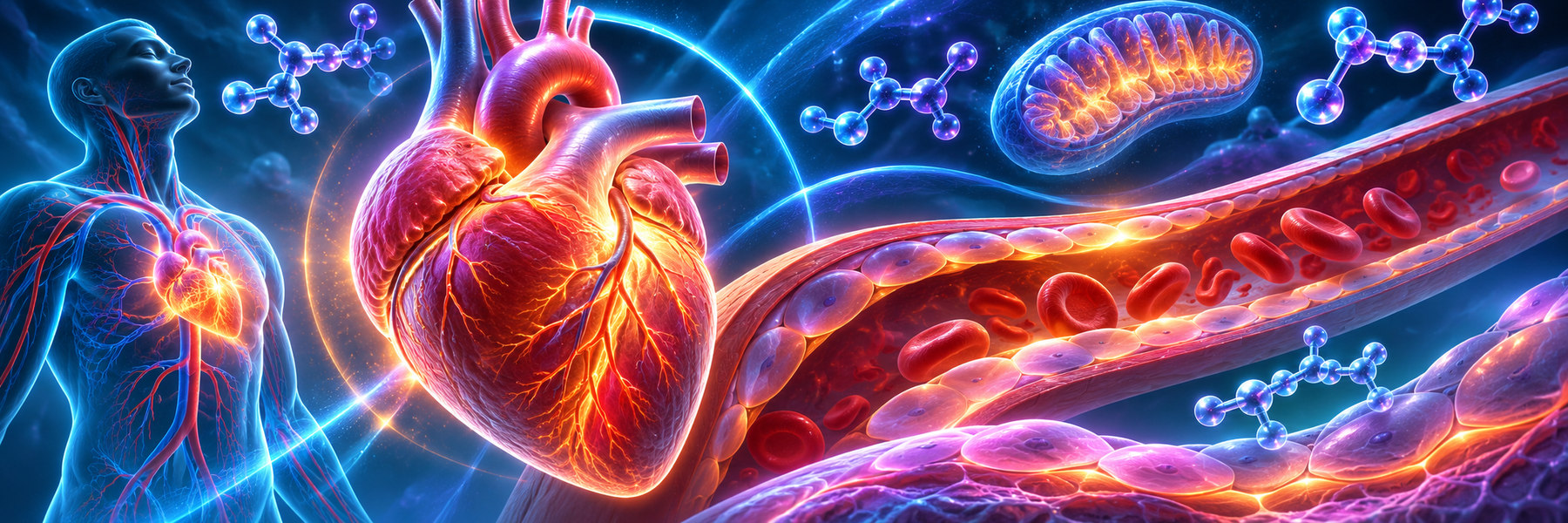
Illustration: healthy circulation depends on responsive endothelial cells, stable blood flow, and many coordinated molecular signals.
3. Compounds Researchers Are Exploring
SS-31 (Elamipretide): Protecting the Heart’s Cellular Power Supply
Explore the SS-31 profile on Peptide Perspectives.
SS-31 is a synthetic tetrapeptide designed to interact with cardiolipin within mitochondrial membranes. In laboratory and animal studies, it has influenced mitochondrial function and oxidative-stress responses relevant to heart injury and age-associated cardiac changes.
A significant milestone came on September 19, 2025, when the FDA granted accelerated approval to elamipretide, marketed as Forzinity, for improving muscle strength in eligible people with Barth syndrome, a rare mitochondrial disorder often associated with heart disease. This was not an approval for routine treatment of heart failure, aging, or coronary artery disease.
The distinction matters: in the PROGRESS-HF randomized trial, involving 71 patients with heart failure and reduced ejection fraction, four weeks of elamipretide did not significantly improve the primary measure of left ventricular remodeling compared with placebo. An earlier heart-attack study also did not show a reduction in infarct size.
Why it matters: SS-31 demonstrates that the mitochondrial membrane is a real therapeutic target. Its next challenge is showing which specific cardiac conditions, if any, benefit from treatment, using meaningful clinical outcomes. Pharmaceutical elamipretide and research-market SS-31 should not be assumed interchangeable.
Cardiogen (AEDR): A Bioregulator Focused on Heart-Tissue Signaling
Explore Cardiogen on Peptide Perspectives.
Cardiogen, or Ala-Glu-Asp-Arg (AEDR), is a synthetic tetrapeptide associated with the Khavinson bioregulator research tradition. It has been investigated for effects on myocardial-cell behavior, cell-structure proteins, and signaling related to cellular survival.
A 2009 study of cultured heart tissue from young and older rats reported increased proliferation-associated activity and reduced expression of p53, a protein involved in cellular stress responses and tumor suppression.
This is a legitimate laboratory observation, but it does not show that Cardiogen regrows damaged human heart muscle, improves ejection fraction, prevents heart attacks, or reverses fibrosis. Lower p53 expression also raises important unanswered questions about where and when such effects might be desirable.
Why it matters: Cardiogen opens a line of research into how very short peptide sequences might influence the cellular response to aging or injury. The next step would be independent reproduction followed by experiments testing function and safety in living systems. There is no validated human cardiovascular treatment protocol.
Vesugen (KED): Investigating the Aging Endothelium
Read the primary Vesugen endothelial-cell research.
Vesugen, or Lys-Glu-Asp (KED), is a synthetic tripeptide associated with vascular bioregulator research. Whereas Cardiogen is mainly linked with heart-muscle tissue experiments, Vesugen has been investigated in relation to endothelial-cell proliferation and aging.
A 2014 study reported changes in the proliferation-associated marker Ki-67 in animal-derived tissue and vascular endothelial cell cultures. The authors also presented molecular-docking results suggesting possible interactions with a gene promoter; docking is a computational hypothesis, not proof that KED enters living human cells and regulates those genes.
Much of this literature comes from a limited research network, and independent, adequately controlled human trials demonstrating better circulation, blood pressure, or vascular outcomes are lacking.
Why it matters: Vesugen draws attention to the endothelium as a potential aging-related target. A future human study could directly measure endothelial function and arterial stiffness rather than relying only on laboratory proliferation markers. A public Peptide Perspectives directory profile for Vesugen could not be verified when this article was prepared.
Semaglutide: Cardiovascular Protection Demonstrated in Human Trials
Explore Semaglutide on Peptide Perspectives.
Semaglutide is a synthetic GLP-1 receptor agonist used in FDA-approved prescription medicines for specific metabolic conditions. Unlike experimental cardiovascular bioregulators, it has been tested in large trials measuring actual heart attacks, strokes, and cardiovascular deaths.
In the SELECT trial, involving 17,604 adults with established cardiovascular disease and overweight or obesity but without diabetes, a major cardiovascular event occurred in 6.5% of participants assigned semaglutide versus 8.0% assigned placebo. That corresponds to an approximately 20% relative reduction over the trial’s follow-up period.
In March 2024, the FDA approved a specific Wegovy indication to reduce cardiovascular death, heart attack, and stroke in adults with established cardiovascular disease and overweight or obesity. This does not mean that every semaglutide product or every person has the same indication or expected benefit.
Why it matters: Semaglutide shows how metabolic peptide signaling can lead to tangible cardiovascular protection. Scientists are now investigating which effects result from weight loss, improved metabolic health, and potential changes in inflammatory or vascular pathways.
Tirzepatide: Connecting Weight, Diabetes, and Heart Failure
Explore Tirzepatide on Peptide Perspectives.
Tirzepatide acts on both GIP and GLP-1 receptors. Its strong effects on body weight and glucose regulation have made it an important focus of cardiometabolic research.
The SUMMIT trial enrolled 731 people with obesity and heart failure with preserved ejection fraction (HFpEF). Cardiovascular death or worsening heart failure occurred in 9.9% of participants receiving tirzepatide versus 15.3% receiving placebo. Participants also reported better heart-failure-related health status. The trial did not establish a reduction in cardiovascular death alone.
A different study, SURPASS-CVOT, compared tirzepatide with dulaglutide, an active GLP-1 medication, in people with type 2 diabetes and established cardiovascular disease. Tirzepatide was noninferior, meaning it was not meaningfully worse within the prespecified trial margin, but it did not establish statistical superiority over dulaglutide for the primary heart attack, stroke, and cardiovascular-death composite.
Why it matters: Tirzepatide offers a powerful way to study how obesity-related metabolic changes affect heart-failure symptoms and cardiovascular outcomes. It is FDA-approved for selected obesity, diabetes, and sleep-apnea indications depending on the product, but should not be described as universally approved to prevent heart attacks or treat all heart failure.
Humanin: Mitochondrial Stress Responses in Heart Tissue
Explore Humanin on Peptide Perspectives.
Humanin is a mitochondria-associated peptide studied for effects on cell-survival pathways and stress responses. Its cardiovascular research focuses partly on what happens when heart tissue briefly loses oxygen and then blood flow returns.
In rat ischemia–reperfusion experiments, Humanin-related treatment reduced selected measures of infarct injury and mitochondrial dysfunction. A 2024 study explored possible protective effects involving lymphatic endothelial cells and mitophagy, the process of recycling damaged mitochondria.
Why it matters: Humanin may help researchers connect mitochondrial quality control with the survival of stressed heart and vessel cells. These are preclinical signals, not evidence that taking Humanin reduces human cardiac risk or safely treats an active heart attack.
MOTS-c: Metabolic Flexibility and Vascular-Aging Questions
Explore MOTS-c on Peptide Perspectives.
MOTS-c is an endogenous mitochondria-derived peptide studied for metabolic adaptation and AMPK-associated signaling. Experimental research has linked it to glucose regulation, insulin sensitivity, and physical performance in animals.
Why include it in a cardiovascular article? Metabolic health influences blood pressure, inflammation, body composition, and long-term vascular risk. MOTS-c may provide clues about how mitochondrial signals coordinate some of those processes.
However, most intervention evidence is preclinical, and existing human studies are largely observational. There is no established trial showing administered MOTS-c prevents heart attacks, improves blood-vessel function, or reduces heart-failure hospitalizations.
Why it matters: MOTS-c is a promising research tool for connecting metabolism with vascular aging, even though its direct cardiovascular benefits in humans remain unproven.
Angiotensin-(1–7): A Natural Peptide in the Blood-Pressure System
Explore the published angiotensin-(1–7) research.
Angiotensin-(1–7) is a naturally occurring seven-amino-acid peptide within the renin–angiotensin system, which helps regulate blood pressure and fluid balance. It interacts with the Mas receptor, a pathway often discussed as a counterbalance to certain effects of angiotensin II.
Animal and mechanistic studies link angiotensin-(1–7) signaling to endothelial nitric-oxide release, vasodilation, and changes in cardiac remodeling, inflammation, and fibrosis.
Why it matters: It offers an elegant example of a peptide already embedded in cardiovascular physiology. Researchers are investigating whether aspects of this pathway might be targeted more precisely. It is not an FDA-approved general circulation or blood-pressure peptide treatment, and it should not be confused with established ACE inhibitors or angiotensin-receptor blockers.
Illustration: the future of cardiovascular medicine may involve better metabolic control, mitochondrial resilience, and more precise vascular signaling.
4. Comparing the Compounds
| Compound | Primary mechanism | Main cardiovascular research interest | Evidence level and regulatory status | Key limitations |
|---|---|---|---|---|
| SS-31 / Elamipretide | Cardiolipin binding and mitochondrial-membrane effects | Myocardial energy, reperfusion injury, selected mitochondrial disorders | Human randomized trials; FDA accelerated approval in eligible Barth syndrome patients | Heart-failure primary endpoints not met in PROGRESS-HF; no approval for general cardioprotection |
| Cardiogen / AEDR | Laboratory proliferation and p53-related signaling | Heart-cell resilience and tissue aging | Rat heart-tissue cultures; mechanistic studies; not FDA-approved | No human cardiac-function trials, dosing, or long-term safety evidence |
| Vesugen / KED | Endothelial Ki-67 and proposed gene-regulation pathways | Vascular cell aging and endothelial response | Preclinical cell and tissue studies; not FDA-approved | No validated human circulation or cardiovascular-outcome benefit |
| Semaglutide | GLP-1 receptor signaling; metabolic and risk-factor effects | Prevention of major cardiovascular events in eligible high-risk adults | Large randomized trials; FDA-approved cardiovascular indication for specific Wegovy populations | Product-specific indication; gastrointestinal and other established prescription risks |
| Tirzepatide | Dual GIP/GLP-1 receptor signaling | HFpEF with obesity, cardiometabolic risk, major events in diabetes | Large randomized human trials; FDA-approved for specific metabolic/OSA uses | Not superior to dulaglutide for SURPASS-CVOT primary composite; not a universal heart-failure treatment |
| Humanin | Mitochondrial stress and cell-survival signaling | Ischemia–reperfusion and endothelial injury | Cell and animal research; not FDA-approved | No controlled human cardiovascular efficacy or safety data |
| MOTS-c | Mitochondrial-derived AMPK-associated metabolic signals | Metabolic flexibility and vascular aging | Mainly preclinical; human observational evidence; not approved | No established direct cardiovascular benefit in humans |
| Angiotensin-(1–7) | Mas-receptor and nitric-oxide signaling | Vascular tone, blood pressure, remodeling | Established physiological pathway; chiefly mechanistic and animal treatment research | No approved general cardiovascular peptide treatment or proven prevention of major events |
The evidence ladder matters. A reduction in a cultured cell’s stress marker is an interesting mechanism. A change in blood pressure or vessel dilation is a measurable physiological effect. Fewer heart attacks, strokes, hospitalizations, or deaths in a randomized human trial provide much stronger evidence of clinical benefit.
5. Where the Science Is Heading
1. From Risk Factors to Real Cardiovascular Outcomes
Semaglutide and tirzepatide are helping reshape cardiovascular research because their trials examine outcomes that matter to patients, not just blood sugar or body weight. Future studies will continue separating improvements driven by weight loss from direct or indirect effects on cardiovascular biology.
2. More Precise Endothelial and Vascular-Aging Research
The endothelium is a compelling target because it can be assessed through well-characterized tests. Vesugen-related research would be strengthened by independent studies of flow-mediated dilation, vascular inflammation, arterial stiffness, and longer-term clinical outcomes.
More proliferating endothelial cells are not necessarily healthier endothelial cells. Their ability to respond appropriately to nitric oxide, resist injury, and maintain normal clotting regulation is ultimately more important.
3. Better Mitochondrial Trials in the Right Patients
SS-31’s rare-disease approval shows the possibilities of highly targeted medicine, while its heart-failure trial results illustrate why biological plausibility is not enough. The next research priority is matching mitochondrial mechanisms to diseases and patients most likely to benefit.
4. Testing Bioregulators Without Overstating Tissue Specificity
Cardiogen (AEDR) and Vesugen (KED) represent two different hypotheses within the short-peptide bioregulator field: myocardial cell regulation and vascular endothelial signaling.
Other bioregulators, such as Epitalon and Cartalax, are sometimes included in broader healthy-aging discussions, but their proposed effects on telomeres or connective tissues do not establish direct heart or vascular benefits. No clinical trial has validated a combined cardiovascular bioregulator protocol.
The most useful next steps would include independently replicated molecular research, pharmacokinetic and toxicity studies, and carefully designed human trials with meaningful vascular and cardiac endpoints.
5. Measuring What Better Heart Health Actually Means
Potential future studies should go beyond isolated laboratory signals to ask whether people have fewer cardiovascular events, improved exercise tolerance, better quality of life, or less progression of measurable disease.
Useful research measures include blood pressure, lipids, HbA1c, NT-proBNP, echocardiography, cardiac MRI, arterial stiffness, flow-mediated dilation, and adjudicated major cardiovascular events. Not every measure applies to every compound, and no one biomarker proves longevity.
6. Keeping Proven Prevention at the Center
The greatest current opportunities for reducing cardiovascular disease still include controlling blood pressure and cholesterol, avoiding tobacco, remaining physically active, improving nutrition and sleep, and using evidence-based medications for those who need them.
Emerging peptide science is most promising when it adds validated options rather than distracting from treatments that already prevent heart attacks, strokes, and hospitalizations.
6. Explore the Compounds and Research
Direct Peptide Perspectives profiles
- SS-31 (Elamipretide): Mitochondrial membrane protection
- Cardiogen (AEDR): Experimental heart-tissue bioregulation
- Semaglutide: GLP-1 signaling and cardiovascular protection
- Tirzepatide: Dual incretin signaling and cardiometabolic health
- Humanin: Mitochondrial stress and cell-survival research
- MOTS-c: Metabolic adaptation and cellular signaling
Additional cardiovascular peptide research
- Vesugen (KED): Primary endothelial-cell aging research
- Angiotensin-(1–7): Mas-receptor and cardiovascular signaling
- Semaglutide: The SELECT cardiovascular outcomes trial
- Tirzepatide: The SUMMIT heart-failure trial
- Tirzepatide: The SURPASS-CVOT trial
- Cardiogen: Rat myocardial tissue-culture study
Vesugen and angiotensin-(1–7) are linked to published research because dedicated public Peptide Perspectives profiles could not be verified at the time of writing.
The Bigger Possibility
The future of cardiovascular medicine may be shaped by approaches that support healthier blood vessels, more resilient mitochondria, better metabolic regulation, and more targeted protection of heart tissue.
We already have powerful evidence that peptide-based metabolic medicines can reduce meaningful cardiovascular risks in selected patients. At the same time, Cardiogen and Vesugen offer intriguing but early-stage questions about cellular and vascular aging.
The real promise is not one peptide that protects every heart. It is a future where research can identify the right biological pathway for the right cardiovascular problem and prove that it makes people’s lives better.
Peptide Perspectives provides educational research coverage, not individual medical advice. Cardiogen, Vesugen, Humanin, MOTS-c, and angiotensin-(1–7) are not FDA-approved treatments for cardiovascular disease. SS-31’s FDA accelerated approval applies to a particular rare-disease indication, not general heart health. Heart attack symptoms, new chest pain, sudden shortness of breath, and stroke symptoms require urgent medical care. Established cardiovascular treatments should not be replaced by unapproved research peptides.