
Can we stay stronger, sharper, and more resilient as the years pass? Researchers are discovering how cellular senescence, mitochondrial health, telomere biology, and short peptide bioregulators may help explain why our bodies age differently, and where future therapies might intervene.
1. The Big Picture: Living Longer Versus Living Better
For much of medical history, the central goal was simply to prevent early death. That goal remains essential. But modern longevity research asks a more personal question: What if more of our later years could be spent with strength, mobility, cognitive clarity, and independence?
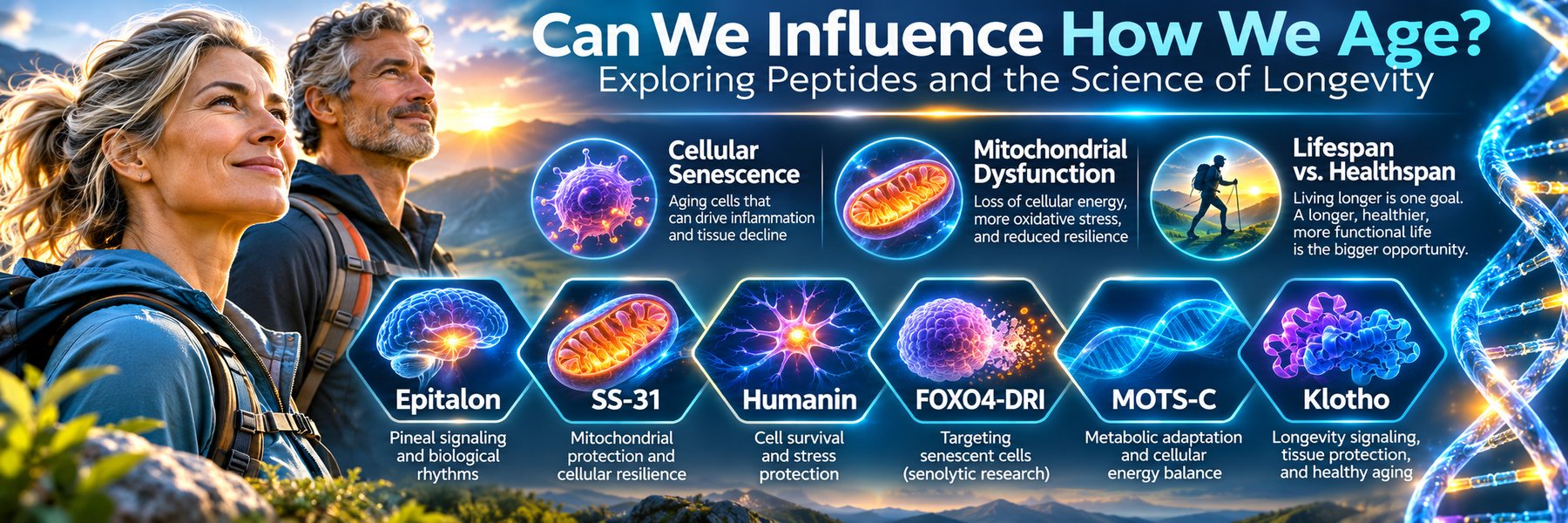
Scientists distinguish lifespan, the total number of years a person lives, from healthspan, the years lived in reasonably good health and function. Healthspan is measured in different ways across studies, including the years before major disease, disability, or declining physical performance. A longer lifespan is valuable; a longer healthy lifespan may matter even more in everyday life.
Aging is not one process controlled by a single gene, peptide, or hormone. It involves interacting changes in how cells repair DNA, manage energy, respond to inflammation, communicate with neighbors, and replace damaged parts. Those changes can begin long before a person notices symptoms.
That complexity makes the science exciting. Rather than searching only for a miracle molecule, researchers are identifying distinct biological processes that might be modified. Epitalon relates to telomere and circadian research; SS-31 targets mitochondrial membranes; Humanin and MOTS-c are signals derived from mitochondrial biology; FOXO4-DRI probes the removal of senescent cells; Klotho is a protective protein associated with healthy-aging pathways. The Khavinson bioregulators, including Pinealon and Livagen, raise additional questions about how very short peptides may influence cellular signaling.
The critical distinction is that extending the life of a cultured cell, improving a mouse’s endurance, and helping a human live longer are three different scientific outcomes. None of the experimental compounds in this article has been shown in a rigorous trial to extend human lifespan or broadly slow human aging.
2. The Biological Pathways: Why Cells Change With Age
Cellular senescence: when protective shutdown becomes persistent
Cells sometimes stop dividing after repeated stress, damaged DNA, or critically shortened telomeres. This is called cellular senescence. It can be beneficial: senescence helps suppress uncontrolled cell growth and participates in wound healing. Problems emerge when certain senescent cells accumulate and release inflammatory molecules, sometimes called the senescence-associated secretory phenotype (SASP), that disturb nearby tissue.
Researchers distinguish senolytics, which aim to eliminate selected senescent cells, from senomorphics, which try to change their behavior without killing them. FOXO4-DRI is an experimental senolytic concept; it is not a proven treatment for human aging. And because senescent cells can have protective roles, indiscriminate removal would not necessarily be desirable.
Mitochondrial dysfunction: more than a weak battery
Mitochondria help turn nutrients into usable ATP, but they also influence metabolic signaling, inflammation, and cell survival. With age and disease, some tissues become less able to maintain, adapt, and recover their mitochondrial networks. Those shifts can reduce metabolic flexibility and resilience.
SS-31 is being investigated for a structural problem: the integrity of mitochondrial membranes. MOTS-c explores how mitochondria communicate metabolic demands, while Humanin is studied for cell-stress and survival signaling. These are different approaches, not interchangeable energy boosters.
Telomeres, DNA repair, and epigenetic regulation
Telomeres cap the ends of chromosomes. They often shorten as dividing cells replicate; severe dysfunction can trigger senescence. Telomerase can maintain telomeres in certain cells, but permanently expanding proliferative capacity is not automatically safe, especially in relation to cancer biology.
Meanwhile, epigenetic regulation affects how genes are expressed without changing the DNA sequence. This is why researchers study short bioregulator peptides, although proposed direct interactions with DNA or chromatin are not yet equivalent to clinically demonstrated gene regulation in humans.
Inflammation, immune aging, and tissue repair
Aging also changes the immune system and can increase chronic low-grade inflammation, often called inflammaging. That can interact with mitochondrial stress, impaired tissue repair, and disease risk. A treatment that shifts an inflammatory marker might be interesting, but researchers must still show that the shift improves actual function or reduces illness.
Klotho and nutrient signaling
Alpha-Klotho is a large membrane-associated and circulating protein, not a small research peptide. It has important roles in mineral balance, including interactions with FGF23, and is being investigated for broader protective effects in kidney, vascular, metabolic, and neurological biology. Genetics and animal studies have made it a compelling longevity-related target, but a blood Klotho result is not a validated biological-age clock.
3. Compounds Researchers Are Exploring
Epitalon (Epithalon): Telomeres and pineal bioregulation
Explore Epitalon on Peptide Perspectives
Epitalon, also written Epithalon or AEDG, is a four-amino-acid synthetic peptide associated with Vladimir Khavinson’s bioregulator program. It has been studied for effects on telomerase, telomere maintenance, circadian signaling, and selected aging-related pathways.
A 2025 human cell-culture study reported telomere extension in normal cell lines and unexpectedly in breast-cancer cell lines through differing mechanisms. The article received a correction later that year. This is meaningful mechanistic work, but it is not evidence that Epitalon lengthens life in humans, and the findings reinforce the need to investigate cancer-related safety.
A 2026 evidence review found limited human biomarker and retinal research, with no adequately powered trial establishing a clinical longevity benefit. Historical reports of improved survival in older adults largely involved Epithalamin, a pineal-derived peptide extract, rather than synthetic Epitalon. They must not be treated as the same intervention.
Why researchers are interested: Epitalon may help clarify how telomere biology, circadian regulation, and cell maintenance intersect. The possibility is scientifically provocative; human lifespan extension remains unproven.
SS-31 (Elamipretide): Protecting the mitochondrial membrane
Explore SS-31 on Peptide Perspectives
SS-31, known pharmaceutically as elamipretide, is a synthetic tetrapeptide that binds cardiolipin, a lipid important to the structure and performance of mitochondrial inner membranes. Rather than trying to stimulate every cell, it targets a specific part of mitochondrial biology.
In September 2025, the FDA granted accelerated approval of Forzinity (elamipretide) to improve muscle strength in adults and children with Barth syndrome weighing at least 30 kg. That rare disease provides a clear mitochondrial treatment target. The approval marks an important achievement in mitochondria-directed medicine. Read the FDA announcement.
The approval is not for general fatigue, anti-aging, healthy people, or lifespan extension. Results from other mitochondrial conditions have been mixed, and research-grade vials cannot be assumed equivalent to the approved formulation.
Why researchers are interested: SS-31 demonstrates that targeting mitochondrial structure can become a clinical strategy, even though much broader longevity claims have not been established.
Humanin: Cellular survival and the stress response
Explore Humanin on Peptide Perspectives
Humanin is a peptide associated with mitochondrial DNA that researchers study for possible effects on apoptosis-related pathways, neuronal protection, metabolic stress, and cellular survival. It illustrates the idea that mitochondria can act as messengers, not just energy producers.
Cell and animal models have reported protective effects under selected stresses. That creates opportunities to study age-sensitive tissues such as the brain and cardiovascular system. Yet helping a stressed cell survive is not always a benefit: the body also needs mechanisms to remove severely damaged or potentially malignant cells.
Why researchers are interested: Humanin could help clarify which stress-response pathways support healthy tissues and which need tighter control. There is no high-quality evidence that Humanin administration extends human lifespan or prevents dementia.
FOXO4-DRI: Targeting selected senescent cells
Explore FOXO4-DRI on Peptide Perspectives
FOXO4-DRI is an experimental, cell-penetrating peptide designed to disrupt an interaction between FOXO4 and the tumor-suppressor protein p53 in certain senescent cells. The idea is to make selected damaged cells more likely to undergo programmed cell death.
A landmark 2017 mouse study reported improvements in several age- and treatment-related measures, including physical condition and kidney function. A 2026 preclinical study further examined vascular-cell senescence and mouse aortic outcomes.
These are exciting results for senolytic research, but they do not demonstrate safe human senescent-cell clearance, longer life, or reversal of aging. Selectivity, effects on normal repair, cancer-related questions, and pharmacology require careful study.
Why researchers are interested: Rather than continuously supporting every cell, FOXO4-DRI examines whether removing particular persistently dysfunctional cells can improve the surrounding tissue environment.
MOTS-c: Metabolic adaptation and physical resilience
Explore MOTS-c on Peptide Perspectives
MOTS-c is a mitochondria-derived signaling peptide associated with AMPK-related metabolic adaptation, glucose handling, and responses to exercise-related stress. It is particularly relevant to healthspan because mobility, muscle performance, and metabolic health contribute so much to how well people age.
A 2021 study in Nature Communications reported better physical performance in old mice receiving MOTS-c. Researchers also observed changes in naturally produced MOTS-c after exercise in humans. This is not evidence that giving MOTS-c to people reproduces exercise or extends human life.
Why researchers are interested: MOTS-c offers a possible connection between mitochondrial signals and the body’s capacity to remain metabolically adaptable as it ages.
Klotho: A longevity-associated protein, not a short peptide
Explore the Klotho research in Nature Aging
Klotho entered longevity research after animal experiments linked its expression to features of aging. It influences phosphate and calcium regulation and has been studied in connection with kidney health, inflammation, cognition, and tissue resilience.
In a notable 2023 study, administering a form of Klotho improved memory performance in aged rhesus monkeys. A 2026 research review connected Klotho biology to several aging pathways. These findings are promising, but monkeys are not humans, and circulating Klotho levels are not a validated treatment target for longevity.
Why researchers are interested: Klotho may reveal how systemic signals coordinate different organs during aging. It remains a biological research target, not an approved human longevity treatment or a standard synthetic peptide. A dedicated Klotho compound page has not yet been confirmed in the Peptide Perspectives directory.
Pinealon: A bioregulator in neurological aging research
Explore Pinealon on Peptide Perspectives
Pinealon (Glu-Asp-Arg, or EDR) is a three-amino-acid bioregulator investigated for oxidative stress, neuronal signaling, and cellular responses to injury. Its role in a longevity discussion is more about possible brain resilience than established lifespan extension.
Laboratory and animal experiments have examined signaling pathways and selected cognition-related outcomes. Independent, high-quality human trials establishing protection against neurodegenerative disease or age-related cognitive decline are lacking.
Why researchers are interested: Pinealon provides a small, defined molecule for investigating whether tissue-associated signaling might help protect vulnerable cells with age.
Livagen: Chromatin-associated bioregulator research
Explore Livagen on Peptide Perspectives
Livagen (Lys-Glu-Asp-Ala, or KEDA) is a synthetic tetrapeptide linked to research into chromatin structure and gene-expression responses. It belongs to the larger family of short synthetic Khavinson bioregulators.
The central hypothesis is that certain short peptides may influence how cells regulate proteins and adapt to changing conditions. Published experimental findings have motivated continued interest, but the precise molecular targets, reproducibility, human exposure, and relevance to clinical aging remain uncertain.
Why researchers are interested: Livagen represents a different longevity hypothesis, one centered on gene regulation rather than mitochondria or senescent-cell removal. Its human anti-aging effectiveness is not established.
NAD+ and related metabolism: A useful comparison, not a peptide
Explore NAD+ on Peptide Perspectives
NAD+ is a critical metabolic coenzyme involved in redox reactions and enzymes connected to cellular maintenance. It is not a peptide. Its inclusion helps connect mitochondrial health with DNA-damage responses and the study of age-associated metabolic changes.
Clinical studies of NAD+ precursors have shown that certain blood NAD-related measures can increase, but consistent gains in physical function, disease prevention, or human lifespan have not been established. This distinction reminds us that changing a molecular biomarker is not the same as changing how a person ages.
Why researchers are interested: NAD+ biology links energy metabolism and cell-maintenance pathways in a way that complements, but does not validate, experimental peptide research.
4. Comparing the Compounds
| Research subject | Main pathway | Longevity / healthspan interest | Evidence level | Major limitation |
|---|---|---|---|---|
| Epitalon | Telomerase, telomere maintenance, circadian signaling | Cellular replication and age-related regulation | Human cell cultures and animal studies; small human biomarker studies | No proven human lifespan or clinical anti-aging benefit; cancer questions |
| SS-31 / Elamipretide | Cardiolipin binding and mitochondrial membrane support | Muscle function in a specific mitochondrial disorder | FDA accelerated approval for eligible Barth syndrome patients; other uses experimental | Not approved for general longevity or healthy adults; other trials mixed |
| Humanin | Mitochondria-derived stress and survival signaling | Neuronal and metabolic resilience | Primarily cell and animal research | No established human longevity efficacy or long-term safety |
| FOXO4-DRI | FOXO4-p53 disruption; experimental senolysis | Reducing selected senescent-cell burdens | Preclinical cell and mouse studies | No validated human senolytic regimen; safety and selectivity uncertain |
| MOTS-c | Mitochondrial metabolic signaling; AMPK-associated pathways | Muscle performance, glucose handling, metabolic adaptability | Animal interventional studies; human endogenous-peptide observations | Human dosing and functional efficacy unestablished |
| Klotho | Large protein with endocrine and tissue-protective signaling | Cognition, renal function, resilience | Animal and nonhuman-primate interventions; human associations | Not a standard peptide; no approved human anti-aging therapy |
| Pinealon | Experimental neuronal and redox signaling | Brain resilience and stress response | Mainly cell and animal research | No robust human longevity or dementia-prevention evidence |
| Livagen | Proposed chromatin / gene-expression modulation | Cellular regulation and age-associated signaling | Preliminary mechanistic and preclinical work | Direct targets, reproducibility, human outcomes uncertain |
| NAD+ | Essential redox coenzyme and repair-enzyme substrate | Energy and cell-maintenance pathways | Established biology; human precursor studies | Not a peptide; biomarker changes do not prove longer life |
Evidence key: Mechanistic studies explain how a molecule might act; preclinical studies test cells or animals; human observational work measures associations; and clinical trials test outcomes in people. Regulatory approval applies only to the approved drug and indication, not to a general claim that the molecule slows human aging.

5. Where the Science Is Heading
From “anti-aging” to measurable healthspan
Researchers increasingly want trials that measure outcomes people can recognize: sustained walking ability, independence, cognitive function, fewer years with major disease, and better recovery after illness. Biological-age clocks and molecular markers can support a study, but they are not yet validated substitutes for those outcomes. A 2025 review of healthspan definitions found no single standardized definition, highlighting the need for consistent measurements.
Better targeting of senescent cells
Senolytics are one of the most attention-grabbing directions in geroscience. The next step is figuring out which senescent cells are harmful, when to target them, and whether eliminating them improves health without compromising tissue repair or tumor suppression. FOXO4-DRI is part of the early mechanistic story, not yet a validated human therapy.
Mitochondria as adaptive systems
Researchers are moving beyond the idea that more ATP alone means better aging. The goal is to maintain mitochondria that can handle stress, change fuel sources, repair damage, and participate in healthy cell signaling. A 2026 review of mitochondrial aging emphasizes that exercise has stronger human evidence for these coordinated adaptations than experimental mitochondrial agents.
What bioregulators add to the conversation
The Khavinson bioregulator tradition proposes that small peptides, often two to four amino acids long, can influence cellular gene-expression and tissue-related pathways. Compounds such as Epitalon, Pinealon, Livagen, and other directory entries like Cortagen invite research across circadian signaling, neural biology, and chromatin regulation.
This is a potentially rich hypothesis, but bioregulators are not a single proven anti-aging class. Short sequences can behave differently from the animal-derived extracts that originally inspired them. Historical observational and clinical reports, including those for Epithalamin, require careful separation from modern studies of individual synthetic peptides. The field would benefit from independent replication, clearly characterized compounds, and clinical endpoints instead of treating changes in gene expression as proof of rejuvenation.
Klotho, tissue-specific biology, and personalized longevity
Klotho research connects longevity with kidney health, brain function, mineral regulation, and systemic communication. Future studies may clarify whether selected patients with a defined biological deficit benefit from targeted interventions. But raising Klotho as a general anti-aging strategy in healthy adults has not been clinically validated.
The most promising future may be precision geroscience: selecting the biological problem, studying the right tissue and population, and measuring real clinical outcomes. That is a stronger approach than assuming several experimental compounds will work better together simply because they target different aging pathways.
The unanswered questions
- Can a molecule improve human healthspan, not simply a cellular biomarker?
- What happens after years, not days or weeks, of exposure?
- Could protecting a stressed cell or changing telomere maintenance also protect a harmful cell?
- Which preclinical results can be reproduced independently in diverse humans?
- How can researchers ensure the identity, purity, and consistency of experimental peptides?
The progress is real, particularly the disease-specific success of elamipretide. And the unknowns are exactly what makes this a dynamic field of discovery.
6. Explore the Compounds
Start with these individual Peptide Perspectives research profiles:
- Epitalon (Epithalon): Telomeres, circadian signals, and pineal bioregulation
- SS-31 (Elamipretide): Mitochondrial membrane protection
- Humanin: Cellular stress and survival signaling
- FOXO4-DRI: Senescent-cell targeting research
- MOTS-c: Mitochondria-derived metabolic adaptation
- Pinealon: Neural signaling and experimental bioregulation
- Livagen: Short-peptide chromatin research
- NAD+: Cellular energy and maintenance biology (not a peptide)
- Cortagen: An additional bioregulator research profile
- Klotho: Original nonhuman-primate longevity-factor study (external research)
The bigger possibility
The future of longevity may be less about defeating aging than about protecting the functions that make a longer life meaningful. The science is beginning to map the pathways that influence resilience, metabolic flexibility, cellular maintenance, and chronic disease risk. Peptides and bioregulators offer research tools for that work, while actual clinical progress will depend on careful trials and outcomes that matter to people.
Peptide Perspectives provides research education, not individualized medical advice. Other than elamipretide for its specific FDA-approved Barth syndrome indication, the research compounds discussed here are not FDA-approved to slow human aging or extend lifespan. Research-use products are not validated treatments; decisions about persistent fatigue, memory changes, frailty, or chronic disease require appropriate clinical evaluation.