
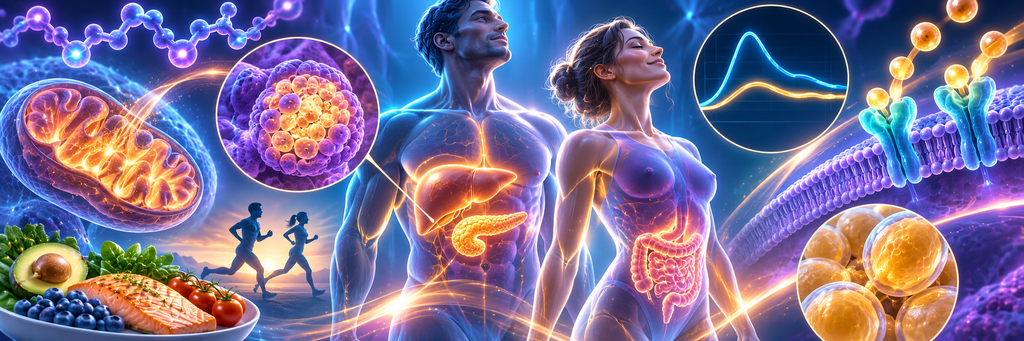
Weight is only one part of the metabolic-health story. Researchers are exploring how peptide signals affect glucose handling, insulin responsiveness, pancreatic function, liver fat, and the mitochondria that help cells use fuel.
1. The Big Picture: Metabolic Health Is More Than a Number on the Scale
A person can lose weight while still struggling with blood sugar regulation, and someone at a relatively stable weight can have significant insulin resistance. Metabolic health is not determined by appearance or body mass index alone. It is about how effectively the body coordinates glucose, insulin, lipids, blood pressure, energy use, and organ function.
Insulin resistance develops when tissues such as muscle, liver, and fat become less responsive to insulin’s signals. The pancreas may compensate by producing more insulin. Over time, this compensation can become insufficient, contributing to prediabetes and type 2 diabetes. Insulin resistance also overlaps with conditions such as metabolic dysfunction-associated steatotic liver disease (MASLD), although these disorders do not always occur together.
The encouraging development is that metabolic medicine is becoming more targeted. Semaglutide and tirzepatide are already FDA-approved medicines for defined indications and have extensive human glucose-control data. Mazdutide, which activates GLP-1 and glucagon receptors, has been approved in China for diabetes, while retatrutide, a three-receptor investigational peptide, reported promising Phase 3 diabetes findings in 2026.
At a different level, MOTS-c explores how mitochondria send metabolic messages; 5-Amino-1MQ investigates an enzyme involved in nicotinamide metabolism; AICAR probes cellular energy sensing; and Pancragen, a short bioregulator, raises questions about pancreatic-cell regulation.
The central research question is not only whether a compound makes someone lighter, but whether it improves the way the body handles fuel and protects long-term function. Importantly, weight loss itself can improve insulin sensitivity. Studies must separate benefits that follow weight change from additional effects of a compound’s mechanism.
2. The Biological Pathways: How Glucose, Insulin, and Cellular Energy Work Together
The Pancreas: Responding to Blood Glucose
After a meal, blood glucose typically rises. Pancreatic beta cells respond by releasing insulin. Insulin helps tissues store or use available nutrients and restrains excessive glucose production by the liver. Alpha cells release glucagon, which helps defend against dangerously low blood sugar by signaling the liver to release glucose.
These hormones are not enemies. Healthy regulation depends on their timing and balance. GLP-1- and GIP-based medicines take advantage of naturally occurring incretin signals, which can enhance insulin release when glucose is elevated and affect other metabolic processes.
Skeletal Muscle: A Major Destination for Glucose
Skeletal muscle is a major site of insulin-stimulated glucose disposal. When insulin binds its receptor, signaling pathways help move GLUT4 transporters to the cell surface so glucose can enter muscle cells. Muscle contraction also activates partly distinct pathways that enhance glucose uptake, which helps explain why physical activity improves glucose regulation even without dramatic weight loss.
MOTS-c research focuses in part on skeletal-muscle metabolic adaptation. AICAR is used experimentally to examine aspects of AMPK, an energy-sensing pathway. Neither administered compound has been proven to reproduce exercise benefits in humans.
The Liver: Glucose Production and Fat Handling
The liver stores and releases glucose and processes many forms of fat. In insulin resistance, the liver may continue producing too much glucose when it should be responding to insulin. Excess liver fat and disrupted metabolic signaling can further complicate glucose regulation.
This is one reason researchers are interested in glucagon-related therapies such as mazdutide and retatrutide. Glucagon receptor activation can raise liver glucose output, so a successful multi-receptor treatment must balance that action with other pathways. The fact that a medicine activates the glucagon receptor does not automatically mean it increases fat burning in a clinically useful way.
Mitochondria, AMPK, and Metabolic Flexibility
Mitochondria help cells convert nutrients into usable energy. AMPK is one of the systems that detects low cellular energy availability and coordinates a response. NAD+ is a separate coenzyme essential to energy-related redox reactions.
These systems connect with how cells shift between using glucose and fatty acids, sometimes called metabolic flexibility. MOTS-c, AICAR, and 5-Amino-1MQ approach this biology through very different mechanisms. A change in AMPK activity or an NAD+ measurement is a mechanistic clue, not proof of improved metabolic health in people.
What Researchers Measure
Useful outcomes include HbA1c, fasting glucose, standardized glucose-tolerance tests, and changes in clinically meaningful disease complications. Researchers may also measure fasting insulin, C-peptide, and estimated insulin-resistance indices such as HOMA-IR, although these are imperfect surrogates and are not interchangeable with direct measurements of insulin sensitivity. Liver-fat imaging, lipids, blood pressure, waist circumference, and physical function help show the broader metabolic picture.
3. Compounds Researchers Are Exploring
MOTS-c: A Mitochondrial Message About Energy Availability
Explore MOTS-c on Peptide Perspectives.
MOTS-c is a naturally occurring 16-amino-acid peptide encoded by mitochondrial DNA. It is of particular interest because mitochondria may do more than make ATP: they may communicate metabolic needs to other parts of the cell and body.
A foundational 2015 research study showed that MOTS-c influenced folate and purine metabolism and AMPK-associated signaling. In mice, experimental administration protected against certain diet-related changes in insulin sensitivity. More recent pancreatic-islet research has explored beta-cell stress, senescence, and glucose intolerance in experimental models.
Why it is exciting: MOTS-c suggests a possible route for influencing metabolic adaptation without starting at an appetite receptor. It may help explain how skeletal muscle and mitochondria respond to changing fuel availability.
What is not yet established: There are no adequately controlled human therapeutic trials demonstrating that administered MOTS-c treats insulin resistance or diabetes, nor a validated long-term safety profile. Human measurements of naturally occurring MOTS-c do not prove the benefits of injecting it.
Tirzepatide: Dual Incretin Signaling and Measurable Insulin-Sensitivity Changes
Explore Tirzepatide on Peptide Perspectives.
Tirzepatide activates both GIP and GLP-1 receptors, affecting glucose-dependent insulin secretion, glucagon regulation, appetite, and other metabolic responses. FDA-approved tirzepatide products are used for specified conditions, including type 2 diabetes and obesity-related indications depending on the product.
In the SURPASS-2 randomized trial, tirzepatide produced larger average reductions in HbA1c than semaglutide 1 mg after 40 weeks in adults with type 2 diabetes. A subsequent metabolic analysis reported improvements in model-derived insulin resistance and beta-cell function. A separate meal-test study also reported changes consistent with improved insulin sensitivity and glucose handling.
Why it is exciting: Tirzepatide demonstrates that targeting more than one hormone receptor can substantially improve human glucose regulation and other cardiometabolic outcomes, not merely reduce body weight.
Important nuance: The degree to which particular insulin-sensitivity changes are independent of weight reduction remains an important research question. Gastrointestinal symptoms, dehydration, gallbladder concerns, pancreatitis warnings, and low blood glucose when combined with certain diabetes medicines remain clinically relevant.
Semaglutide: An Established GLP-1 Foundation for Metabolic Health
Explore Semaglutide on Peptide Perspectives.
Semaglutide is a GLP-1 receptor agonist that enhances glucose-dependent insulin secretion, reduces inappropriate glucagon secretion in many settings, slows gastric emptying, and influences appetite-related brain signaling.
It has strong randomized human evidence for improving glucose control in type 2 diabetes. Some approved products and indications have also demonstrated important cardiovascular or kidney benefits in selected populations. These are product- and patient-specific regulatory claims, not universal promises about all formulations.
Why it is exciting: Semaglutide shows what can happen when a hormone pathway progresses from biological discovery to large outcome-driven trials. It provides a benchmark against which newer experimental medicines can be assessed.
Important nuance: Semaglutide does not permanently restore all beta-cell function or cure diabetes. Weight changes contribute to metabolic improvements, and medications have known gastrointestinal and other safety considerations. Its benefit is best understood as part of long-term evidence-based metabolic care.
Mazdutide: Combining GLP-1 and Glucagon Receptor Biology
Explore Mazdutide on Peptide Perspectives.
Mazdutide is an oxyntomodulin-inspired peptide that activates GLP-1 and glucagon receptors. Its design brings together glucose-regulating incretin biology and experimental interest in liver lipid handling and energy expenditure.
In the DREAMS-1 Phase 3 study, 320 adults with type 2 diabetes in China were randomized to mazdutide or placebo. After 24 weeks, average HbA1c reductions were approximately 1.57 and 2.15 percentage points in the two treatment groups versus 0.14 with placebo. Mazdutide received Chinese regulatory approval for type 2 diabetes in September 2025, following an obesity indication earlier that year.
Why it is exciting: Mazdutide highlights a new strategy for treating intertwined problems such as elevated glucose and excess liver fat through multiple hormone signals.
Important nuance: Its Chinese approvals do not mean FDA approval in the United States. The relative contributions of direct glucagon-receptor biology, reduced food intake, and weight loss remain under investigation; stomach and intestinal adverse effects are common in the clinical literature.
5-Amino-1MQ: An Enzyme-Focused Metabolic Hypothesis
Explore 5-Amino-1MQ on Peptide Perspectives.
5-Amino-1MQ is not a peptide. It is an investigational small-molecule inhibitor of nicotinamide N-methyltransferase (NNMT), an enzyme involved in nicotinamide processing and methyl-group metabolism. Its inclusion makes the comparison more useful because it approaches metabolic regulation at the intracellular enzyme level rather than through appetite hormones.
A 2024 mouse study reported improvements in glucose tolerance, insulin-related measurements, liver fat, and selected metabolic markers in diet-induced obesity after treatment with 5A1MQ. Some effects persisted in analyses adjusting for differences in body weight or fat mass, which makes the mechanism especially interesting to explore.
Why it is exciting: NNMT inhibition raises the possibility of changing adipose-tissue and nicotinamide metabolism in ways not explained solely by reduced calorie intake.
What is not yet established: Human efficacy, safe dosing, interactions with diabetes medications, and long-term consequences of altering methylation-related metabolism are unknown. Changes in nicotinamide handling should not be equated with proven increases in useful NAD+ activity or mitochondrial performance in people.
Retatrutide: Triple-Receptor Research Moves Into Phase 3
Explore Retatrutide on Peptide Perspectives.
Retatrutide is an investigational peptide that activates GIP, GLP-1, and glucagon receptors. It extends the multi-receptor research idea beyond semaglutide’s single receptor and tirzepatide’s dual incretin action.
A published Phase 3 diabetes trial reported average HbA1c reductions of approximately 1.69 to 1.94 percentage points at 40 weeks across studied regimens, versus 0.81 with placebo, in adults with type 2 diabetes inadequately controlled by diet and exercise alone. On October 28, 2026, the manufacturer also released topline results of an 80-week head-to-head trial reporting average HbA1c reductions of 2.2 percentage points with retatrutide versus 1.8 with semaglutide 2 mg. The latter results were company-reported topline findings at the time of writing and should be distinguished from full peer-reviewed publication.
Why it is exciting: Triple-receptor agonism is becoming a serious clinical research strategy for diabetes and broader metabolic dysfunction.
Important nuance: Retatrutide is not FDA-approved as of November 2026, and its longer-term safety and comparative clinical outcomes continue to be evaluated. Its greater weight-loss effects cannot be assumed to represent entirely weight-independent changes in insulin sensitivity.
AICAR: Studying the Cell’s Energy Sensor
Explore AICAR on Peptide Perspectives.
AICAR is an experimental nucleoside analogue, not a peptide, that can influence AMPK-associated pathways after conversion inside cells. It is widely used as a laboratory tool for studying how tissues respond to changes in energy availability.
Unlike many early metabolic compounds, AICAR has some small human physiology research. A study in 10 men with type 2 diabetes found that short-term intravenous AICAR reduced hepatic glucose output and circulating glucose under closely controlled experimental conditions.
Why it is exciting: AICAR helps researchers investigate how liver glucose production and cellular energy sensing interact with insulin resistance.
Important nuance: A short laboratory infusion study does not validate AICAR as a safe long-term diabetes treatment, an exercise replacement, or a performance-enhancing regimen. It has no FDA-approved indication for general metabolic optimization.
Pancragen: A Bioregulator Focused on Pancreatic Cell Signaling
Explore Pancragen on Peptide Perspectives.
Pancragen (KEDW) is a four-amino-acid peptide associated with the Khavinson bioregulator research tradition. Its experimental focus includes pancreatic differentiation factors, glucose tolerance, and changes in the function of endocrine pancreatic cells.
Laboratory studies have reported changes in transcription factors associated with pancreatic-cell identity. Small experiments in rats and aged rhesus monkeys have reported changes in glucose-response patterns. An older preliminary human report described metabolic changes in a small group of older adults with diabetes, but lacks the rigorous randomized, blinded design needed to establish treatment efficacy.
Why it is exciting: Pancragen raises a different question from incretin therapy: could a short peptide influence the cellular programs involved in maintaining pancreatic function?
What is not yet established: There is no convincing evidence that Pancragen regenerates human beta cells, reverses diabetes, improves long-term cardiovascular outcomes, or is safe as a metabolic treatment. It is investigational and not FDA-approved.
4. Comparing the Compounds
How to interpret the comparison: A change in a cell-signaling protein, a mouse glucose-tolerance test, and a randomized human trial measuring HbA1c are different levels of evidence. Even a lower HbA1c does not automatically prove long-term protection from cardiovascular, kidney, or liver complications. Those outcomes require their own carefully designed studies.
5. Where the Science Is Heading
Beyond Appetite: Combining Hormone and Cellular Insights
Approved incretin therapies established that glucose-regulating hormones can have broad clinical effects. MOTS-c and 5-Amino-1MQ point to a different area of exploration: how cells themselves detect and adapt to fuel availability.
Future research may investigate whether targeting intracellular metabolism provides added benefits in carefully chosen populations, but different mechanisms do not establish that combining research compounds is safe or effective. There is no validated human protocol for stacking these experimental compounds with approved GLP-1 medications.
Understanding What Improves Independently of Weight Loss
One of the most important open questions is which changes reflect direct pharmacology and which follow reduced visceral fat, lower energy intake, or increased physical activity. Clinical studies can help by measuring insulin sensitivity directly and analyzing outcomes across different amounts of weight change.
For readers, this is an important distinction: a medication can be very effective for glucose regulation without proving that every improvement is separate from its impact on body weight.
Metabolic Liver Disease and Cardiovascular Protection
Metabolic health includes liver fat, blood pressure, vascular function, and kidney health. Researchers are studying whether next-generation receptor agonists can improve these outcomes, and whether improvements translate into less liver fibrosis, fewer cardiovascular events, and reduced kidney disease progression.
A fall in liver fat on imaging is encouraging, but it does not automatically show reversal of liver scarring. Similarly, better triglycerides or blood pressure are important but are not identical to proven reductions in heart attacks or death.
Pancreatic Resilience and Bioregulator Research
Pancragen illustrates a more exploratory direction: studying how pancreatic cells maintain identity and respond to metabolic stress. Even if a short peptide changes differentiation markers in culture, researchers still must establish where it travels in the body, which cells it reaches, and whether the effect improves human health without unwanted consequences.
Greater clarity about pancreatic beta-cell survival could matter enormously in future diabetes treatment, but regeneration claims require evidence beyond laboratory gene-expression changes.
Getting More Precise About Measurement and Safety
Future studies need long-term follow-up, meaningful glucose outcomes, appropriate liver and kidney measures, and careful monitoring for gastrointestinal reactions, dehydration, hypoglycemia with combination diabetes treatment, and other adverse events. Standardized pharmaceutical manufacturing and identity testing are especially important for experimental peptides.
For established insulin resistance, the foundations remain important: regular physical activity, resistance training, sufficient sleep, individualized nutrition, and clinically appropriate medication. Those approaches have far more human evidence than experimental AMPK or NNMT compounds. Peptide discoveries are most promising when they eventually add rigorously tested options to this foundation.
6. Explore the Compounds
Continue with the individual Peptide Perspectives profiles:
- MOTS-c: Mitochondrial signaling and metabolic adaptation
- Tirzepatide: Dual incretin signaling and glucose regulation
- Semaglutide: GLP-1 receptor biology and diabetes
- Mazdutide: Dual glucagon/GLP-1 signaling
- 5-Amino-1MQ: NNMT inhibition and nicotinamide metabolism
- Retatrutide: Triple receptor agonism
- AICAR: Experimental AMPK and energy-sensing research
- Pancragen: Pancreatic bioregulator and glucose-response research
Related pathways worth exploring: NAD+ is central to energy-related cellular reactions, but is not a peptide; Humanin is studied for mitochondrial stress responses; and Survodutide is another investigational GLP-1/glucagon dual agonist with interest in metabolic liver disease.
Selected clinical and preclinical research: SURPASS-2, Tirzepatide insulin-sensitivity analysis, Mazdutide DREAMS-1, Retatrutide Phase 3 diabetes results, MOTS-c foundational study, 5-Amino-1MQ mouse metabolism study, and AICAR human physiology study.
The Bigger Possibility
The future of metabolic health may be defined less by a single weight target and more by the body’s ability to keep glucose stable, use fuel efficiently, preserve organ function, and remain resilient as circumstances change.
Semaglutide and tirzepatide already demonstrate the practical value of peptide-based hormone medicine. Mazdutide and retatrutide expand multi-receptor research. MOTS-c, AICAR, and 5-Amino-1MQ investigate the energy machinery inside cells, while Pancragen raises more preliminary questions about pancreatic-cell regulation.
The scientific opportunity is to connect those discoveries to outcomes that truly matter: better metabolic function, fewer complications, and healthier years of life.
Peptide Perspectives provides educational research coverage, not individualized medical advice. Semaglutide and tirzepatide have product-specific FDA-approved indications. Mazdutide is approved for certain uses in China but not by the U.S. FDA; retatrutide, MOTS-c, 5-Amino-1MQ, AICAR, and Pancragen are not FDA-approved metabolic treatments. Experimental compounds may lack verified identity, sterility, or long-term human safety data. People using insulin or sulfonylureas, or experiencing persistent high or low blood sugar, should seek individualized clinical guidance rather than replacing established treatment with research peptides.