
From mitochondrial signaling to experimental “exercise mimetics,” scientists are investigating what makes muscles more resilient to sustained effort. The crucial question is whether activating an exercise-related pathway can ever reproduce the physical benefits of training.

1. The Big Picture: Endurance Is an Adaptation, Not a Single Molecule
There is something remarkable about the body’s response to training. A walk that once felt exhausting can become comfortable. A cyclist can hold a steady pace longer. Older adults can regain confidence climbing stairs. Behind these improvements are coordinated changes in the heart, lungs, blood vessels, skeletal muscle, nervous system, and the way cells use energy.
Endurance describes the capacity to sustain an activity, while stamina is a broader everyday term that can include physical effort, fatigue tolerance, and recovery. Neither can be reduced to one hormone concentration or mitochondrial marker.
Researchers are investigating the biological signals that accompany training. MOTS-c, a peptide encoded by mitochondrial DNA, has attracted attention for its links to metabolism and exercise-related adaptation. SLU-PP-332, a non-peptide experimental nuclear-receptor agonist, stimulates a gene-expression program associated with aerobic exercise in mice. AICAR, another non-peptide research compound, influences the cellular energy sensor AMPK. SS-31 examines mitochondrial membrane stability, while CJC-1295, ipamorelin, tesamorelin, and MK-677 probe growth hormone-related signaling rather than the classic exercise-mimetic pathways.
The findings are intriguing, but their levels of evidence differ dramatically. In a landmark 2008 mouse study, AICAR increased running endurance by approximately 44%. A 2023 SLU-PP-332 mouse study reported approximately 70% longer running time under its experimental conditions. Neither finding demonstrates a comparable effect in humans. Meanwhile, randomized human studies of growth hormone have not consistently improved maximal oxygen uptake or strength in healthy adults.
The opportunity is bigger than an athletic shortcut. Understanding these mechanisms could someday help people who cannot exercise normally because of illness, disability, or age-related physical decline. But a treatment that mimics part of a molecular response to exercise is not the same as a treatment that recreates the full benefits of exercising.
2. The Biological Pathways: What Makes Exercise Capacity Improve?
Mitochondria: Turning Fuel into Sustained Energy
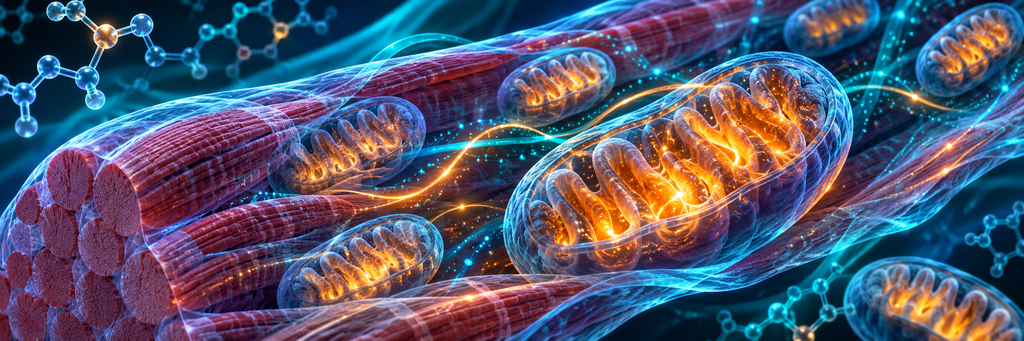
Mitochondria help generate ATP, the usable energy that powers muscular contraction. During sustained movement, muscles draw on carbohydrates and fats, using oxygen-dependent processes to meet energy demands. Training can increase mitochondrial content and improve the ability to use available fuel. Researchers study MOTS-c as a mitochondrial-derived signal and SS-31 as a compound that interacts with cardiolipin, a lipid important to the inner mitochondrial membrane.
More mitochondria or a higher laboratory measure of cellular respiration is encouraging, but it does not automatically produce faster race times or greater endurance in people.
AMPK: The Cell’s Energy Sensor
AMP-activated protein kinase (AMPK) responds to changes in cellular energy balance. When energy demand rises, AMPK-related pathways help coordinate glucose uptake, fatty-acid oxidation, and adaptation. AICAR is converted inside cells to a nucleotide called ZMP, which can activate AMPK-related signaling. MOTS-c is also linked to metabolic and AMPK-associated responses in experimental models, but its biology is not identical to AICAR’s.
PGC-1α and ERR: The Machinery of Oxidative Adaptation
PGC-1α is a key coordinator of mitochondrial gene programs. Estrogen-related receptors (ERRα, ERRβ, and ERRγ) are nuclear receptors involved in oxidative metabolism; despite their name, they are distinct from classical estrogen receptors. SLU-PP-332 activates all three ERR subtypes, with notable ERRα activity, and can induce exercise-associated gene expression in experimental muscle.
This creates an important distinction: turning on genes also activated by exercise is not equivalent to producing all of exercise’s physiological adaptations.
Muscle Fibers, Oxygen Delivery, and VO₂max
Aerobic performance depends on more than muscle metabolism. The heart must pump blood, lungs must exchange gases, capillaries must deliver oxygen, and muscles must use it. VO₂max, the maximum rate of oxygen consumption during intense exercise, measures an integrated capacity across several systems. Running economy, endurance at a submaximal effort, muscle strength, hydration, pacing, and fatigue regulation matter too.
A compound that improves a mouse treadmill test has not necessarily improved a person’s VO₂max, sport performance, or ability to complete daily activities.
Growth Hormone and Recovery: A Different Endocrine Pathway
Growth hormone (GH) is released by the pituitary in pulses and influences fat metabolism, tissue maintenance, and IGF-1 signaling. CJC-1295 activates the GHRH receptor; ipamorelin and the non-peptide MK-677 act through the ghrelin receptor; tesamorelin is a prescription GHRH analogue for a specific clinical condition.
These mechanisms are not equivalent to AMPK or ERR activation, and raising GH or IGF-1 does not establish faster recovery or improved aerobic performance.
3. Compounds Researchers Are Exploring
MOTS-c: A Mitochondrial Peptide That Responds to Exercise
Explore MOTS-c on Peptide Perspectives.
MOTS-c is a naturally occurring 16-amino-acid peptide encoded by mitochondrial DNA. Researchers have linked it to glucose metabolism, cellular stress responses, and communication between mitochondria and nuclear gene-regulation pathways.
In a 2021 Nature Communications study, investigators observed increases in naturally occurring MOTS-c in skeletal muscle and circulation following exercise in a small human experiment. Separate experiments in young, middle-aged, and older mice found that administered MOTS-c improved certain measures of physical capacity, including in aging animals.
Why it is promising: MOTS-c suggests mitochondria may actively signal how muscle adapts to energy stress, rather than merely supplying fuel. This could inspire research into physical decline and metabolic dysfunction.
What remains unknown: The human study measured endogenous responses to exercise, not benefits from MOTS-c injections. No adequate randomized human trial has demonstrated that administered MOTS-c improves endurance, VO₂max, recovery, or athletic performance, and no FDA-approved therapeutic product exists.
SLU-PP-332: Reproducing an Exercise-Related Gene Program in Mice
Explore SLU-PP-332 on Peptide Perspectives.
SLU-PP-332 is not a peptide. It is a synthetic experimental agonist of the ERRα, ERRβ, and ERRγ nuclear receptors, developed to probe how muscle controls oxidative metabolism.
A 2023 preclinical study reported changes in mitochondrial function, oxidative muscle-fiber characteristics, and exercise-associated genes. Sedentary treated mice ran approximately 70% longer and 45% farther than controls in a treadmill-to-exhaustion test. When researchers removed ERRα activity specifically from skeletal muscle, the endurance effect was lost, providing evidence for the proposed mechanism.
A related, chemically distinct compound called SLU-PP-915 was subsequently described as orally active in animal experiments. It is not the same molecule and does not establish human efficacy for SLU-PP-332.
Why it is promising: ERR-targeted research could eventually suggest ways to support oxidative muscle function in conditions where movement is severely limited.
What remains unknown: There are no published controlled human endurance trials demonstrating benefits from SLU-PP-332. Human exposure, long-term safety, appropriate formulations, and off-target effects remain unknown. The dramatic mouse percentages are not human performance predictions.
AICAR: Studying the Cellular Energy Switch
Explore AICAR on Peptide Perspectives.
AICAR (acadesine) is a synthetic nucleoside analogue, not a peptide, converted inside cells to ZMP, which influences AMPK-related signaling. It became widely discussed after the 2008 Cell study in which sedentary mice had approximately 44% greater running endurance after four weeks of experimental treatment.
AICAR has also been evaluated in human medical research, including short-term metabolic experiments and trials in other diseases. Those clinical settings did not establish better athletic performance or endurance. Human research has raised concerns related to uric-acid metabolism, renal findings, and other adverse effects.
Why it is promising: AICAR demonstrates that a defined energy-sensing pathway can influence oxidative adaptations in animals, making it an important research tool.
What remains unknown: There is no validated human endurance regimen or approved performance indication. Effects on AMPK should not be treated as equivalent to completing an aerobic workout, and AICAR is prohibited under anti-doping rules.
SS-31 (Elamipretide): Protecting Mitochondrial Membranes
Explore SS-31 on Peptide Perspectives.
SS-31 (elamipretide) is a synthetic tetrapeptide investigated for binding cardiolipin within the inner mitochondrial membrane. Its research focuses on mitochondrial stability and the response to cellular energy stress.
In September 2025, the FDA granted accelerated approval to the pharmaceutical product Forzinity for improving muscle strength in eligible people with Barth syndrome, a rare inherited mitochondrial disease. The approval was based on an intermediate strength endpoint and requires confirmatory evidence. Importantly, the small randomized trial did not show a statistically significant improvement in its key six-minute-walk or fatigue outcomes.
Why it is promising: SS-31 shows that mitochondria-targeted peptide medicine has moved beyond cell experiments and into an approved, highly specialized clinical setting.
What remains unknown: This does not establish that SS-31 improves running economy, healthy-adult endurance, or ordinary exercise recovery. Approved elamipretide cannot be assumed equivalent to online research-vial SS-31.
CJC-1295: Growth Hormone Signaling Is Not Endurance Training
Explore CJC-1295 with DAC and CJC-1295 without DAC.
CJC-1295 refers to a group of synthetic growth hormone-releasing hormone (GHRH) analogues. The DAC-containing version is longer-acting and differs materially from products marketed as CJC-1295 without DAC.
In small randomized studies of healthy adults, CJC-1295 with DAC increased circulating GH and IGF-1 over several days. These are real human endocrine findings, but the studies did not demonstrate improved VO₂max, longer time to exhaustion, or recovery from training.
Why it is promising: CJC-1295 provides a tool for investigating how hormone pulses and downstream growth-factor signaling affect tissue biology.
What remains unknown: Whether any performance benefit would exceed its endocrine effects is unproven. No form is FDA-approved for sports endurance or healthy aging; DAC findings should not be applied to no-DAC products.
Ipamorelin: Ghrelin-Receptor Control of GH Release
Explore Ipamorelin on Peptide Perspectives.
Ipamorelin is a synthetic peptide that activates the growth hormone secretagogue receptor (GHSR-1a), rather than CJC-1295’s GHRH receptor. Early human pharmacology demonstrates that ipamorelin can trigger GH release, which has prompted research interest in endocrine physiology and body composition.
The frequently discussed idea of combining it with a GHRH analogue is a mechanistic hypothesis, not a proven human endurance intervention.
Why it is promising: The ghrelin pathway offers another way to study how GH pulses are controlled and how endocrine responses interact with metabolism.
What remains unknown: There is no convincing randomized human evidence that ipamorelin improves aerobic capacity, running performance, muscle recovery, or the experience of fatigue. It is not FDA-approved for performance enhancement.
Tesamorelin: A Real Clinical GHRH Medicine, but for a Different Purpose
Explore the official tesamorelin prescribing information.
Tesamorelin is a synthetic GHRH analogue with an FDA-approved clinical use: reducing excess abdominal fat in adults with HIV-associated lipodystrophy. The indication demonstrates that carefully studied GH-pathway medicines can offer measurable benefits in a specific population.
However, tesamorelin is not approved to improve athletic performance, endurance, exercise recovery, or general weight loss. Its product labeling includes warnings concerning elevated IGF-1, glucose intolerance, fluid retention, and certain malignancy-related concerns.
Why it is promising: It offers a valuable clinical contrast to experimental GH secretagogues: a medicine can be effective for a defined condition without being an all-purpose fitness enhancer.
What remains unknown: Whether it helps any defined muscle-function or endurance condition beyond its approved use requires separate trials. A dedicated public Peptide Perspectives profile for tesamorelin was not confirmed in the directory during preparation.
MK-677 (Ibutamoren): More Lean Mass Did Not Mean Better Function
Explore MK-677 on Peptide Perspectives.
MK-677 (ibutamoren) is not a peptide. It is an oral ghrelin-receptor agonist that increases GH and IGF-1 signaling and has been studied as a possible way to counter age-related losses in lean mass.
In a randomized trial involving 65 adults ages 60–81, MK-677 increased fat-free mass relative to placebo over one year, but did not improve strength or physical function. Fasting glucose increased and insulin sensitivity declined, with other effects including increased appetite and fluid-related symptoms.
Why it is promising: This provides an unusually useful human test of the idea that altering hormone-driven body composition might improve function.
What remains unknown: The results do not establish better stamina or workout recovery. MK-677 has no FDA approval for endurance, athletic performance, or anti-aging treatment.
4. Comparing the Compounds
| Compound | Primary pathway | Main research interest | Evidence level / regulatory status | Key limitation |
|---|---|---|---|---|
| MOTS-c | Mitochondria-derived signaling, AMPK-associated adaptation | Metabolic resilience and physical capacity with age | Animal performance studies; small human observational exercise data; not FDA-approved | Endogenous human exercise response does not prove injected-human benefits |
| SLU-PP-332 | ERRα/β/γ activation | Oxidative muscle genes and experimental endurance | Cell and mouse studies; non-peptide, investigational | No human endurance trials or established safety |
| AICAR | ZMP/AMPK energy sensing | Fuel use, oxidative metabolism, treadmill endurance | Animal performance evidence; human metabolic studies; non-peptide, not FDA-approved | No proven human performance gain; clinical safety concerns |
| SS-31 | Mitochondrial cardiolipin binding | Mitochondrial disorders, muscle strength | Human rare-disease trials; accelerated FDA approval for Barth syndrome only | No healthy-athlete endurance benefit; key walking/fatigue endpoints negative |
| CJC-1295 with DAC | GHRH receptor and GH/IGF-1 | Hormone secretion and tissue physiology | Small human endocrine trials; not approved for athletic use | Raising GH is not proof of increased VO₂max or recovery |
| Ipamorelin | Ghrelin/GHS receptor | GH release and endocrine responses | Early human pharmacology; not FDA-approved | No validated endurance or functional outcomes |
| Tesamorelin | GHRH receptor | Excess abdominal fat in HIV-associated lipodystrophy | FDA-approved for a specific condition | Not an approved fitness or recovery therapy |
| MK-677 | Oral non-peptide ghrelin-receptor agonism | GH/IGF-1, body composition, aging | Randomized human body-composition trial; not FDA-approved | More fat-free mass did not improve strength/function; glucose concerns |
What the evidence means: A changed cellular gene, a better mouse treadmill result, an elevated GH level, improved strength in a rare disease, and a faster 10-kilometer run are different outcomes. No compound in this table has demonstrated a reproducible endurance advantage in healthy humans sufficient to support clinical performance-enhancement use.

5. Where the Science Is Heading
Exercise Mimetics May Matter Most When Exercise Is Hardest
The strongest future clinical application may not be helping competitive athletes run faster. It could be supporting people with prolonged immobility, severe frailty, metabolic disease, or certain muscle disorders who cannot safely perform enough physical activity to gain its full benefits. SLU-PP-332 and AICAR provide early tools to investigate this possibility, but both still need substantially more translational research.
Measuring Performance, Not Just Cellular Activity
Future trials should assess VO₂max, time to exhaustion, submaximal work capacity, walking speed, six-minute-walk performance, muscular strength, repeated-day recovery, and patient-reported function. A blood biomarker or muscle biopsy can clarify a mechanism, but cannot replace an objectively meaningful performance measure.
Mitochondrial Quality, Not Simply Quantity
Researchers are moving beyond counting mitochondria to studying their quality control, membrane function, stress responses, and integration with oxygen delivery. MOTS-c and SS-31 illustrate different approaches. A compound that protects mitochondria during illness may be valuable even if it never becomes an endurance-enhancing drug for healthy athletes.
Growth Hormone Research Needs a Functional Standard
A systematic review and meta-analysis of GH trials in healthy young adults found changes in lean mass and fat mass but no significant improvement in VO₂max or muscle strength. This provides an important standard for CJC-1295, ipamorelin, tesamorelin, and MK-677. More hormone activity does not automatically mean better performance, and clinical indications cannot be extrapolated to healthy athletes.
New ERR Compounds Are Still Preclinical
The development of the related SLU-PP-915 molecule shows that scientists are trying to improve on SLU-PP-332’s experimental limitations, including oral exposure. That progress is encouraging for drug design, but both remain research compounds, and mouse performance does not establish human benefit or safety.
Anti-Doping Rules and Research-Grade Product Risks
Athletes should be especially careful. Under the 2026 WADA Prohibited List, AICAR and MOTS-c are expressly listed as prohibited metabolic modulators, and CJC-1295, ipamorelin, tesamorelin, and growth hormone-related secretagogues fall within prohibited hormone categories. Unapproved pharmacological substances such as SLU-PP-332 are also covered by anti-doping restrictions. The absence of a specific compound name from one subsection does not mean it is permitted.
Outside regulated sport, unapproved research products still present risks involving identity, contamination, formulation, unpredictable metabolism, and long-term toxicity. There is no clinically validated performance stack or dosing schedule for these experimental combinations.
Exercise Remains the Benchmark
Aerobic training, resistance training, recovery, adequate nutrition, and appropriate progression improve multiple systems at once. No exercise-mimetic compound has been shown to recreate this full package in humans. That is not a reason to dismiss the research; it is the scientific standard a future therapy must meet.
6. Explore the Compounds
Direct Peptide Perspectives profiles:
- MOTS-c: Mitochondrial signaling and exercise adaptation
- SLU-PP-332: ERR activation and exercise-mimetic research
- AICAR: AMPK activation and endurance biology
- SS-31 (Elamipretide): Mitochondrial membrane protection
- CJC-1295 with DAC: Long-acting GH signaling
- CJC-1295 without DAC: Short-acting GHRH research
- Ipamorelin: Ghrelin-receptor and GH physiology
- MK-677 (Ibutamoren): Ghrelin signaling and body composition
Related science and clinical sources: 2021 MOTS-c exercise and aging research; 2023 SLU-PP-332 mouse endurance study; 2008 AICAR study; SS-31’s FDA rare-disease approval; 2006 CJC-1295 endocrine study; 2017 GH performance meta-analysis; 2008 MK-677 functional outcomes trial; and 2026 WADA Prohibited List.
Additional related profiles: Humanin explores mitochondrial stress biology; NAD+ is a central cellular coenzyme, not a peptide; and L-Carnitine is involved in long-chain fatty-acid transport rather than directly mimicking exercise. Their mechanisms do not establish performance enhancement in healthy people.
The Bigger Possibility
Exercise is one of the most powerful biological interventions we know because it changes the heart, muscles, blood vessels, metabolism, brain, and daily function together. The emerging science of peptides and exercise mimetics gives researchers a way to investigate individual pieces of that response.
MOTS-c points to mitochondria as signaling partners in adaptation. SLU-PP-332 and AICAR demonstrate that specific energy-related pathways can alter running capacity in mice. SS-31 shows that mitochondrial medicine can reach an approved rare-disease indication. Growth hormone-related compounds help distinguish endocrine changes from actual changes in performance.
The most exciting future is not replacing training. It is understanding adaptation well enough to help more people build or preserve endurance, especially when illness or aging makes that difficult, and proving those benefits in rigorous human trials.
Peptide Perspectives provides educational research information, not individualized medical or athletic advice. SLU-PP-332, MOTS-c, AICAR, CJC-1295, ipamorelin, and MK-677 are not FDA-approved for endurance or athletic performance. SS-31 and tesamorelin have narrow, product-specific clinical indications unrelated to general endurance enhancement. Anti-doping rules prohibit many of these compounds. Research-vial products may lack established identity, sterility, or long-term human safety. Do not substitute experimental compounds for appropriate training, rehabilitation, or medical care.