
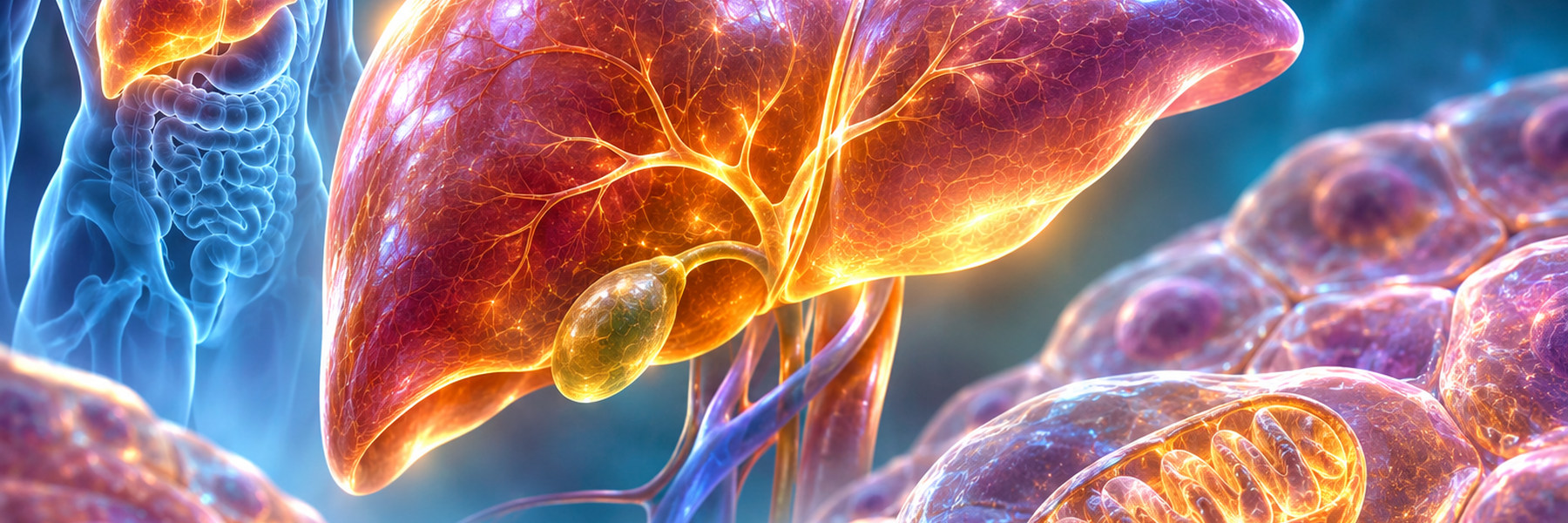
The liver is more than a filter. It is a metabolic command center that processes nutrients, transforms medications, coordinates immune responses, and repairs itself after injury. From FDA-approved metabolic medicines to experimental mitochondrial peptides and bioregulators, researchers are investigating ways to protect its remarkable cellular machinery.

1. The Big Picture: Liver Health Is About Protection, Not a “Cleanse”
Every meal, medication, and major change in metabolism reaches the liver in one way or another. It stores and releases glucose, processes fats, makes proteins needed for blood clotting, produces bile, and transforms chemicals so the body can use or eliminate them. This is a continuous, regulated process, not a periodic event that needs a commercial “detox.”
The liver already has sophisticated chemical-processing systems. Most people do not need a supplement, cleanse, or peptide to make those systems switch on. What does matter is limiting injury, identifying disease early, and supporting the cells that do this work.
One major research focus is metabolic dysfunction-associated steatotic liver disease (MASLD), in which excess fat accumulates in the liver in association with cardiometabolic risk factors. Some people develop metabolic dysfunction-associated steatohepatitis (MASH), a more damaging pattern involving liver-cell injury and inflammation that can lead to fibrosis, or scarring. MASLD/MASH are not the same as viral hepatitis, alcohol-associated liver disease, autoimmune hepatitis, medication-induced injury, or cirrhosis from other causes.
The scientific progress is already tangible. In August 2025, the FDA granted accelerated approval to Wegovy (semaglutide injection) for adults with noncirrhotic MASH and moderate-to-advanced fibrosis, stages F2–F3. Another approved medicine, resmetirom (Rezdiffra), addresses that same broad disease category through a different, non-peptide pathway. Tirzepatide has encouraging human liver-biopsy data, while survodutide and the FGF21 analogue efruxifermin represent newer clinical research directions.
At an earlier stage, MOTS-c and SS-31 explore mitochondrial and cell-protection mechanisms. Ovagen (EDL) represents the still more preliminary world of liver-focused short-peptide bioregulators.
The essential distinction: improving a liver enzyme, reducing fat on MRI, resolving inflammation on a biopsy, reversing fibrosis, and preventing liver failure are different outcomes. A responsible article can be excited about all of them without pretending they provide the same level of evidence.
2. The Biological Pathways: How the Liver Manages Fuel, Medications, and Stress
Nutrient Handling: The Liver as a Metabolic Switchboard
After a meal, the liver helps store glucose as glycogen, convert and distribute nutrients, and make or process lipids. Between meals, it releases glucose when needed. In insulin resistance, the liver may keep producing glucose when it should respond to insulin, while excess liver fat can contribute to additional metabolic stress.
GLP-1 and related peptide medicines influence this broader network through appetite, weight, glucose regulation, and other systemic effects. An improvement in liver health does not necessarily mean a drug is directly acting on a receptor on a liver cell. Some mechanistic studies have struggled to detect GLP-1 receptors in human hepatocytes, supporting the importance of indirect cardiometabolic pathways.
Drug Processing: Phase I, Phase II, and Bile
Phase I reactions often change a molecule’s chemical structure through enzymes including the cytochrome P450 family. Phase II reactions can attach water-soluble groups that help the body eliminate substances. The liver also produces bile and helps process bilirubin, cholesterol-related compounds, and some waste products.
These systems are not automatically safer when “boosted.” Faster transformation can sometimes create more reactive intermediates, while slowing a pathway can change medication exposure. No peptide discussed here has been shown to make medication processing universally safer or faster.
Mitochondria and Oxidative Stress
Liver cells need substantial energy to synthesize proteins, move molecules, and maintain metabolic balance. Their mitochondria also help regulate fatty-acid oxidation and cellular stress responses. When energy handling is disrupted, reactive oxygen species and other stress pathways can contribute to cell injury.
MOTS-c explores communication from mitochondrial DNA to cellular metabolism, while SS-31 (elamipretide) interacts with cardiolipin in the inner mitochondrial membrane. Both are scientifically relevant to liver-cell resilience, but most direct liver evidence is preclinical.
Inflammation and Fibrosis: Repair Can Become Scarring
Kupffer cells, the liver’s resident macrophages, help recognize injury and organize immune responses. After repeated injury, hepatic stellate cells can become activated and deposit excess extracellular matrix, contributing to fibrosis. Signals such as TGF-β, inflammatory cytokines, and oxidative stress are part of this network.
The liver is unusually capable of regeneration after some injuries. But regeneration is not unlimited, and more cell division is not always better. Effective therapy must preserve normal structure and function without driving uncontrolled or abnormal growth.
Measuring Liver Health: Why One Number Is Not Enough
ALT and AST are enzymes that often rise when liver cells are injured, but they are not direct measures of liver function or fibrosis. Clinicians may also consider bilirubin, albumin, INR, platelets, metabolic tests, fibrosis scores such as FIB-4, elastography, MRI-derived fat measurements, and sometimes biopsy. A normal ALT does not necessarily exclude clinically important fibrosis, and an elevated result has many possible causes.
3. Compounds Researchers Are Exploring
Semaglutide: A Peptide Medicine with a Liver-Specific FDA Indication
Explore Semaglutide on Peptide Perspectives.
Semaglutide activates the GLP-1 receptor and has strong human evidence across specified metabolic conditions. Its liver story is especially important because a large clinical trial measured actual tissue changes, not merely weight loss or a blood test.
In the Phase 3 ESSENCE trial, the planned 72-week interim analysis involved 800 adults with biopsy-confirmed MASH and F2–F3 fibrosis. MASH resolution without worsening of fibrosis occurred in 62.9% of semaglutide-treated participants versus 34.3% with placebo. Fibrosis improvement without worsening MASH occurred in 36.8% versus 22.4%. These findings supported accelerated FDA approval of Wegovy injection for the indicated population in August 2025.
Why researchers are interested: Semaglutide demonstrates that peptide-based metabolic therapy can improve biopsy-measured liver disease. The ongoing study is designed to determine whether these tissue changes translate into fewer major liver-related complications over time.
Important limits: This is a Wegovy injection-specific indication, not a blanket claim about every semaglutide preparation or every liver disorder. Gastrointestinal symptoms, dehydration, gallbladder disease, and other labeling precautions matter. The relative contributions of weight loss and other metabolic effects remain under investigation.
Tirzepatide: Dual Incretin Signaling and MASH Resolution
Explore Tirzepatide on Peptide Perspectives.
Tirzepatide activates both GIP and GLP-1 receptors, influencing glucose regulation, food intake, and weight. The question for liver research is whether these metabolic changes can reduce the hepatocyte injury and inflammation characteristic of MASH.
The 52-week SYNERGY-NASH Phase 2 trial randomized 190 adults with biopsy-confirmed MASH and F2–F3 fibrosis. MASH resolution without worsening fibrosis occurred in 44%, 56%, and 62% across three tirzepatide dose groups versus 10% with placebo. Improvements in fibrosis were also observed, although larger and longer trials are needed.
Why researchers are interested: Tirzepatide connects dual incretin signaling to clinically meaningful tissue measures rather than assuming a smaller waistline automatically means a healthier liver.
Important limits: Tirzepatide has FDA-approved uses for other conditions, but does not have a U.S. MASH-specific approval as of November 8, 2026. The study cannot establish reversal of cirrhosis or prevention of liver failure. Side effects and patient selection require medical supervision.
MOTS-c: Mitochondrial Signaling and Liver Metabolism
Explore MOTS-c on Peptide Perspectives.
MOTS-c is a 16-amino-acid mitochondrial-derived peptide studied for cellular energy regulation and responses to metabolic stress. It has become interesting in liver research because fatty liver disease involves more than fat accumulation: disrupted mitochondrial metabolism, inflammatory signaling, and vulnerability to hepatocyte injury can all contribute.
A 2024 experimental study reported that administered MOTS-c reduced steatosis, inflammation, apoptosis, and fibrosis in a mouse model of steatohepatitis, with evidence implicating an interaction with Bcl-2 in its protective effects. A 2026 study explored AMPK and ACE2-related signaling in diabetic mice and liver-cell models, again reporting improvements in experimental fat accumulation.
Why researchers are interested: MOTS-c raises the possibility that messages originating from mitochondria could influence how liver cells handle fuel and resist stress, potentially complementing what is known about exercise-induced metabolic adaptation.
Important limits: These are mouse and cell findings, not clinical proof that injected MOTS-c treats MASLD, MASH, or abnormal liver enzymes in people. Human therapeutic efficacy, dosing, exposure, liver safety, and long-term risks are not established. It is not FDA-approved.
SS-31 (Elamipretide): Stabilizing Mitochondria During Liver Injury
Explore SS-31 on Peptide Perspectives.
SS-31 (elamipretide) is a synthetic four-amino-acid peptide that interacts with cardiolipin, an important lipid of the inner mitochondrial membrane. Its mechanisms are especially relevant when tissues experience oxygen deprivation, energy disruption, or a sudden return of blood flow.
In a 2021 liver ischemia–reperfusion mouse study, SS-31 was associated with less liver tissue injury, lower ALT and AST, and changes in oxidative and macrophage inflammatory responses. It is a compelling mechanistic lead for understanding how to protect hepatocytes during acute stress.
Why researchers are interested: Rather than primarily reducing appetite or liver fat, SS-31 explores mitochondrial membrane resilience and a potentially different kind of tissue protection.
Important limits: The liver findings are preclinical. The FDA’s 2025 accelerated approval of a pharmaceutical elamipretide product for Barth syndrome, a rare mitochondrial condition, does not establish an indication for fatty liver, hepatitis, or liver transplantation. Research-vial products are not equivalent to the approved medicine.
Ovagen (EDL): A Liver-Focused Bioregulator with Unconfirmed Claims
Explore Ovagen on Peptide Perspectives.
Ovagen, a three-amino-acid peptide with the sequence Glu-Asp-Leu (EDL), belongs to the Khavinson short-peptide bioregulator research tradition. It has been promoted in relation to hepatocyte growth, liver recovery, and gene-expression regulation.
The Peptide Perspectives Ovagen profile summarizes early findings described in a liver-regeneration patent, including rat-liver tissue experiments and a small historical human comparison. These descriptions are intriguing as research hypotheses, but patent-reported outcomes are not equivalent to independently peer-reviewed and replicated clinical trials. A separately conducted evidence search found no adequately published liver-specific clinical research validating Ovagen’s marketed use.
Why researchers are interested: The idea that a short amino-acid sequence might influence tissue-specific repair is an important question in peptide biology and can be tested in modern liver-cell organoids and controlled models.
Important limits: There is no reliable human evidence that Ovagen regenerates a damaged liver, treats hepatitis, reverses cirrhosis, or normalizes liver enzymes. Its mechanism, tissue exposure, long-term safety, and validated dosing remain unknown. It is not FDA-approved.
Survodutide: GLP-1 Plus Glucagon Receptors in Liver Disease Research
Explore Survodutide on Peptide Perspectives.
Survodutide is an investigational dual GLP-1 and glucagon receptor agonist. The glucagon component creates particular interest in hepatic metabolism, although glucagon can also increase liver glucose output, so its contribution must be assessed in the context of the entire molecule.
In a 2024 Phase 2 MASH trial, improvement in MASH without worsening fibrosis was reported in 47%, 62%, and 43% of participants across active-treatment groups, versus 14% with placebo. A separate 2026 Phase 3 MASLD study found substantial reductions in MRI-measured liver fat in adults with obesity and MASLD. MRI liver-fat reduction is not the same outcome as biopsy-confirmed fibrosis improvement.
Why researchers are interested: Survodutide may help clarify how gut-hormone and glucagon signaling can influence liver fat, metabolic stress, and inflammation.
Important limits: It remains investigational in the United States, and its gastrointestinal tolerability and long-term liver outcomes require further study.
Efruxifermin: An FGF21 Analogue Targeting Liver and Metabolic Signals
Read the clinical research on efruxifermin.
Efruxifermin is an experimental long-acting fibroblast growth factor 21 (FGF21) analogue. FGF21 is a protein hormone involved in metabolic communication among the liver, adipose tissue, and other organs. Efruxifermin is therefore a larger engineered protein-based therapeutic, not a short research tripeptide.
A 2026 meta-analysis of four randomized trials involving 419 patients found encouraging improvements in liver biopsy endpoints and liver-related biomarkers. Preliminary 96-week data in participants with compensated MASH-related cirrhosis have also prompted interest in fibrosis regression, but important results remain preliminary, study populations differ, and confirmatory trials are needed.
Why researchers are interested: FGF21 therapy offers a liver-metabolic strategy different from the incretin pathway, potentially relevant to fibrosis and more advanced disease.
Important limits: Efruxifermin is not FDA-approved for MASH or cirrhosis. Gastrointestinal adverse events and treatment discontinuations occurred more often with active treatment in pooled trials, and long-term clinical benefits remain unconfirmed.
Resmetirom: The Approved Non-Peptide Benchmark for Liver-Targeted Treatment
Explore the official Rezdiffra (resmetirom) labeling.
Resmetirom is not a peptide. It is an oral thyroid hormone receptor-beta (THR-β) agonist that targets an important liver metabolic pathway. It belongs in this comparison because it is one of the clearest examples of how a molecular liver hypothesis becomes a treatment supported by randomized human trials.
The FDA granted accelerated approval in March 2024 to Rezdiffra for adults with noncirrhotic MASH and moderate-to-advanced fibrosis (F2–F3), alongside diet and exercise. Trial results showed improvements in liver inflammation and fibrosis endpoints.
Why researchers are interested: Resmetirom offers a complementary clinical pathway to GLP-1 treatment and illustrates that liver-targeted medicine need not involve peptides alone.
Important limits: It is not indicated for all liver diseases or decompensated cirrhosis. Clinicians must account for potential liver-related adverse reactions, gallbladder effects, and clinically important drug interactions, including with certain statins and CYP2C8-modifying medicines. Continued approval depends on confirmatory clinical benefit.
4. Comparing the Compounds
| Compound | Main pathway | Liver research focus | Evidence / U.S. status | Known limitation |
|---|---|---|---|---|
| Semaglutide | GLP-1 receptor, systemic metabolic regulation | MASH resolution and fibrosis improvement | Phase 3 biopsy data; Wegovy injection accelerated approval for defined F2–F3 MASH | Not all liver diseases; outcome-trial confirmation ongoing |
| Tirzepatide | GIP/GLP-1 receptors | MASH resolution, fibrosis, metabolic health | Phase 2 human biopsy trial; no U.S. MASH-specific approval | Needs larger, longer MASH trials |
| MOTS-c | Mitochondrial signaling, Bcl-2, AMPK-associated responses | Steatosis, inflammation, mitochondrial stress | Cell and animal studies; not FDA-approved | No established human liver efficacy or safety |
| SS-31 | Mitochondrial cardiolipin stabilization | Ischemia–reperfusion injury, oxidative stress | Preclinical liver research; approved only for unrelated Barth syndrome indication | No proven MASH or liver-repair benefit in humans |
| Ovagen | Proposed short-peptide bioregulation | Hepatocyte growth and repair hypotheses | Patent-reported early findings; no validated human liver trials | No confirmed mechanism, clinical efficacy, or safety |
| Survodutide | GLP-1/glucagon dual agonism | MASH, hepatic fat, glucose-lipid signaling | Phase 2 MASH and Phase 3 MASLD human research; investigational | MRI fat and biopsy endpoints are distinct; long-term outcomes pending |
| Efruxifermin | FGF21 analogue signaling | Fibrosis and metabolic liver biology | Randomized human trials; investigational | Not approved; confirmatory and safety evidence still developing |
| Resmetirom | THR-β agonism, hepatic lipid metabolism | Noncirrhotic MASH with F2–F3 fibrosis | FDA accelerated approval; non-peptide | Specific indication, monitoring, and drug interactions |
The evidence ladder: A rat’s liver enzymes, a reduction in fat on MRI, a biopsy showing less MASH inflammation, a one-stage change in fibrosis, and fewer hospitalizations for liver failure are not equivalent endpoints. The most useful research reports what was measured, in whom, and with what level of certainty.
5. Where the Science Is Heading
Metabolic Liver Care Is Entering a New Treatment Era
The availability of resmetirom and a specific semaglutide formulation for selected adults with MASH has changed the clinical conversation. Instead of relying exclusively on lifestyle and risk-factor management, specialists now have medications supported by biopsy-based studies. The next major step is proving durable reductions in cirrhosis, liver decompensation, transplantation, and liver-related death.
Mitochondrial Protection Is a Different Research Strategy
MOTS-c and SS-31 highlight two distinct possibilities: changing metabolic stress signaling and stabilizing mitochondrial membrane function. Neither is a validated liver treatment, but these mechanisms could inform future therapies for acute injury, fatty liver disease, or transplantation-associated stress. Studies must distinguish acute ischemic injury from slowly progressive metabolic fibrosis.
FGF21 and Dual-Receptor Medicines Broaden the Possibilities
Efruxifermin and survodutide represent different ways of addressing systemic metabolism and hepatic disease. FGF21 is a metabolic protein hormone, while survodutide combines gut and glucagon receptor activation. Researchers will need to determine whether these approaches add benefit beyond weight loss and how they compare with existing approved treatments.
Bioregulators Need Modern, Reproducible Testing
Ovagen provides a useful opportunity to ask how small peptide sequences might influence liver-cell behavior. Before a bioregulator can be considered a credible therapy, independent groups must establish its chemical identity, actual cell target, pharmacokinetics, effects in modern liver models, and carefully measured human outcomes. Patents and community reports can generate hypotheses, but cannot substitute for clinical trials.
Better Models and Better Measurements
Human liver organoids, liver-on-chip systems, spatial molecular profiling, MRI-based fat measurements, and noninvasive fibrosis tools may help scientists identify which cells and pathways are responding to treatment. Those technologies may reduce reliance on imprecise assumptions about a compound’s effect, although biopsy and outcome trials remain important in defined research settings.
The Liver’s Proven Foundations Still Matter
The liver benefits from appropriate metabolic care, physical activity, reducing alcohol when relevant, vaccination and treatment for viral hepatitis when indicated, and evaluation of medication or supplement-related injury. Depending on the diagnosis, a clinician may address obesity, diabetes, lipids, or hypertension and consider established liver-directed treatments.
A frequently overlooked risk is that some herbal products, bodybuilding products, and unregulated research substances can themselves damage the liver. No experimental peptide should be assumed “liver protective” simply because its label uses that phrase. Combining experimental compounds also introduces unknown interactions, especially in people with impaired liver function.
The best future treatment is one that improves real liver outcomes without compromising the organ’s essential ability to process medicines, maintain metabolic balance, and support the rest of the body.
6. Explore the Compounds and Research
Peptide Perspectives compound profiles:
- Ovagen: Liver-associated bioregulator research
- MOTS-c: Mitochondrial metabolism and cellular stress
- Semaglutide: GLP-1 and MASH outcomes
- Tirzepatide: Dual incretin signaling and liver research
- SS-31 (Elamipretide): Mitochondrial protection
- Survodutide: GLP-1/glucagon signaling and liver fat
Additional clinical and scientific resources:
- FDA: Wegovy’s MASH approval
- ESSENCE: Phase 3 semaglutide MASH trial
- SYNERGY-NASH: Tirzepatide MASH trial
- MOTS-c: Bcl-2 and experimental steatohepatitis
- SS-31: Experimental liver ischemia–reperfusion protection
- Survodutide: Phase 2 MASH trial
- Efruxifermin: Review of randomized MASH studies
- Resmetirom: FDA-approved Rezdiffra information
Related research directions: Humanin is another mitochondrial-derived peptide studied for stress signaling; KPV explores inflammatory pathways largely outside human liver trials; and Mazdutide is a GLP-1/glucagon dual agonist with growing metabolic research. Their mechanisms do not establish liver-specific clinical benefit for every liver condition.
The Bigger Possibility
The most promising future for liver health is not a better detox slogan. It is a more precise understanding of why liver cells become stressed, how fibrosis develops, and which interventions can preserve function before damage becomes irreversible.
Semaglutide shows that peptide-based treatment can produce clinically meaningful improvements in selected MASH patients. Tirzepatide and survodutide expand human research into multi-receptor metabolic approaches. Efruxifermin explores FGF21 signaling, while SS-31 and MOTS-c offer very different mitochondrial hypotheses. Ovagen keeps the short-peptide bioregulator question on the table, but its claims need rigorous independent testing.
The real opportunity is healthier liver tissue, slower disease progression, and fewer complications, demonstrated through well-designed human research rather than promised through the language of cleansing.
Peptide Perspectives provides educational research information, not individualized medical advice. The named FDA approvals apply to specific products and patient populations, not to every form of a molecule or all liver diseases. Ovagen, MOTS-c, and survodutide are not FDA-approved liver therapies; SS-31’s approved use is for a different rare condition. Experimental products may lack verified identity, purity, sterility, and long-term safety. Persistent elevations in liver enzymes, unexplained jaundice, swelling, abdominal pain, or concerns about medication toxicity warrant appropriate clinical evaluation. Do not replace proven liver care with experimental peptides.