
Peptide Stacking & Synergy Series | Article 04
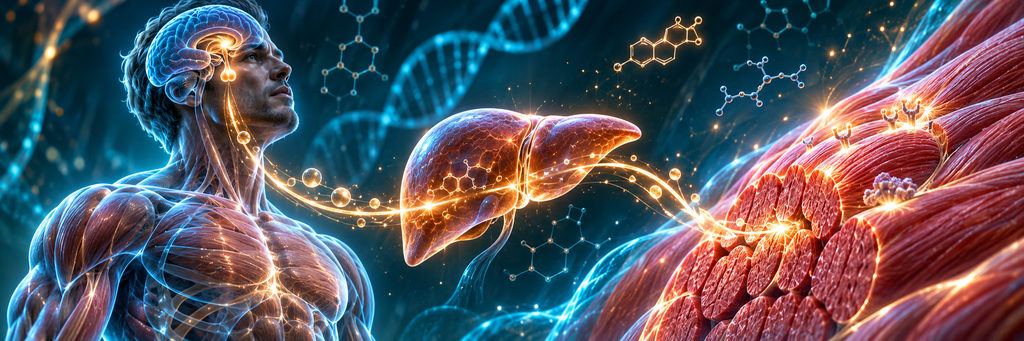
Muscle growth is a complicated biological project. It depends not only on growth-related hormones but also on mechanical tension, sufficient food, muscle protein synthesis, satellite-cell activity, recovery and the nervous system’s ability to recruit muscle. Growth hormone (GH), insulin-like growth factor 1 (IGF-1), and myostatin are involved in that biology. But changing a blood hormone level is not the same thing as building useful muscle or increasing strength.
This article examines four widely discussed peptide combinations and two additional research directions. It distinguishes studied hormonal effects, clinical uses for specific diseases, preclinical muscle biology, and unvalidated community stacks. None of the proposed multi-peptide combinations below is an FDA-approved muscle-building treatment.
1. The Big Picture: Muscle Is More Than Size
Building muscle can support strength, mobility, glucose regulation, athletic performance, and healthy aging. For athletes, the objective may be greater force production or muscle size. For older adults or people recovering from illness, preserving muscle function can be more important than appearance.
The most reliable human evidence still supports progressive resistance training, adequate energy intake, sufficient protein, and consistent recovery. Peptide researchers are asking whether pharmaceutical signals can someday augment those foundations, particularly in conditions involving severe muscle wasting or hormonal disease.
There are reasons for excitement. Several peptide pathways can directly influence GH secretion, IGF-1 signaling, or the signals that restrict muscle growth. Yet trials of compounds targeting the muscle-growth system repeatedly remind us that larger muscles do not necessarily produce proportionally greater strength or functional improvement.
2. The Biological Pathways: The Body’s Muscle-Growth Network
GH release starts in the brain
The hypothalamus sends growth hormone-releasing hormone (GHRH) and somatostatin signals to the pituitary. GHRH promotes GH release; somatostatin restrains it. A second pathway, the ghrelin receptor GHSR-1a, can also stimulate pituitary GH secretion. Natural GH release is pulsatile and is influenced by sleep, exercise, nutritional status, age and health.
CJC-1295 and tesamorelin act in the GHRH pathway, while ipamorelin acts at the ghrelin receptor. The two receptor families can converge on GH secretion, which explains the interest in pairing a GHRH analogue with a GH secretagogue. Converging effects also mean overlapping risks.
IGF-1 links endocrine signals to cell growth
GH stimulates production of IGF-1, especially in the liver, while muscle itself produces locally regulated IGF-1-related signals. The IGF-1 receptor can activate PI3K–AKT–mTOR pathways associated with protein synthesis, growth and survival. These are not muscle-specific switches: growth signals can affect many organs and tissues.
A key distinction: pharmaceutical mecasermin is recombinant human IGF-1 approved for narrowly defined pediatric growth disorders. IGF-1 LR3 and IGF-1 DES, commonly discussed in research communities, are distinct modified compounds and should not be assumed to share mecasermin’s clinical evidence or approved indication.
MGF and satellite cells: intriguing, unfinished biology
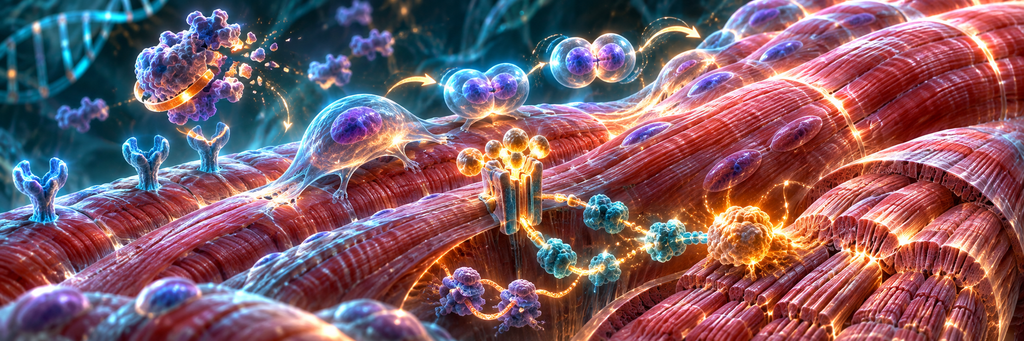
Mechano growth factor (MGF) refers to muscle-associated IGF-1Ec splice-variant biology. IGF-1Ec expression can respond to mechanical load or injury. However, whether a separate endogenous Ec-domain peptide is consistently produced, secreted and independently active remains debated. Commercial synthetic MGF and PEG-MGF preparations are not equivalent to demonstrating a benefit from endogenous transcript changes.
Myostatin is a growth brake
Myostatin, a member of the TGF-beta family, limits muscle growth through activin receptor and SMAD signaling. Blocking myostatin or related ligands has increased muscle size in some experiments and clinical trials, but functional gains are variable. Follistatin-344 is of research interest because follistatin can bind myostatin and additional activin-family proteins, making specificity and off-target effects major questions.
Recovery still requires mechanical loading
Muscle adaptation also depends on repeated, progressively challenging movement, adequate protein and calories, sleep, and allowing sufficient recovery between sessions. Manipulating hormones cannot replace those signals.
3. Peptide Stacks Researchers Are Discussing
Stack A: CJC-1295 + Ipamorelin
Rationale: A GHRH receptor agonist plus a ghrelin-receptor agonist could stimulate pituitary GH release through complementary upstream mechanisms.
What is known: The albumin-binding CJC-1295 with DAC increased circulating GH and IGF-1 in short randomized human pharmacology trials. Those studies measured hormones, not muscle hypertrophy or lifting performance. Ipamorelin has limited human investigation, including a bowel-surgery trial that did not meet its efficacy goals. No controlled human trial has demonstrated that the exact CJC-1295 + ipamorelin blend increases strength, muscle mass, recovery or sleep.
Formulation matters: The long-acting with-DAC CJC-1295 studied in people is not interchangeable with CJC-1295 without DAC, also called modified GRF 1-29. The latter is shorter acting and lacks comparable direct human clinical evidence. A blend label that simply says “CJC-1295” is not sufficiently specific to interpret trial results.
Added risks: GH/IGF-1 elevation, fluid retention, joint discomfort, altered glucose regulation and uncertain immune reactions are concerns. More GH does not guarantee more myofibrillar protein or strength.
Profiles: CJC-1295 with DAC · CJC-1295 without DAC · Ipamorelin · CJC-1295/Ipamorelin blend.
Stack B: IGF-1 + MGF
Rationale: This proposed pairing attempts to combine downstream IGF-1 receptor signaling with muscle-local IGF-1Ec/MGF-associated responses to mechanical stress and regeneration.
What is known: IGF-1 has well-established biology and narrowly defined therapeutic use as mecasermin. Laboratory research on MGF/IGF-1Ec explores muscle repair and satellite-cell regulation; there are no validated clinical trials showing that injected IGF-1 plus synthetic MGF improves bodybuilding outcomes. It is particularly important to identify whether “IGF-1” means native recombinant IGF-1, IGF-1 LR3, or IGF-1 DES, and whether “MGF” means an Ec-domain-derived peptide or PEG-MGF. These are not interchangeable substances.
Added risks: Direct IGF-1 exposure can cause severe hypoglycemia and may affect abnormal cell growth; mecasermin is contraindicated in patients with malignancy. Combining it with unvalidated growth-signaling preparations introduces further uncertainty.
Profiles: IGF-1 LR3 · IGF-1 DES · MGF · PEG-MGF.
Stack C: CJC-1295 + Ipamorelin + MGF
Rationale: A community-proposed multi-pathway approach combining greater GH release with a putative local muscle-response signal.
What is known: Each part has a mechanistic story, but there is no clinical evidence that the three-agent combination produces more muscle than training and nutrition, or that it is safe. Upstream GH stimulation already raises IGF-1, creating biological overlap with the muscle-growth pathways this stack hopes to augment.
Added risks: Multiple unapproved preparations increase manufacturing, sterility, immunogenicity and adverse-effect attribution problems. A larger stack also makes it harder to monitor changes in IGF-1, glucose, edema and other symptoms. Theoretical complementarity is not a valid dosing or safety strategy.
Stack D: Tesamorelin + Ipamorelin
Rationale: Tesamorelin activates the GHRH receptor and ipamorelin targets the ghrelin receptor, an endocrine pairing similar in principle to CJC-1295 plus ipamorelin.
What is known: Tesamorelin is FDA-approved to reduce excess abdominal fat in adults with HIV-associated lipodystrophy. It is not approved for general weight loss or muscle building. Its approved evidence supports a specific disease-related fat outcome, not an athletic hypertrophy claim. There is no established clinical efficacy or safety data for tesamorelin plus ipamorelin as a combination.
Added risks: The tesamorelin label warns about elevated IGF-1, glucose intolerance or diabetes, fluid retention and malignancy-related precautions. Adding ipamorelin may compound signaling along the same GH axis rather than provide an independent muscle-building benefit. Prescribed tesamorelin therapy should not be modified by adding another secretagogue without specialist oversight.
Profile: Ipamorelin. For tesamorelin, see FDA-labeled EGRIFTA WR information; a current public Peptide Perspectives tesamorelin profile was not confirmed in the directory.
Additional research direction: Sermorelin + Ipamorelin
Rationale: Sermorelin, an older GHRH(1-29) analogue, provides another way to study GHRH signaling alongside the ghrelin receptor. This is mechanistically similar to other GHRH-plus-ipamorelin concepts rather than a fundamentally new muscle-building pathway.
Limits: No reliable combination-specific human evidence establishes hypertrophy or improved athletic performance. Substituting one GHRH analogue for another does not solve the central uncertainties about health outcomes and safety.
Profile: Sermorelin.
Additional research direction: Follistatin-344 and myostatin-pathway modulation
Rationale: Unlike GH secretagogues, follistatin-related research seeks to reduce inhibitory signaling that restrains muscle growth. This makes it a mechanistically different area of investigation, not an established ingredient to add to a GH stack.
Limits: Follistatin interacts with several activin-family proteins, with potential reproductive, metabolic and other systemic effects. Even targeted myostatin inhibitors can increase muscle size without reliable corresponding improvements in strength. There is no validated human protocol supporting Follistatin-344 stacked with GH/IGF-1 compounds for performance.
Profile: Follistatin-344.
4. Compare the Research Stacks
| Proposed pairing | Complementary rationale | Evidence for full stack | Main uncertainty |
|---|---|---|---|
| CJC-1295 + Ipamorelin | GHRH receptor plus ghrelin receptor | No controlled human hypertrophy trial | GH/IGF-1 overlap; CJC variant identity; safety |
| IGF-1 + MGF | Systemic/direct IGF-1 plus local IGF-1Ec-related biology | No validated human combination efficacy | Hypoglycemia, growth signaling, MGF identity |
| CJC-1295 + Ipamorelin + MGF | Upstream GH release plus experimental muscle signaling | No validated human combination efficacy | Cumulative endocrine signaling and unknown interactions |
| Tesamorelin + Ipamorelin | Two routes toward pituitary GH release | No validated human combination efficacy | IGF-1 elevation, glucose, fluid retention |
| Sermorelin + Ipamorelin | Shorter-acting GHRH-related signaling plus ghrelin receptor | No validated human hypertrophy trial | Similar overlap to other GH secretagogue pairs |
| Follistatin-related approaches | Myostatin/activin pathway regulation | Preclinical and broader drug-class clinical studies, not validated performance stacks | Off-target effects; mass-to-function gap |
Evidence perspective: It matters whether the outcome is a transient GH rise, increased IGF-1, greater measured lean mass, actual myofibrillar hypertrophy, increased strength, or better function. These are different endpoints. Fluid retention can also change measured lean mass without equivalent muscle gains.
5. Supplements: Where the Stronger Practical Evidence Lies
Creatine monohydrate
Creatine supports rapid ATP regeneration during repeated high-intensity effort. In combination with resistance training, human trials support improvements in strength and modest increases in muscle size or lean mass. It is an especially reasonable evidence-based comparison against more speculative peptide claims. Creatine-related increases in water stored in muscle can raise body weight and lean-mass measurements without being pure new muscle protein.
Whey protein and adequate total protein
Whey is convenient, leucine-rich and well studied. Its main value is helping achieve sufficient daily protein intake when diet alone falls short. A supplement is not inherently superior to a protein-rich meal, and more protein offers diminishing returns once needs are met. Training quality and consistent total intake matter more than elaborate timing rituals.
Essential amino acids and leucine
Essential amino acids (EAAs), particularly leucine, contribute substrates and signaling for muscle protein synthesis. They may help when meals contain too little high-quality protein or when appetite limits intake. If total protein is already adequate, extra EAAs often add little. Branched-chain amino acids alone are not a complete replacement for EAAs or sufficient dietary protein.
HMB (beta-hydroxy-beta-methylbutyrate)
HMB is a leucine metabolite studied for muscle protein turnover and recovery. Evidence is mixed. It may be more useful for some people undergoing high training stress, periods of inactivity, or calorie restriction than for experienced, well-fed lifters. It is not a reliable shortcut to large muscle gains.
Vitamin D, omega-3 fatty acids and carbohydrate availability
Correcting vitamin D deficiency matters for musculoskeletal health, but routine extra vitamin D does not reliably build muscle in people with adequate status. Omega-3 fatty acids may be useful for overall health and selected recovery contexts, but hypertrophy findings are inconsistent. Adequate carbohydrate and energy availability support training performance, while chronic under-fueling undermines adaptation.
Practical ranking: Progressive resistance training and adequate food/protein are foundational; creatine has strong adjunct evidence; EAAs or whey are useful mainly when intake is inadequate; HMB and other supplements are conditional tools. No supplement has been shown to make the unvalidated peptide stacks safe or effective.
6. Risks of Overlapping Growth Signals
A stack with multiple substances acting along the GH → IGF-1 axis is not necessarily multi-pathway in a meaningful clinical sense. CJC-1295, sermorelin and tesamorelin all involve GHRH signaling. Ipamorelin uses a distinct receptor but still converges on GH release. Adding direct IGF-1 or a purported MGF peptide adds uncertainty to the same broad growth-signaling network.
Potential concerns include edema, joint symptoms, changes in glucose handling, hypoglycemia with direct IGF-1, abnormal tissue growth, possible neoplasm-related concerns, allergy, and injection-related contamination. The safety of prolonged combined exposure has not been established. Individuals with diabetes, active or prior malignancy, endocrine disorders, or ongoing growth-related conditions require especially careful medical evaluation.
For tested athletes, GH secretagogues and related anabolic substances may also be prohibited under anti-doping rules. Research-use labels are not evidence of purity, sterility or safety for injection.
7. Where the Science Is Heading
A next generation of muscle research could focus on better separation of the outcomes researchers care about: muscle size, actual contractile protein, strength, mobility, fatigue, and healthy aging. Promising directions include selectively regulating myostatin/activin signaling, understanding local IGF-1 variants, improving therapies for muscle-wasting conditions, and testing whether any intervention adds value beyond a standardized training and protein program.
The ideal studies would measure strength and function, use verified formulations, distinguish drug effects from training effects, and closely monitor glucose, IGF-1, fluid retention and longer-term safety. Instead of assuming that more signaling produces more muscle, researchers need to determine which pathways are genuinely limiting in each population.
8. Explore the Compounds and Research
- CJC-1295 with DAC and without DAC: Related but pharmacologically different GHRH analogues.
- Ipamorelin and CJC-1295/Ipamorelin blend: GH secretagogue research.
- IGF-1 LR3 and IGF-1 DES: Modified growth-factor research compounds, not interchangeable with mecasermin.
- MGF and PEG-MGF: IGF-1Ec-related muscle signaling hypotheses.
- Sermorelin: GHRH-related endocrine signaling.
- Follistatin-344: Myostatin/activin-related research.
- Tesamorelin FDA prescribing information: Approved for a specific HIV-associated lipodystrophy indication, not bodybuilding.
Selected primary sources and reviews: CJC-1295 human pharmacology study; FDA tesamorelin label; FDA mecasermin label; MGF/IGF-1Ec biology review; myostatin-inhibition review; supplement evidence review.
The Bigger Possibility
The science of muscle growth is evolving toward more precise control of the signals that support repair, remodeling and strength. GH-related peptides, IGF-1 variants, and myostatin modulation offer valuable research questions, but the case for combining experimental compounds to build muscle remains unproven. For now, the strongest actionable combination is progressive resistance training, sufficient nutrition and protein, recovery, and creatine when appropriate.
Peptide Perspectives provides educational research information, not personalized medical advice or an administration protocol. The experimental peptide combinations discussed here are not FDA-approved for muscle building and lack established combination-specific efficacy and safety. Do not self-administer research-use injections, substitute them for diagnosed endocrine care, or treat hormone increases as proof of better performance.