
Peptide Stacking & Synergy Series | Article 03
Could a combination of mitochondrial peptides and nutritional compounds support better cellular energy, stress resilience, and physical performance? Explore why the biology is exciting, where clinical evidence exists, and why experimental combinations remain unproven.
1. The Big Picture: Energy Is More Than Feeling Awake
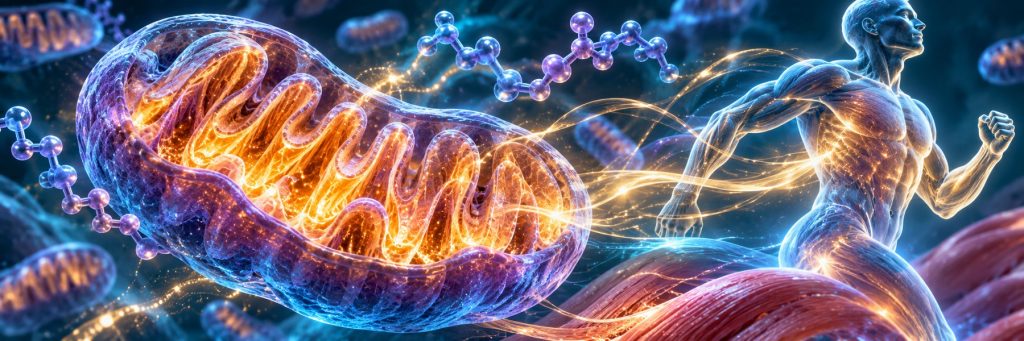
Every heartbeat, muscle contraction, nerve signal, and repair process requires energy. Mitochondria are central to that demand: they convert energy from nutrients into ATP, a molecule cells use to power much of their work. They also help regulate calcium handling, oxidative stress, and signals that determine how cells adapt to changing conditions.
The appeal of a mitochondrial “stack” is easy to understand. What if one molecule helped cells adjust fuel use, another helped preserve the structure of mitochondrial membranes, and a third helped cells survive metabolic stress? The idea is that complementary mechanisms might create resilience that a single intervention cannot.
Researchers are studying three especially interesting peptides: MOTS-C, a mitochondria-encoded signal associated with metabolic adaptation; SS-31 (elamipretide), a synthetic mitochondria-targeting peptide that interacts with cardiolipin; and Humanin, a mitochondria-encoded peptide studied for cellular stress and survival pathways.
These are not equivalent therapies. Elamipretide received FDA accelerated approval in September 2025 for improving muscle strength in eligible people with Barth syndrome weighing at least 30 kg. That specific milestone does not establish a benefit for everyday fatigue, healthy adults, exercise performance, aging, or combinations with other peptides. MOTS-C and Humanin remain investigational without established therapeutic human efficacy. FDA approval announcement | Forzinity prescribing information
There is also a practical lesson: reliable sleep, adequate energy intake, physical conditioning, and treatment of an actual nutritional deficiency can have clearer evidence for human energy and performance than an elaborate experimental peptide combination.
2. The Biological Pathways: How Mitochondria Make and Manage Energy
ATP production and the electron transport chain
Inside mitochondria, proteins in the inner membrane transfer electrons and help build a proton gradient. ATP synthase uses that gradient to produce ATP. The folds of the inner membrane, called cristae, provide an organized setting for this process. Mitochondria are not simply batteries: they continually change their activity to match tissue demand.
Cardiolipin and membrane integrity
Cardiolipin is a specialized lipid concentrated in mitochondrial membranes. It helps organize proteins involved in oxidative phosphorylation. The rare genetic condition Barth syndrome disrupts cardiolipin remodeling, explaining why a cardiolipin-targeting compound such as elamipretide is of particular interest in this disease.
AMPK and metabolic flexibility
AMPK helps cells respond when energy availability is low relative to demand. This pathway influences glucose uptake, fat metabolism, and cellular adaptation. MOTS-C is connected to AMPK-associated biology in preclinical studies. However, the precise mechanisms of administered MOTS-C are still being worked out, including research involving CK2 and other signaling systems.
Stress signaling and apoptosis
Mitochondria also help decide when a heavily damaged cell should undergo apoptosis, or programmed cell death. Humanin has demonstrated effects on some anti-apoptotic pathways in cultured cells and animals. Preventing inappropriate cell death may be protective in some contexts, but keeping damaged or cancerous cells alive may be harmful in others.
Mitochondrial quality control
Cells continually repair, reorganize, and remove malfunctioning mitochondria through processes including fusion, fission, and mitophagy. Physical exercise is an established human intervention that influences mitochondrial capacity and related signaling. This matters because a mechanistically interesting peptide does not replace the benefits of training.
3. The Peptide Stacks Researchers Are Exploring
Stack 1: MOTS-C + SS-31: Metabolic Signaling Meets Membrane Protection
Research logic: MOTS-C is studied for metabolic adaptation and stress signaling, whereas SS-31 primarily targets mitochondrial membrane-associated biology. In theory, this could address both the regulation of energy demand and the environment in which ATP-producing machinery operates.
What supports MOTS-C: Published mouse and cell studies have reported AMPK/PGC-1α-associated changes, improved muscle mitochondrial bioenergetics, and altered oxidative-stress markers. A 2026 study used transgenic mouse models to explore these mechanisms. The study also included a limited human exercise-related measurement, which does not establish therapeutic benefit from administering MOTS-C to people. 2026 mechanistic study | 2021 physical-performance mouse study
What supports SS-31: Elamipretide has been studied in human mitochondrial disorders and, importantly, now has a narrowly defined U.S. approved use for Barth syndrome. Its approval relied on an intermediate measure of muscle strength, under the accelerated approval framework. The FDA does not consider that approval proof of benefit for general energy or fitness.
What is missing: No reliable controlled human trial establishes that MOTS-C + SS-31 improves ATP production, endurance, fatigue, or muscle health more than either agent or standard care. The combination has no established clinical dose, schedule, or interaction profile.
Overlapping-pathway warning: Although the compounds have different primary research emphases, both influence mitochondrial stress biology. Their combined effects could be redundant or unpredictable rather than additive. Unregulated injectable MOTS-C adds identity, sterility, immunogenicity, and unknown-safety concerns.
Verdict: The most conceptually complementary of the three experimental pairings for studying metabolic signaling alongside membrane integrity, but not a validated treatment stack.
Stack 2: SS-31 + Humanin: Membrane Biology Meets Cell-Survival Signaling
Research logic: SS-31 centers on the mitochondrial membrane and cardiolipin, while Humanin has been studied as a mitochondrial-derived signal influencing apoptosis, neuronal stress responses, and metabolism. The pairing raises an interesting question: can protecting the organelle and adjusting a cell’s stress response be useful in the same setting?
What supports Humanin: Its science includes cell-culture and animal findings involving BAX/BID/BIM-related death pathways, receptor-associated signaling, and experimental neuroprotection. Human observational associations do not show that administering Humanin treats fatigue or mitochondrial disease. Analogue studies using HNG (S14G-Humanin) should not automatically be treated as findings for native Humanin.
What supports SS-31: Its specific clinical advance in Barth syndrome provides an important example of mitochondrial-targeted drug development, without validating a Humanin combination.
What is missing: No controlled human evidence demonstrates the safety or efficacy of SS-31 + Humanin as a pair. No evidence establishes that adding Humanin improves the FDA-approved Barth syndrome indication.
Distinct safety question: Humanin-related anti-apoptotic effects are not universally desirable. Certain preclinical cancer models raise concerns about tumor-cell survival and response to treatment. This is not proof that Humanin causes cancer in humans, but it is a serious reason not to describe it as a universally protective add-on.
Verdict: Strong conceptual interest in cellular stress research, paired with unusually important questions about the context in which cytoprotection helps or harms.
Stack 3: MOTS-C + Humanin: Two Mitochondria-Derived Signals
Research logic: Both peptides are encoded by mitochondrial DNA, yet are linked to different signaling emphases. MOTS-C is associated with metabolic adaptation, whereas Humanin is more directly associated with stress resistance and cell survival.
What research suggests: Mouse and cellular studies suggest metabolic and protective actions from each peptide. Humanin-related analogues have produced changes in selected metabolic outcomes in rodents, but these do not translate into proven enhancement of human exercise performance, sustained energy, or lifespan.
What is missing: There is no established clinical evidence that pairing the two improves human ATP generation, strength, stamina, or resilience. The fact that both are naturally produced does not establish that injections or other synthetic formulations are safe.
Overlapping-pathway warning: Both may affect stress-responsive signaling and metabolic regulation, potentially complicating glucose-related outcomes, adverse-event attribution, and interpretation of laboratory biomarkers.
Verdict: A useful research model for mitochondrial communication, not a proven energy or longevity regimen.
Beyond the Three: Additional Research Directions
Mitochondrial quality-control support: Urolithin A is not a peptide, but has been investigated for mitophagy-related mechanisms in human studies. Its early findings warrant exploration as an alternative research direction, not as a validated additive to mitochondrial peptide stacks.
Other metabolic compounds: AICAR and experimental ERR agonists such as SLU-PP-332 affect exercise-related pathways but are not validated human performance treatments. Adding these to MOTS-C would create more pathway overlap and additional uncertainty.
The restraint principle: A four- or five-compound combination may sound comprehensive but multiplies uncertainties. There is no reason to assume more mitochondrial targets will mean more usable energy.
4. Supplements That May Complement Mitochondrial Health
Supplement strategies should begin with the person’s goal and nutritional status. A supplement supported for strength training is not automatically proven to improve mitochondrial disease; an increase in a blood biomarker is not the same as feeling more energetic.
CoQ10: The electron-transport cofactor
Coenzyme Q10 helps carry electrons in the mitochondrial respiratory chain and also participates in antioxidant biology. Human randomized trials have examined fatigue and exercise performance. A 2022 meta-analysis of 13 randomized trials reported an average reduction in fatigue scores, but more recent exercise-focused reviews have found small, inconsistent performance effects. Formulation and absorption vary, and CoQ10 can interact with medications such as warfarin. Fatigue meta-analysis | Exercise review
Best research fit: Exploring fatigue outcomes in selected populations, with modest expectations for athletic performance. Not proven: synergy with MOTS-C, SS-31, or Humanin.
PQQ: A possible signaling adjunct, not a proven mitochondrial builder
Pyrroloquinoline quinone has antioxidant and redox-related properties and is frequently marketed as a stimulus for mitochondrial biogenesis. Some small human studies explore fatigue, mood, sleep, and biomarkers, but evidence is limited by sample sizes, study designs, and formulation differences. Claims that PQQ reliably creates new mitochondria in people or enhances the effects of SS-31 are not established.
Best research fit: An exploratory nutritional topic rather than a foundational performance intervention.
Creatine: The strongest practical performance addition
Creatine supports rapid ATP regeneration through the phosphocreatine system, especially during short, intense efforts. This system is distinct from mitochondrial oxidative phosphorylation but functionally complements it during exercise. Human evidence supports benefits for strength and high-intensity performance when paired with training, though responses vary.
Best practical fit: Resistance training, strength maintenance, and repeated high-intensity performance. Not proven: that creatine improves the effects of mitochondrial peptide injections. Creatine can increase body water and may affect interpretation of serum creatinine; kidney concerns warrant individualized review.
NAD+ precursors: Clear biochemical activity, uncertain functional benefit
Nicotinamide riboside (NR) and nicotinamide mononucleotide (NMN) are studied as precursors of NAD+, a cofactor involved in cellular redox reactions and many enzymes. A 2026 systematic review of 33 human intervention studies found that oral precursor products generally affected NAD-related biomarkers, but functional and healthspan outcomes were inconsistent or frequently null. Raising NAD+ is not synonymous with increasing athletic performance or reversing aging. 2026 systematic review
Best research fit: Human metabolism and biomarker studies, with product quality and regulatory differences considered. Not proven: clinical benefit when added to a mitochondrial peptide stack.
B vitamins: Most valuable when a deficiency exists
Thiamin (B1), riboflavin (B2), niacin (B3), pyridoxine (B6), folate (B9), and B12 contribute to metabolism in different ways. Several are cofactor precursors needed for enzymatic reactions associated with energy production. Correcting a verified deficiency can improve relevant symptoms and physiological function; taking large doses without deficiency generally does not create extra ATP output or performance.
Excess vitamin B6 can cause neuropathy, and some high-dose B-vitamin regimens have other risks. Specific mitochondrial disorders sometimes require specialist-directed formulations.
Best practical fit: Dietary adequacy and targeted replacement when clinical history or testing indicates a need.

5. Comparing the Compounds and Strategies
| Component | Main pathway or role | Evidence level | Potential research or practical value | Important limitation |
|---|---|---|---|---|
| MOTS-C | Metabolic and stress-responsive signaling, including AMPK-associated biology | Primarily cell and animal studies; human observational findings | Metabolic adaptation, muscle bioenergetics | No established human therapeutic efficacy, dosing, or safety |
| SS-31 / elamipretide | Cardiolipin-associated mitochondrial membrane targeting | Human trials; FDA accelerated approval for eligible Barth syndrome patients | Narrow approved muscle-strength indication; mitochondrial drug development | No established general fatigue, performance, or stack benefit |
| Humanin | Cell-survival, apoptosis-related and stress-signaling pathways | Cell and animal studies; human associations | Cytoprotection and mitochondrial communication research | No established therapeutic human benefit; cancer-related preclinical cautions |
| CoQ10 | Electron transport and redox roles | Human randomized trials and reviews | Some fatigue-related research | Athletic results inconsistent; potential interactions |
| PQQ | Redox and signaling research | Small human and preclinical studies | Experimental mitochondrial-related nutritional research | Reliable performance benefit unproven |
| Creatine | Phosphocreatine ATP buffering | Strong human exercise evidence | Strength and repeated high-intensity performance | Not a direct proven therapy for mitochondrial disease |
| NR / NMN | NAD+ precursor pathways | Human biomarker trials, variable clinical results | NAD metabolism research | Biomarker effects do not guarantee functional benefits |
| B vitamins | Enzymatic cofactors | Strong clinical evidence for correcting deficiency | Restoring normal function if deficient | Excess supplementation may cause harm |
Evidence perspective: There is no clinical evidence that any of the three proposed peptide pairs works better than one peptide alone. Current data also cannot establish which theoretical combination has the best benefit-risk profile.
6. Where the Science Is Heading: The Right Kind of Synergy
More disease-specific mitochondrial medicines
Elamipretide’s Barth syndrome approval is a meaningful milestone because it shows that mitochondrial drug development can reach regulated clinical care. It also illustrates why results must be evaluated for an identified disease and a measured clinical endpoint, not generalized to all forms of tiredness.
Better measures than “more ATP”
Researchers need outcomes that matter to patients: walking ability, muscle strength, exercise tolerance, fatigue scores, activities of daily living, and adverse events. Laboratory measures of mitochondrial respiration can support a mechanism but do not independently prove people feel or function better.
Understanding which cells benefit
Mitochondria are present throughout the body, but a compound’s actions can differ by tissue, age, disease, and cellular stress. A beneficial signal in skeletal muscle may not have the same implications in the heart, immune system, or tumor environment.
Combination trials built around real comparisons
Future studies should compare each peptide alone with the combination and appropriate control groups. They should track pharmacokinetics, dose exposure, immune reactions, glucose regulation, renal and hepatic safety, and longer-term consequences. If studies skip the single-agent arms, even a positive result might not establish synergy.
Supplements with realistic expectations
Creatine, nutritional adequacy, and tailored correction of deficiencies provide a more defensible starting point for performance support than self-directed experimental peptide stacks. CoQ10, PQQ, and NAD+ precursors remain useful subjects for targeted studies, but the evidence does not support indiscriminate supplement layering.
7. Explore the Compounds
- MOTS-C: Metabolic signaling and mitochondrial adaptation
- SS-31 / Elamipretide: Cardiolipin and mitochondrial membrane research
- Humanin: Cell survival and mitochondrial stress signaling
- AICAR: AMPK-associated research
- SLU-PP-332: Experimental ERR signaling
Selected Further Reading
- FDA: Elamipretide accelerated approval for Barth syndrome
- FDA-approved Forzinity labeling
- 2026 MOTS-C bioenergetics study
- 2021 MOTS-C and physical performance study
- CoQ10 fatigue meta-analysis
- CoQ10 performance meta-analysis
- NAD+ precursor evidence review
The Bigger Possibility
The most exciting prospect is not a universal “mitochondrial booster.” It is the possibility of learning which cellular process is failing, which tissue needs help, and which targeted intervention can actually restore function. SS-31 shows that such a research approach can reach a narrowly defined clinical indication. MOTS-C and Humanin offer valuable scientific hypotheses that still need human testing.
More compounds do not automatically create more energy. Better evidence, thoughtful combinations, sound nutrition, and measurable outcomes are the path forward.
Medical and research disclaimer: Peptide Perspectives provides educational research information, not individualized treatment advice. MOTS-C and Humanin are not FDA-approved therapeutic products. Elamipretide’s approval applies to a specific eligible Barth syndrome population and does not validate off-label stacking. None of the proposed peptide combinations has established human clinical efficacy or an evidence-based dosing schedule. Experimental compounds and unregulated injectable products can introduce contamination, immune, interaction, and unknown long-term safety risks. Speak with a qualified clinician about persistent fatigue, exercise intolerance, or suspected mitochondrial disease.