
What if the next generation of pain research looks beyond temporarily quieting symptoms and begins to address inflammation, injured nerves, and tissue recovery? Scientists are examining how peptides influence different parts of the pain system, from immune signaling to neuroprotection.
1. The Big Picture: Chronic Pain Is More Than a Warning Signal
Pain is an essential protective system. It alerts us to injury and encourages us to protect vulnerable tissues. But pain can also persist long after an injury should have healed, or arise from altered nerve signaling without ongoing tissue damage. For people living with chronic pain, this can affect sleep, movement, work, relationships, and quality of life.
Chronic pain is generally defined as pain that persists or recurs for more than three months. Importantly, it is not a single disease or mechanism. Arthritis-related pain, painful small-fiber neuropathy, inflammatory bowel disease, persistent tendon pain, migraine, and fibromyalgia can involve very different biological processes. Some overlap, but they are not interchangeable.
That complexity explains why peptide research is attracting attention. Peptides are short chains of amino acids that can act as signaling molecules. Some influence immune activity; others participate in nerve communication, tissue protection, and repair. The possibility of identifying which biological mechanism contributes to a particular kind of pain is more interesting than assuming one compound can treat every chronic pain condition.
The current evidence is uneven. ARA-290 (cibinetide) has reached randomized human trials in specific small-fiber neuropathies. KPV has intriguing anti-inflammatory laboratory and animal findings, while BPC-157 has a much broader preclinical tissue-repair literature but very limited human evidence. VIP illustrates a surprising complication: a peptide that can influence inflammation and nerve signaling may also trigger headache under certain conditions. And blocking the CGRP peptide pathway has already produced approved migraine medicines.
The research opportunity is compelling, but less pain, less inflammation, and tissue regeneration are three different outcomes. Good clinical trials need to measure them separately.
2. The Biological Pathways: Why Pain Can Persist
Inflammation: Helpful Defense Can Become an Ongoing Signal
When tissue is injured, immune cells release signals that coordinate protection and repair. Cytokines such as TNF-alpha, IL-1beta, and IL-6, alongside pathways such as NF-kappaB, can also change how sensitive nearby pain-sensing nerve endings become.
Inflammation is not always the cause of chronic pain, and shutting down immune signaling completely would be unsafe. KPV is of interest because it affects selected inflammatory pathways in experimental systems. The question is whether future formulations can control harmful inflammation while preserving healthy immune defense.
Nerve-Related Pain: When the Wiring Becomes Part of the Problem
Neuropathic pain results from disease or injury affecting the somatosensory nervous system. It may feel like burning, tingling, electric shocks, or painful sensitivity to normally harmless touch. Small-fiber neuropathy can affect tiny sensory nerve fibers involved in pain and temperature.
ARA-290 has been studied specifically in some people with small-fiber neuropathy, with investigators measuring both symptoms and nerve-fiber structure. The work is promising because it asks whether nerve-related outcomes can change alongside pain, rather than assuming symptom relief alone proves nerve regeneration.
Central Sensitization and Nociplastic Pain: The Volume Knob Changes
Sometimes the nervous system becomes more responsive, amplifying pain signals even without a proportionate new injury. In some people, this contributes to nociplastic pain, a category in which altered nociceptive processing is prominent without clear evidence that tissue damage or a nerve lesion fully explains the pain.
The brain and spinal cord are active participants in pain processing. Sleep, stress, past injury, movement, and the body’s descending pain-control networks all matter. That does not make the pain imaginary. It means successful treatment may need to address nervous-system sensitivity as well as tissue biology.
Tissue Protection and Remodeling: Healing Is Not the Same as Analgesia
Tendons, ligaments, skin, and muscle heal through overlapping processes that include inflammation, cell migration, blood-vessel signaling, and collagen remodeling. BPC-157 and full-length thymosin beta-4 are investigated in selected animal injury models for their effects on these processes.
However, a tissue that looks better under a microscope does not necessarily hurt less or function better. Conversely, a pain treatment can reduce nerve signaling without rebuilding damaged tissue. Both measures are essential in regenerative pain research.
Neurovascular Peptides: The Same Signal Can Help or Hurt
VIP and calcitonin gene-related peptide (CGRP) participate in communication between nerves, blood vessels, and immune cells. These signals can have protective roles in some contexts and pain-promoting effects in others. Migraine research has made this distinction especially clear: blocking CGRP signaling, not adding CGRP, can prevent attacks in appropriately selected patients.
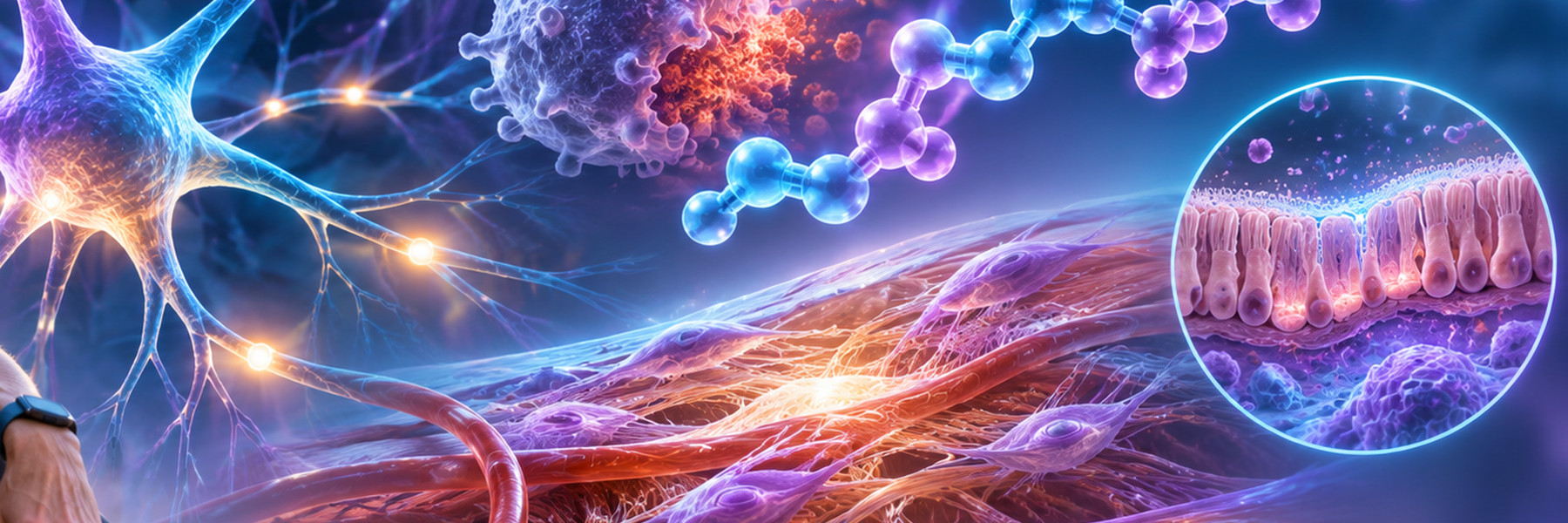
3. Compounds Researchers Are Exploring
ARA-290 (Cibinetide): A Human Research Lead for Small-Fiber Neuropathy
Explore ARA-290 on Peptide Perspectives.
ARA-290, also called cibinetide, is an experimental 11-amino-acid peptide derived from a tissue-protective region of erythropoietin. It was designed to investigate tissue-protection signaling without relying on erythropoietin’s red-blood-cell-producing effects.
Its most relevant human findings come from sarcoidosis-associated small-fiber neuropathy. In a 22-person randomized pilot study, an improvement was reported in a small-fiber symptom score, although the primary pain measure improved similarly in both treatment groups. A later 64-person Phase 2b trial reported significant improvement in a corneal nerve-fiber measure at one tested dose. Some pain-related outcomes showed encouraging patterns, but the placebo-corrected moderate-to-severe pain comparison was not statistically significant.
Why researchers are interested: Cibinetide explores an important possibility: neuroprotective approaches could affect nerve structure or function as well as symptoms. What remains unknown: Whether these results translate into reliable, lasting pain improvement in larger, diverse human populations. ARA-290 remains investigational and is not FDA-approved for chronic pain.
KPV: Exploring Inflammatory Signals That May Sensitize Nerves
Explore KPV on Peptide Perspectives.
KPV (Lys-Pro-Val) is a three-amino-acid fragment of alpha-melanocyte-stimulating hormone. Laboratory work suggests that it can reduce selected NF-kappaB and MAPK inflammatory signals, and one mechanistic study showed uptake through the peptide transporter PepT1 in intestinal and immune-cell models.
A Gastroenterology study reported reduced intestinal inflammation in two mouse colitis models. That makes KPV relevant to research on inflammatory environments in which pain may arise, particularly within the gastrointestinal tract.
Why researchers are interested: Local anti-inflammatory signaling could eventually be useful for conditions where excessive inflammation contributes to symptoms. What remains unknown: There are no adequate human clinical trials demonstrating that KPV relieves chronic pain, treats arthritis, or improves neuropathy. Results from experimental intestinal formulations cannot be assumed to apply to injected KPV or other products.
BPC-157: Tissue Repair and the Question of Painful Injury
Explore BPC-157 on Peptide Perspectives.
BPC-157 is a synthetic pentadecapeptide studied in animal models of tendon, ligament, muscle, nerve, and gastrointestinal injury. Investigators have reported effects on cell migration, blood-vessel-associated signaling, tissue organization, and selected functional recovery measures.
These findings offer a plausible research connection to pain that accompanies injured tissue. But the human evidence is extremely limited. An October 2026 systematic review identified three small human studies involving 30 people in total, including uncontrolled studies of knee pain and interstitial cystitis symptoms. Certainty was rated very low because of study design and sample-size limitations.
Why researchers are interested: Understanding whether a compound supports actual tissue recovery could inform treatments for some painful injuries. What remains unknown: Whether BPC-157 reliably reduces pain or restores function in people, and whether long-term exposure is safe. It is not FDA-approved for pain or tissue repair, and research-grade products are not established clinical medicines.
VIP: A Neuroimmune Peptide That Demonstrates Why Context Matters
Explore VIP research and migraine findings.
Vasoactive intestinal peptide (VIP) is a naturally occurring neuropeptide involved in blood-vessel function, intestinal secretion, and nerve–immune communication. Experimental researchers are interested in how VPAC receptors affect inflammatory and neuronal signaling.
However, VIP is not simply an anti-inflammatory pain treatment. In a randomized crossover trial of 21 people with migraine, a prolonged VIP infusion provoked migraine attacks in 15 of 21 participants, compared with 1 of 21 after placebo. That is a clear human example of a peptide signaling pathway contributing to pain rather than relieving it.
Why researchers are interested: VIP can help identify neurovascular and neuroimmune pathways that might eventually be targeted more selectively. What remains unknown: Whether a particular VIP-receptor intervention could safely treat any defined chronic pain condition. VIP administration should not be promoted as a general analgesic; it can have vascular and secretory effects and is not FDA-approved for chronic pain.
Thymosin Beta-4: Cell Migration and Recovery, Not a Proven Pain Medicine
Explore full-length Thymosin Beta-4.
Full-length thymosin beta-4 (Tβ4) is a 43-amino-acid peptide that interacts with actin, an important component of the cellular structure that helps cells move and remodel tissue. Experimental studies have examined inflammatory signaling, wound closure, and tissue responses to injury.
Small human ophthalmic trials have studied a specialized Tβ4 eye-drop formulation for certain corneal-healing conditions. Those findings do not establish relief of chronic musculoskeletal pain or generalized nerve injury. Products labeled TB-500 may contain a different fragment and should not be treated as interchangeable with the full-length peptide.
Why researchers are interested: Better healing may eventually help certain injury-related pain states. What remains unknown: Whether any systemic Tβ4 formulation improves pain, mobility, or recovery in controlled human studies. It is not FDA-approved for chronic pain.
LL-37: Host Defense with Both Protective and Inflammatory Effects
Explore LL-37 on Peptide Perspectives.
LL-37 is a naturally occurring human antimicrobial peptide involved in defense against microbes and communication among epithelial and immune cells. Its actions can include both pro-inflammatory and anti-inflammatory signaling, depending on tissue and experimental context.
That makes LL-37 relevant to the biology of neuroimmune sensitization, but not an established pain-relieving compound. A small human topical trial investigated difficult-to-heal venous leg ulcers, not chronic nerve pain. In some experimental settings, excess inflammatory signaling could plausibly worsen symptoms rather than improve them.
Why researchers are interested: LL-37 may reveal how antimicrobial defense, inflammation, and tissue recovery are connected. What remains unknown: Whether externally administering LL-37 is safe or effective for any chronic pain condition. No FDA-approved LL-37 treatment exists for this purpose.
Oxytocin: A Pain Modulator at the Brain–Body Interface
Explore Oxytocin on Peptide Perspectives.
Oxytocin is an endogenous nine-amino-acid hormone and neuropeptide involved in childbirth, lactation, social behavior, and neural communication. It also interacts with pathways that can influence pain perception, stress responses, and descending pain control.
Human studies have investigated intranasal and other research formulations for several pain conditions, but results are mixed and highly context-dependent. A 2026 research perspective argues that oxytocin may be better understood as a potential biopsychosocial adjunct than as a universal analgesic.
Why researchers are interested: Pain is influenced by more than peripheral injury, and oxytocin offers a window into the links among stress, neural signaling, and perception. What remains unknown: Which patients, if any, gain reliable chronic pain benefits and what regimen would be safe. FDA-approved oxytocin uses in obstetrics do not establish approval for chronic pain treatment.
CGRP: The Clearest Example of a Pain Peptide Leading to Approved Treatment
Explore CGRP-targeted migraine research.
Calcitonin gene-related peptide (CGRP) is an endogenous neuropeptide involved in blood-vessel signaling and pain transmission, particularly in the trigeminal system relevant to migraine.
The breakthrough has come from blocking CGRP or its receptor, not administering the peptide itself. Multiple FDA-approved monoclonal antibodies and small-molecule receptor antagonists (gepants) are used for migraine prevention or treatment according to the individual product’s indication. A 2025 scientific review discusses the substantial randomized-trial evidence for preventive CGRP antibodies.
Why researchers are interested: CGRP is proof that understanding a peptide-based pain signal can produce clinically valuable targeted medicines. What remains unknown: Which additional pain disorders might benefit from carefully chosen neuropeptide targets. Migraine data do not establish treatment for all forms of chronic pain.
4. Comparing the Compounds
| Compound or pathway | Principal mechanism | Main pain-related research interest | Evidence level and U.S. status | Major limitation |
|---|---|---|---|---|
| ARA-290 / Cibinetide | Tissue-protective signaling and small-nerve-fiber biology | Selected small-fiber neuropathies | Small randomized human studies; investigational | Structural nerve signals encouraging; pain results mixed and not definitive |
| KPV | NF-kappaB / MAPK-associated inflammatory signaling | Inflammation-related pain mechanisms | Cell and animal evidence; not FDA-approved | No controlled human chronic pain outcomes |
| BPC-157 | Experimental tissue repair, cell migration and vascular signaling | Pain associated with injury and tissue repair | Animal studies; extremely limited uncontrolled human data | No reliable efficacy, long-term safety, or standardized formulation |
| VIP | VPAC-related neuroimmune and vascular signaling | Neurogenic inflammation and migraine pathways | Mechanistic research; human migraine provocation trial | Prolonged administration can trigger migraine; not a general analgesic |
| Thymosin beta-4 | Actin regulation and cellular migration | Injury repair and tissue remodeling | Preclinical; limited human ophthalmic trials | Improved healing in one context does not prove chronic pain relief |
| LL-37 | Antimicrobial and immune signaling | Inflammation, barrier repair, immune–nerve interplay | Preclinical; small topical wound study | Can amplify or reduce inflammation; no chronic pain indication |
| Oxytocin | Central and peripheral neuropeptide signaling | Pain perception, stress and modulation | Mixed small human studies; no chronic pain approval | Context-dependent effects; no validated general pain therapy |
| CGRP pathway | Trigeminal pain signaling and neurovascular effects | Migraine prevention and treatment | Approved CGRP-blocking medicines supported by human trials | Blocking the pathway is beneficial in migraine; CGRP itself is not a treatment |
How to interpret the evidence: A lower inflammatory marker, a repaired animal tendon, an increase in corneal nerve fibers, and a clinically meaningful improvement in daily function are different findings. Each can justify further research, but they should not be presented as equivalent proof of pain relief.
5. Where the Science Is Heading
More Precise Treatments for Different Types of Pain
The most promising future is likely to involve matching the intervention to the mechanism. Some conditions are driven mainly by ongoing tissue inflammation; others involve a demonstrable nerve lesion, while still others involve altered pain processing and overlapping physical, psychological, and social factors.
New trials will need to identify the right participants, then assess not only pain scores but also walking ability, daily activities, sleep, work participation, and quality of life.
Measuring Nerve Repair Rather Than Assuming It
Cibinetide research offers a useful model: clinicians can use corneal confocal microscopy, skin nerve-fiber measurements, and sensory testing alongside patient-reported outcomes. These tools may help distinguish a true nerve-related change from short-lived symptom fluctuations.
However, improved nerve-fiber appearance is not automatically proof of pain recovery. Large, longer studies must determine whether structure, sensation, and daily function change together.
Targeted Inflammation Control Without Suppressing All Immune Defense
KPV illustrates the appeal of identifying localized inflammatory pathways. Research into delivery systems could eventually make it possible to focus treatment on an inflamed tissue while limiting exposure elsewhere.
But inflammation is also necessary for infection control and healing, and pain may persist after inflammation has subsided. The goal is precise regulation, not shutting down the immune system.
From Peptide Biology to Approved Non-Opioid Medicine
CGRP-targeted migraine therapies demonstrate that identifying the right peptide pathway can change clinical practice. Other pain targets are moving forward too. In January 2025, the FDA approved suzetrigine (Journavx), a non-peptide NaV1.8 sodium-channel blocker for moderate-to-severe acute pain in adults. It is not approved for general chronic pain, but it shows how mechanism-based non-opioid therapies can reach patients. Read the FDA announcement.
Another related but non-peptide research compound is palmitoylethanolamide (PEA), an endogenous lipid mediator. A 2025 meta-analysis found encouraging pain-related outcomes across small and heterogeneous human trials. Its evidence should be assessed independently rather than used to validate experimental peptide therapies.
The Unanswered Questions
Before experimental peptides can become dependable chronic pain treatments, researchers need to establish which conditions actually respond, which formulations reach the relevant tissue, whether benefits persist, how adverse effects are monitored, and whether symptom changes translate into better function.
For now, evidence-based care remains essential. Depending on the pain condition, this can include diagnosis and treatment of underlying disease, physical rehabilitation, cognitive and behavioral approaches, appropriate medications, and multidisciplinary pain care. New peptide research should complement that foundation, not replace it.
6. Explore the Compounds and Research
Direct Peptide Perspectives profiles:
- ARA-290 (Cibinetide): Nerve protection and small-fiber neuropathy
- KPV: Inflammatory signaling and experimental immune regulation
- BPC-157: Tissue repair, soft-tissue injury, and inflammation
- Thymosin Beta-4 (Full Length): Cellular migration and tissue remodeling
- LL-37: Immune signaling and antimicrobial defense
- Oxytocin: Brain–body signaling and pain modulation research
Additional clinical and mechanistic research:
- VIP: Human migraine provocation study
- CGRP: Migraine prevention therapies targeting the peptide pathway
- ARA-290: Randomized corneal nerve-fiber study
- BPC-157: 2026 systematic review of human evidence
- PEA: Human pain-study meta-analysis (related non-peptide compound)
VIP and CGRP are linked to published research because dedicated public Peptide Perspectives profiles could not be confirmed for this article.
The Bigger Possibility
The future of chronic pain research may not be one new compound that makes every kind of pain disappear. It may be a more precise understanding of why pain persists, followed by treatments directed at the relevant biology.
ARA-290 brings nerve protection into the conversation. KPV investigates inflammatory signaling. BPC-157 and thymosin beta-4 raise questions about tissue recovery. VIP and CGRP reveal how complex neurovascular peptide signaling can be, and how a mechanism may sometimes need to be blocked rather than stimulated.
The most exciting advances will be those that demonstrate less pain, better function, and greater independence in well-designed human trials, while maintaining the safety standards that patients deserve.
Peptide Perspectives publishes educational research, not individualized medical advice. ARA-290, KPV, BPC-157, VIP, thymosin beta-4, LL-37, and oxytocin are not FDA-approved treatments for general chronic pain. Investigational research products may lack verified identity, sterility, or long-term human safety data. Persistent, progressive, or unexplained pain deserves clinical assessment, and new weakness, bladder or bowel dysfunction, fever with severe back pain, or other neurological warning signs require prompt medical attention.