
Can a small chain of amino acids help skin look and function better? From copper-binding peptides to collagen signals and expression-line research, cosmetic science is exploring the cellular language behind healthier-looking skin.
1. The Big Picture: Skin Renewal Begins Beneath the Surface
Healthy skin does more than look smooth. It protects us from environmental stress, helps retain moisture, provides sensation, and repairs itself after everyday wear. As skin ages, its appearance changes for many reasons: collagen fibers become more fragmented, elastin loses some of its resilience, natural moisture regulation shifts, and repeated facial expressions leave increasingly visible lines.
Sun exposure is a particularly important accelerator of these changes. Ultraviolet light can promote oxidative stress and enzymes that break down the skin’s structural framework. Genetics, hormones, smoking, inflammation, and normal aging also influence how skin responds.
Peptides are attracting attention because many are designed around signals skin cells already recognize. Some may encourage fibroblasts to support the extracellular matrix, the network surrounding cells. Others are inspired by signaling involved in facial expression lines. A newer group is being investigated for the cellular stresses associated with skin aging.
This research is more sophisticated than simply claiming a cream “adds collagen.” Scientists want to know whether a peptide reaches the right layer of skin, changes a relevant biological process, and produces visible, repeatable results in people.
There is reason for optimism. A 2026 systematic review of randomized trials evaluated 19 studies with 1,341 participants and found improvements in some skin-aging measures. But the pooled wrinkle benefit was modest, and much of it was driven by oral peptide formulations rather than topical treatments. Results for elasticity and skin density were inconsistent.
That makes the best message both encouraging and precise: some peptide-containing products can improve the appearance of skin, but their effects depend on the exact ingredient, formulation, clinical study, and endpoint.
2. The Biological Pathways: What Really Changes as Skin Ages?
Collagen: The Structural Scaffolding
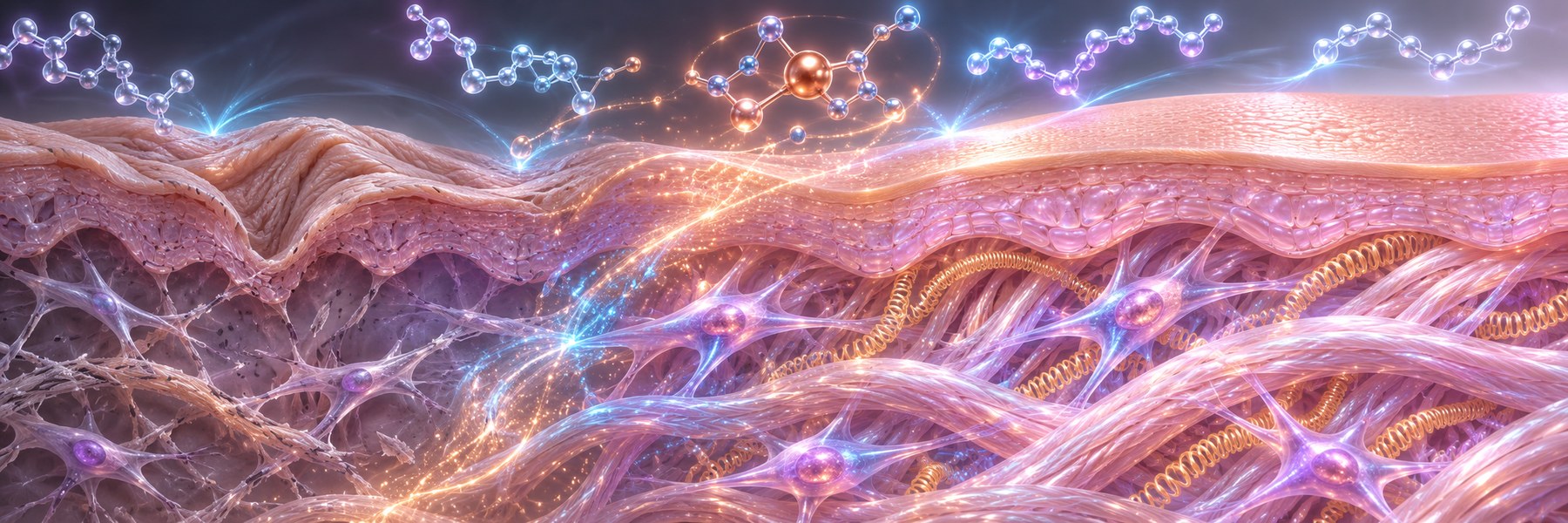
The dermis, the deeper layer of the skin, contains collagen fibers that provide tensile strength. Fibroblasts produce and organize much of this network. Over time, collagen production and repair can decline, while UV exposure and inflammatory signaling increase breakdown by enzymes called matrix metalloproteinases (MMPs).
GHK-Cu, Matrixyl, and SYN-COLL are studied for different proposed ways to influence collagen-associated pathways. But more collagen in a laboratory dish does not automatically mean visibly firmer human skin.
Elastin, Hydration, and the Skin Barrier
Collagen provides strength; elastin helps skin stretch and rebound. The extracellular matrix also contains hyaluronic acid and other molecules that influence hydration and mechanical behavior. Above the dermis, the epidermal barrier limits water loss and keeps irritants out.
This distinction matters because a moisturizer can make fine lines temporarily less visible by hydrating the outer skin, without rebuilding the deeper collagen network. Researchers therefore measure hydration, barrier function, elasticity, and wrinkle depth as different outcomes.
Expression Lines: Repeated Movement Meets Skin Structure
Smiling, squinting, and frowning repeatedly fold the skin. These dynamic wrinkles can gradually become visible even when the face is relaxed, particularly as the dermis loses elasticity.
SNAP-8, SYN-AKE, and Argireline were developed around experimental mechanisms associated with nerve-to-muscle signaling. Their proposed actions differ, but they share a major unanswered question: can an ordinary cosmetic cream deliver enough active ingredient to the relevant neuromuscular structures to change facial movement?
These peptides are not equivalent to injectable botulinum toxin, which has a different, well-established mechanism and much stronger human efficacy evidence.
Cellular Repair and the Aging Skin Environment
Healthy skin constantly renews its surface and responds to microscopic damage. Fibroblast behavior, inflammation, oxidative stress, and the buildup of certain senescent cells may all influence the local environment.
The emerging OS-01 research program investigates skin-aging and barrier-related outcomes through a proposed senomorphic approach, while copper-binding peptides such as GHK-Cu are studied for signals involved in remodeling. These are distinct approaches, not proof that a topical peptide reverses the biological age of an entire person.
3. Compounds Researchers Are Exploring
GHK-Cu: Copper-Binding Signals and Skin Remodeling
Explore GHK-Cu on Peptide Perspectives.
GHK-Cu is a complex of the naturally occurring tripeptide glycyl-L-histidyl-L-lysine with copper. It has attracted sustained research interest because copper participates in enzymes important for connective-tissue structure, while GHK-related signaling may influence fibroblasts, extracellular matrix proteins, and matrix turnover.
Cell and tissue studies have reported changes in collagen-related markers and remodeling pathways. Small older human cosmetic studies have also suggested improvements in skin appearance and density, but some frequently repeated results were published only as meeting abstracts rather than complete peer-reviewed trials. A recent evidence review highlights this limitation.
Why researchers are interested: GHK-Cu connects collagen, cellular signaling, and tissue-repair biology. A carefully formulated topical product may be worth studying for skin quality, but results cannot be generalized to injected research-grade copper peptides, which have no established cosmetic safety or efficacy.
Matrixyl: A Collagen-Signaling Peptide with Human Trial Evidence
Explore Matrixyl on Peptide Perspectives.
Matrixyl commonly refers to palmitoyl pentapeptide-4, a lipid-modified version of the short collagen-derived sequence KTTKS. It was designed to mimic a matrikine, a small fragment of the extracellular matrix that can act as a cellular signal.
The strongest reason to include Matrixyl is its clinical evidence: a 12-week randomized, double-blind, split-face study involving 93 women found improvements in selected fine-line and wrinkle measures with a palmitoyl pentapeptide-4 moisturizer compared with its vehicle control. This is promising product-specific human cosmetic evidence, not proof that every Matrixyl serum rebuilds collagen in the same way.
The name can be confusing. Matrixyl 3000 is a different blend commonly containing palmitoyl tripeptide-1 and palmitoyl tetrapeptide-7. It should not be described as chemically identical to Matrixyl/palmitoyl pentapeptide-4.
Why researchers are interested: Matrixyl is one of the clearer examples of collagen-inspired chemistry progressing into a controlled cosmetic trial, with opportunities to improve delivery and confirm changes in dermal structure.
SNAP-8: Exploring Expression Lines Through SNARE Signaling
Explore SNAP-8 on Peptide Perspectives.
SNAP-8 (acetyl octapeptide-3) is a synthetic eight-amino-acid cosmetic peptide designed to resemble part of the protein machinery involved in neurotransmitter release. Its proposed target is the SNARE complex, which helps nerve cells release acetylcholine to signal muscle contraction.
The idea is appealing: subtle changes in signaling might soften the appearance of expression-related wrinkles. Laboratory and supplier-sponsored evaluations have explored this possibility. Some small human studies report improvements with multi-ingredient serums or specialized microneedle patches, although those designs cannot isolate SNAP-8’s contribution.
Its most important limitation is delivery. The outer skin barrier makes it difficult for many peptides to reach deeper tissues, and there is no convincing evidence that an ordinary SNAP-8 serum performs like an injected neuromuscular blocker.
Why researchers are interested: SNAP-8 provides a different research direction from collagen stimulation: studying the relationship between repetitive facial movement and wrinkle appearance.
SYN-AKE: A Venom-Inspired Cosmetic Peptide
Explore SYN-AKE on Peptide Perspectives.
SYN-AKE, listed on ingredient labels as dipeptide diaminobutyroyl benzylamide diacetate, is a synthetic cosmetic peptide inspired by the mechanism of waglerin-1, a venom-derived molecule that interacts with muscle nicotinic acetylcholine receptors.
The research concept is to influence receptor signaling associated with muscle contraction. Importantly, SYN-AKE is not literal snake venom, and a venom-inspired design does not mean a topical cream blocks facial muscles in the way a clinical neuromuscular drug does.
Some cosmetic studies and manufacturer evaluations report improvements in wrinkle appearance, but rigorous, independent, ingredient-isolating human trials remain limited. Research involving a product that combines SYN-AKE with other peptides or moisturizers cannot identify how much benefit belongs to SYN-AKE alone.
Why researchers are interested: The compound shows how scientists can adapt a biological mechanism into a cosmetic ingredient while testing whether small, topical effects are achievable without invasive procedures.
SYN-COLL: The TGF-β and Collagen Research Pathway
Explore SYN-COLL on Peptide Perspectives.
SYN-COLL (palmitoyl tripeptide-5) is a lipid-modified tripeptide investigated for possible effects on collagen-associated signaling, including pathways involving transforming growth factor beta (TGF-β) and extracellular matrix maintenance.
In laboratory and formulation-related research, these mechanisms have motivated interest in skin firmness, elasticity, and wrinkle appearance. But many commonly quoted percentage improvements are based on supplier testing, not large independent clinical trials of the isolated ingredient.
TGF-β also participates in complex processes, including normal healing and, in some circumstances, fibrosis. A mechanistic hypothesis that a cosmetic ingredient influences this pathway should not be interpreted as guaranteed or universally beneficial collagen growth.
Why researchers are interested: SYN-COLL represents the possibility of tuning matrix-related signals to improve skin texture, an appealing concept that needs stronger product-specific clinical confirmation.
Argireline: Another Approach to Facial Expression Lines
Explore Acetyl Hexapeptide-8 (Argireline) on Peptide Perspectives.
Argireline (acetyl hexapeptide-8) is an earlier synthetic cosmetic peptide associated with proposed SNARE-related signaling. Older sources may call it acetyl hexapeptide-3, so the ingredient label and exact chemical identity matter.
It has more published topical cosmetic literature than several newer wrinkle peptides, including controlled evaluations, but findings vary by formula and delivery system. A 2025 review discusses both wrinkle-related results and the continuing challenge of transport through the skin barrier.
Why researchers are interested: Argireline provides a useful benchmark for the promise and limitations of topically delivered expression-line peptides. It is not the same peptide as SNAP-8, and neither should be equated with injectable botulinum toxin.
PAL-GHK: An Important Distinction from GHK-Cu
Explore PAL-GHK on Peptide Perspectives.
PAL-GHK (palmitoyl tripeptide-1) is GHK modified with a fatty-acid chain. This changes the molecule’s behavior in cosmetic formulations and distinguishes it from GHK-Cu, the copper complex.
PAL-GHK is studied as a matrikine-like ingredient connected to extracellular matrix signaling and skin-conditioning research. It is also associated with Matrixyl 3000 formulations, which combine palmitoyl tripeptide-1 with another peptide.
While laboratory findings suggest collagen-associated activity, human evidence often concerns multi-ingredient cosmetic products. Those results should not be automatically assigned to PAL-GHK by itself.
Why researchers are interested: Lipid modification could improve formulation characteristics, making PAL-GHK a useful example of how small structural changes may matter as much as the underlying amino-acid sequence.
OS-01: Exploring Skin Senescence and Barrier Health
Explore OS-01 on Peptide Perspectives.
OS-01, also called Peptide 14, is an experimental cosmetic peptide investigated for possible senomorphic effects: influencing cellular behaviors associated with senescence rather than simply stimulating collagen production.
A 2024 double-blind, vehicle-controlled split-face study involving 22 participants reported improvements in selected skin barrier and appearance measurements after 12 weeks. Subsequent pilot research has examined further barrier-related outcomes. These studies are noteworthy because they involved people, not just cell cultures, but remain limited in size and have industry involvement.
The findings do not establish that OS-01 clears senescent cells in people, reverses biological aging, or produces systemic longevity benefits.
Why researchers are interested: OS-01 broadens the cosmetic conversation from individual wrinkles to the biological conditions that help determine skin function over time.
4. Comparing the Compounds
| Compound | Proposed main mechanism | Main cosmetic research interest | Evidence level | Key limitation |
|---|---|---|---|---|
| GHK-Cu | Copper-associated matrix and fibroblast signaling | Collagen, skin structure, repair | Cell/tissue research; small or incompletely reported human studies | Strong human outcomes and injected-form safety not established |
| Matrixyl | Palmitoyl-KTTKS matrikine signaling | Fine lines and matrix support | Laboratory data; randomized 93-person cosmetic formulation trial | Study outcomes do not apply to every Matrixyl product |
| SNAP-8 | Proposed SNARE-related signaling | Expression-line appearance | Mechanistic, supplier, multi-ingredient human studies | Deep-tissue delivery and independent effect uncertain |
| SYN-AKE | Proposed acetylcholine-receptor interaction | Dynamic wrinkle appearance | Mostly formulation, laboratory, and supplier evidence | Not validated as topical muscle paralysis; independent trials limited |
| SYN-COLL | Proposed TGF-β/matrix signaling | Collagen and firmness | Mechanistic and manufacturer/formulation data | Limited independent ingredient-specific clinical evidence |
| Argireline | Proposed SNARE signaling | Fine lines and expression wrinkles | Small human topical studies; mechanistic data | Variable outcomes and skin-penetration limitations |
| PAL-GHK | Lipidated GHK-related matrix signaling | Skin conditioning and collagen pathways | Preclinical and combination-product research | Not the same compound as GHK-Cu; isolated benefit unclear |
| OS-01 | Proposed senescence-associated signaling | Skin barrier, texture, wrinkles | Small controlled human studies | Long-term and independent confirmation needed |
What the evidence means: A laboratory increase in collagen-related proteins, a supplier’s wrinkle measurement, and an independent randomized human study are different kinds of findings. Topical cosmetic performance also does not establish safety or efficacy for injection. None of the compounds above is an FDA-approved injectable treatment for general skin rejuvenation.
5. Where the Science Is Heading
Better Delivery: Getting the Right Peptide to the Right Layer
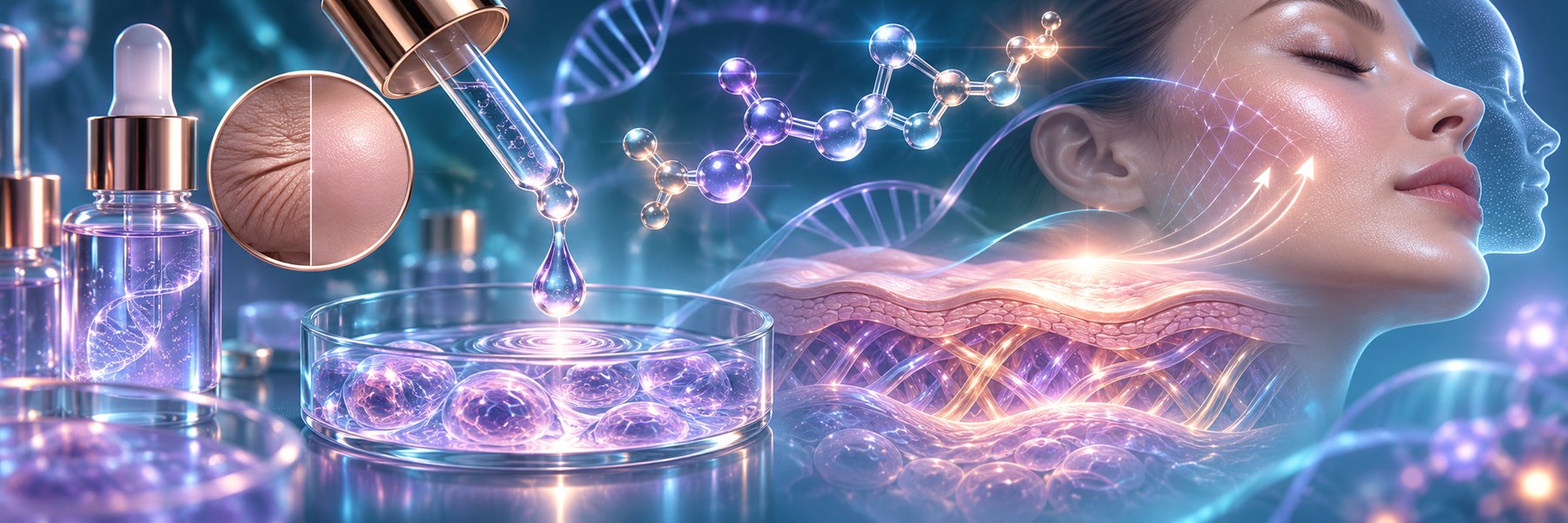
Skin is designed to keep substances out. Peptides can be unstable, chemically sensitive, or unable to cross the outer layer in sufficient amounts. Researchers are studying lipid modification, encapsulation, microneedle platforms, and improved vehicles to address these barriers.
But enhanced penetration is not automatically better. A product meant for intact skin has a different safety profile from a product introduced through needles or damaged skin, and a formulation that works with one peptide cannot automatically be generalized to another.
Separating True Matrix Remodeling from Temporary Smoothing
One especially valuable next step is measuring what actually changes inside the skin. Improved hydration can make a wrinkle look shallower within days; collagen remodeling may require longer observation and more direct measurements.
Better studies will combine standardized photographs, wrinkle profilometry, cutometry for elasticity, transepidermal water loss, and, where appropriate, validated imaging or tissue-level measures. These endpoints can help distinguish a pleasant cosmetic effect from meaningful structural change.
Understanding Cellular Senescence Without Overpromising Rejuvenation
Skin aging also involves changes in inflammatory signaling, metabolic stress, and the surrounding tissue environment. OS-01 and other experimental approaches are expanding this area of research.
The opportunity is to learn whether cellular stress-related signals can be safely altered to maintain a stronger skin barrier or healthier dermal structure. But changes in a senescence marker do not establish a younger biological age, and suppressing every senescence pathway would not necessarily be desirable.
More Independent, Formulation-Specific Human Trials
The field needs larger randomized, blinded studies comparing a finished peptide product against the same base formulation without the peptide. Studies should describe active concentration, stability, skin exposure, adverse reactions, duration, and the exact effect measured.
A 2026 review of aesthetic dermatology peptides emphasizes that small trials, industry sponsorship, short follow-up, and multi-ingredient formulations complicate interpretation. That does not invalidate promising findings; it identifies the evidence needed to turn promising cosmetic science into reliable consumer results.
What Already Matters for Long-Term Skin Health
Even as peptide cosmetics improve, daily broad-spectrum sunscreen, sun avoidance when appropriate, gentle barrier care, and evidence-based topical treatments such as retinoids when suitable remain important foundations for managing visible photoaging.
Peptides may eventually become more valuable additions to those tools, especially when their role is defined rather than treated as a cure-all.
6. Explore the Compounds
Continue into the individual Peptide Perspectives research profiles:
- GHK-Cu: Copper signaling, collagen, and skin repair
- Matrixyl: Palmitoyl pentapeptide-4 and collagen-associated signaling
- SNAP-8: Acetyl octapeptide-3 and expression-line research
- SYN-AKE: Venom-inspired topical wrinkle science
- SYN-COLL: Palmitoyl tripeptide-5 and skin firmness
- Argireline: Acetyl hexapeptide-8 and SNARE-related research
- PAL-GHK: Lipid-modified GHK and extracellular matrix research
- OS-01: Skin senescence and barrier-function studies
Related areas in the directory include Pentapeptide-18, Rigin, and Palmitoyl Dipeptide-6.
The Bigger Possibility
The future of peptide skincare is not simply about making wrinkles disappear. It is about understanding why skin loses structure, how cells communicate during repair, and what a well-designed topical formula can realistically change.
GHK-Cu, Matrixyl, and SYN-COLL point toward collagen-associated research. SNAP-8, SYN-AKE, and Argireline explore the appearance of expression lines from a different angle. OS-01 raises newer questions about the cellular environment of aging skin.
Each approach offers a distinct scientific possibility. The most convincing future products will be those that combine sound molecular biology with effective delivery, measured improvements, and transparent human evidence.
Peptide Perspectives shares educational research, not individualized medical advice. Cosmetic peptides are not interchangeable with prescription dermatologic treatments or injectable drugs. Irritation, sensitivity, and formulation quality matter, and research-only peptides are not validated for self-injection or home microneedling. Persistent or concerning skin changes should be evaluated by a qualified clinician.