
How sleep architecture, circadian timing, and nighttime hormone signaling shape recovery, and where peptide research may lead.
1. The Big Picture: Rest Is an Active Biological Process
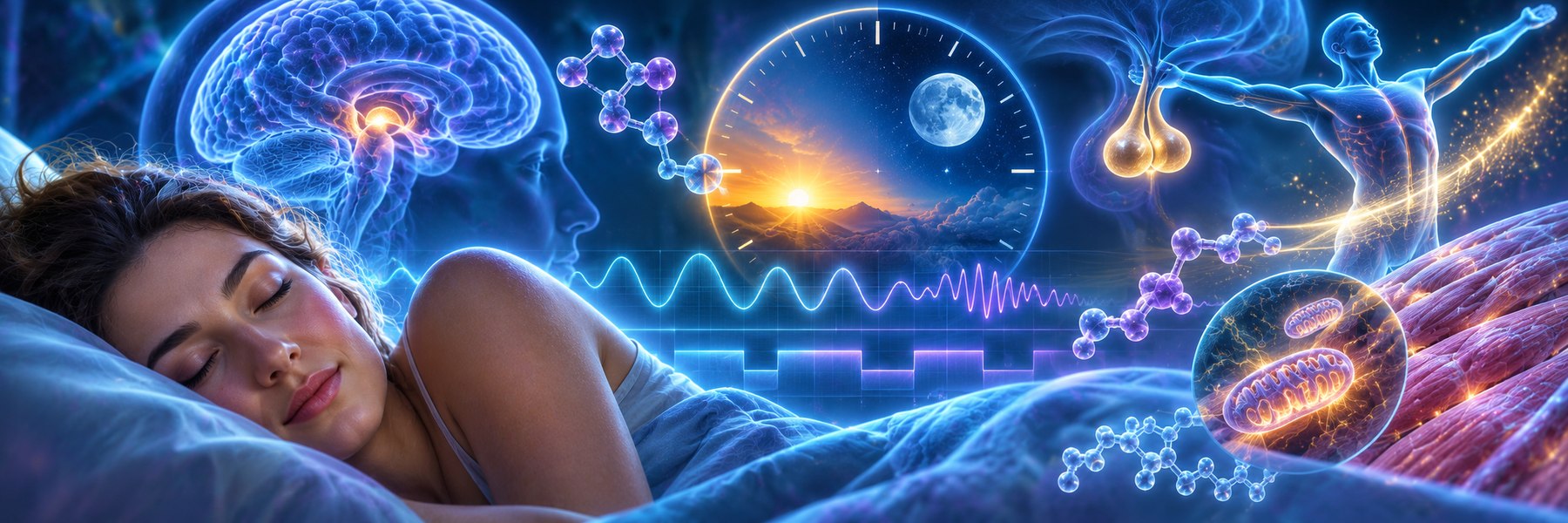
Sleep can look like the quietest part of the day, yet the sleeping brain and body are busy. Neural networks reorganize information, hormones follow carefully timed rhythms, immune responses shift, and many tissues perform essential maintenance. Getting enough sleep matters, but restorative sleep is about more than the number of hours spent in bed.
A person may sleep for eight hours yet awaken exhausted because sleep was fragmented. Another may fall asleep easily but have a disrupted circadian schedule. Sleep apnea, chronic pain, medications, stress, and other health conditions can also interfere with recovery. These problems do not all respond to the same treatment.
Researchers are studying peptides because natural peptide signals already participate in the brain’s sleep-wake circuitry and in the hormone changes that accompany sleep. Delta sleep-inducing peptide (DSIP) was investigated directly in small human sleep trials decades ago. Pinealon and Epitalon, short peptides associated with the bioregulator research tradition, raise questions about neuroprotection and circadian signaling. Growth hormone-releasing pathways connect deep sleep to nighttime anabolic activity, while the orexin system illustrates how research on native neuropeptides can lead to established sleep medicines.
The possibilities are worth exploring. A future therapy could act on a specific cause of sleep disruption rather than simply making someone drowsy. But a rise in growth hormone, a change in melatonin, or an increase in a sleep-stage percentage does not automatically mean better recovery or better health.
The most promising question is not, Which peptide makes people sleepy? It is, Which biological signal might restore healthier sleep in a well-defined group of patients?
2. The Biological Pathways: What Makes Sleep Restorative?
Sleep Architecture: The Brain Cycles Through Different Jobs
Sleep is organized into repeating periods of non-rapid-eye-movement (NREM) and rapid-eye-movement (REM) sleep. NREM includes lighter stages N1 and N2 and deeper N3 slow-wave sleep. Early in the night, N3 is often more prominent; later cycles usually contain more REM sleep.
N3 is associated with slow brain waves, aspects of physical restoration, and a large growth hormone pulse in many healthy adults. REM contributes to processes such as emotional and procedural memory processing. N2 also has important roles in learning and sleep stability. None of these stages is expendable.
This is why claims that a compound "increases deep sleep" need context: Was the change measured by laboratory polysomnography, a validated clinical tool, or a consumer device? Did people feel better, function better, and experience fewer symptoms?
Circadian Timing: The Body’s Internal Clock
The brain’s suprachiasmatic nucleus (SCN) coordinates a roughly 24-hour rhythm shaped strongly by the light-dark cycle. After darkness, the pineal gland typically secretes melatonin, a hormone that signals biological nighttime. Melatonin is not a peptide and is better understood as a timing cue than as a general anesthetic.
Epitalon research includes small studies of nighttime melatonin patterns, while Pinealon’s relationship to circadian outcomes remains largely a hypothesis rather than a demonstrated clinical sleep benefit. Peptide bioregulators associated with the pineal gland should not be confused with proven clock-resetting medicines.
Nighttime Hormones: The Growth Hormone Connection
Sleep and hormones influence each other. A major growth hormone (GH) pulse often occurs soon after sleep onset, especially in association with deep NREM sleep. Growth hormone-releasing hormone (GHRH) and somatostatin help regulate GH secretion, while cortisol typically reaches low levels during early nighttime and rises toward morning.
GHRH has also shown direct sleep-related effects in small human experiments. This makes the pathway scientifically interesting, but raising GH with a secretagogue does not prove that a person has entered more restorative sleep. The molecule, dose, brain access, and timing can all change the outcome.
Orexin: The Signal That Keeps Us Awake
Two endogenous neuropeptides, orexin-A and orexin-B (also called hypocretins), help stabilize wakefulness. This discovery led to FDA-approved non-peptide orexin receptor antagonists for insomnia, including suvorexant, lemborexant, and daridorexant. Their success demonstrates the value of understanding peptide signaling, even when the eventual medication is a small molecule rather than a peptide injection.
Recovery: Sleep Matters Beyond a Hormone Number
Healthy sleep supports attention, memory, metabolic regulation, immune responses, and physical performance. But persistent insomnia may require approaches such as cognitive behavioral therapy for insomnia (CBT-I), and daytime sleepiness or loud snoring may warrant evaluation for sleep apnea. These established pathways of care should not be displaced by experimental compounds.
3. Compounds Researchers Are Exploring
DSIP: A Direct but Inconclusive History of Human Sleep Studies
Explore DSIP on Peptide Perspectives.
Delta sleep-inducing peptide (DSIP) is a nine-amino-acid peptide first investigated for possible sleep-regulating properties. Its name comes from early experimental observations, but the modern evidence is more nuanced than the name suggests.
Small double-blind human studies in the 1980s reported changes in sleep onset, sleep efficiency, or sleep-stage measures in some volunteers and patients with insomnia. Yet the results were inconsistent. A 1987 controlled insomnia trial found little clinically meaningful benefit overall, and a 1992 double-blind study judged its statistically significant results weak and potentially influenced by placebo changes. Another small 1987 study reported more favorable findings.
Research potential: DSIP is a useful reminder that peptide signals may interact with the systems governing sleep, stress, and alertness. New research could clarify its mechanism, appropriate populations, and whether any effect can be reliably reproduced. It is not FDA-approved for insomnia, and older intravenous research cannot validate modern nasal sprays or self-injected products.
Pinealon: A Neuroprotective Bioregulator with an Unanswered Sleep Question
Explore Pinealon on Peptide Perspectives.
Pinealon (EDR, Glu-Asp-Arg) is a three-amino-acid bioregulator studied mainly in laboratory and animal models involving neuronal stress, redox biology, and cell signaling. It is often discussed alongside pineal-related compounds, but its established research interests are neuroprotection and cellular regulation, not demonstrated improvement in insomnia.
The proposed sleep connection is indirect: healthier neuronal responses and circadian-related biology might eventually inform research on recovery or sleep timing. At present, that is a hypothesis. There is no robust controlled human polysomnography evidence showing that Pinealon improves N3 sleep, REM sleep, sleep efficiency, or next-day functioning.
Research potential: Pinealon helps broaden the discussion beyond sedation to the biology of neural resilience. Its therapeutic sleep applications remain unvalidated.
Epitalon: Pineal Signaling and Circadian Biology
Explore Epitalon (Epithalon) on Peptide Perspectives.
Epitalon (AEDG, Ala-Glu-Asp-Gly) is a synthetic tetrapeptide associated with Khavinson’s peptide bioregulator research. It has attracted attention for telomere-related experiments and possible effects on circadian or pineal signaling.
An October 2026 scientific review describes small human physiological studies in which Epitalon was associated with changes in nighttime melatonin measures, particularly in selected older participants with altered baseline secretion. These results are interesting because melatonin timing and the sleep-wake rhythm are closely linked.
However, a measured change in melatonin does not establish better sleep quality or a treatment for insomnia. Studies of the older pineal extract Epithalamin cannot automatically be attributed to synthetic Epitalon because the preparations are chemically different. The review also identifies unresolved questions about safety, product quality, and long-term effects.
Research potential: Epitalon offers a possible way to study how short peptide signals intersect with aging-related circadian changes, but clinical sleep benefits are unproven.
Sermorelin: Investigating the GHRH–Sleep Relationship
Explore Sermorelin on Peptide Perspectives.
Sermorelin is a 29-amino-acid fragment of human growth hormone-releasing hormone that activates the GHRH receptor and promotes GH release. Unlike DSIP, it was developed to act primarily on an endocrine pathway, not as a sleep medication.
Why is it in a sleep article? Small human investigations of native GHRH have reported effects on slow-wave sleep, REM sleep, and cortisol under certain experimental conditions. For example, a 1999 double-blind crossover study evaluated intranasal GHRH and found changes in sleep stages and hormone measures.
Those findings do not establish that sermorelin administration improves sleep, because the exact molecule, route, and conditions differ from the GHRH sleep studies. No high-quality clinical evidence validates sermorelin as a general treatment for insomnia or nighttime recovery.
Research potential: Sermorelin shows how the brain’s sleep systems and the endocrine GH axis overlap, while illustrating the need for actual sleep outcomes in future trials.
Ipamorelin: GH Release Is Not the Same as Restorative Sleep
Explore Ipamorelin on Peptide Perspectives.
Ipamorelin is a synthetic growth hormone secretagogue that activates the ghrelin receptor (GHSR-1a), a different receptor from that targeted by GHRH and sermorelin. Human pharmacology studies demonstrate that it can stimulate GH release.
That makes ipamorelin relevant to nighttime hormone signaling, but not automatically a sleep enhancer. The FDA has reviewed pharmacodynamic studies and noted the absence of data supporting its effectiveness for diagnosing or treating GH deficiency through compounded use.
There is no persuasive controlled human sleep-trial evidence that ipamorelin improves sleep continuity, N3 sleep, REM, or morning recovery. Elevating GH also does not demonstrate improved tissue healing, mood, or performance.
Research potential: Ipamorelin may help scientists distinguish endocrine effects from true changes in the sleep system. It is not an FDA-approved insomnia medicine.
CJC-1295 (No DAC): GHRH-Receptor Research with a Naming Caveat
Explore CJC-1295 (No DAC) on Peptide Perspectives.
Products marketed as CJC-1295 without DAC generally refer to a short-acting modified GHRH(1–29) analogue; the term should not be treated as chemically interchangeable with CJC-1295 with DAC, the longer-acting molecule used in certain published endocrine studies.
Because these compounds act at GHRH-related pathways, researchers are interested in their potential to influence GH pulse dynamics. But an endocrine response is only one part of nighttime physiology.
Research potential: GHRH analogues could help map how timing, receptor activation, and GH pulses relate to sleep. For CJC-1295 without DAC specifically, there is no established human insomnia-treatment evidence, and long-term safety remains uncertain.
MK-677 (Ibutamoren): Human Sleep Data, but Important Tradeoffs
Explore MK-677 on Peptide Perspectives.
MK-677 (ibutamoren) is an oral small-molecule ghrelin receptor agonist, not a peptide. It belongs in this story because it has a rare feature among the GH-secretagogue compounds discussed here: published human sleep recordings.
A small 1997 study reported increases in selected deep-sleep and REM measures in young or older adults during treatment. These results make MK-677 an interesting proof-of-concept for the relationship among ghrelin-receptor signaling, GH, and sleep architecture.
But a separate one-year randomized trial in older adults found increased appetite, edema, higher blood glucose, and reduced insulin sensitivity, without improved strength or physical function. The small sleep study does not establish a safe or effective long-term treatment for insomnia.
Research potential: MK-677 shows why physiological sleep findings are worth studying while underscoring the importance of metabolic safety. It is not FDA-approved for sleep, growth hormone enhancement, or anti-aging.
Orexin-A and Orexin-B: A Peptide System with Proven Clinical Impact
Explore the NIH overview of orexin therapies.
Orexin-A and orexin-B are endogenous neuropeptides made by neurons in the hypothalamus. Their main job is to help stabilize wakefulness, so stimulating the system is not the same as promoting sleep.
The breakthrough came from blocking orexin receptors for certain patients with insomnia. FDA-approved drugs such as suvorexant, lemborexant, and daridorexant are not peptides, but their development was made possible by research into the peptides themselves.
Research potential: Orexin biology is one of the strongest examples of peptide science leading to targeted, clinically validated sleep treatments. It also demonstrates why the direction of a signal matters: orexin antagonism may help insomnia, while orexin activation is investigated for conditions involving excessive daytime sleepiness.
4. Comparing the Compounds
| Compound or pathway | Primary mechanism | Sleep-related research interest | Evidence level / regulatory status | Known limitations |
|---|---|---|---|---|
| DSIP | Experimental sleep and stress-related signaling | Insomnia, sleep continuity, sleep architecture | Small older controlled human studies; not FDA-approved | Mixed results; clinically meaningful benefits not reliably established |
| Pinealon | Short-peptide neuronal and cellular-stress signaling | Hypothesized brain recovery and circadian relevance | Mainly cell/animal mechanistic research | No robust human sleep-architecture trials |
| Epitalon | Pineal/circadian-related and other bioregulator mechanisms | Nighttime melatonin rhythm and aging | Small human biomarker studies plus preclinical research | Melatonin changes do not prove insomnia benefit; safety unresolved |
| Sermorelin | GHRH-receptor activation and GH secretion | Links between GH axis and sleep | Human endocrine data; human GHRH sleep studies involve different preparations | Sermorelin-specific sleep benefits unproven |
| Ipamorelin | Ghrelin-receptor agonism and GH release | Nocturnal GH and recovery hypotheses | Human endocrine pharmacology; not approved for sleep | No convincing human sleep outcome trials |
| CJC-1295 No DAC | Short-acting GHRH analogue | GH pulsatility and nocturnal endocrine timing | Mechanistic/endocrine; limited specific human data | Naming/formulation confusion; no validated insomnia benefit |
| MK-677 | Oral small-molecule ghrelin agonist | Slow-wave/REM changes in small human studies | Controlled human sleep and metabolic studies; not FDA-approved | Appetite, edema, glucose and insulin-sensitivity concerns |
| Orexin-A/B pathway | Endogenous wakefulness signaling via orexin receptors | Sleep onset and maintenance via receptor blockade | Several FDA-approved non-peptide antagonists | Orexin peptides themselves are wake-promoting; not interchangeable with blockers |
Evidence key: A change in GH, melatonin, or EEG stage duration is a biological finding. Meaningful sleep treatment requires evidence that people sleep better, function better, and avoid unacceptable adverse effects. None of the investigational peptides listed is FDA-approved as a treatment for chronic insomnia.
5. Where the Science Is Heading
Restoring Sleep Architecture, Not Just Inducing Drowsiness
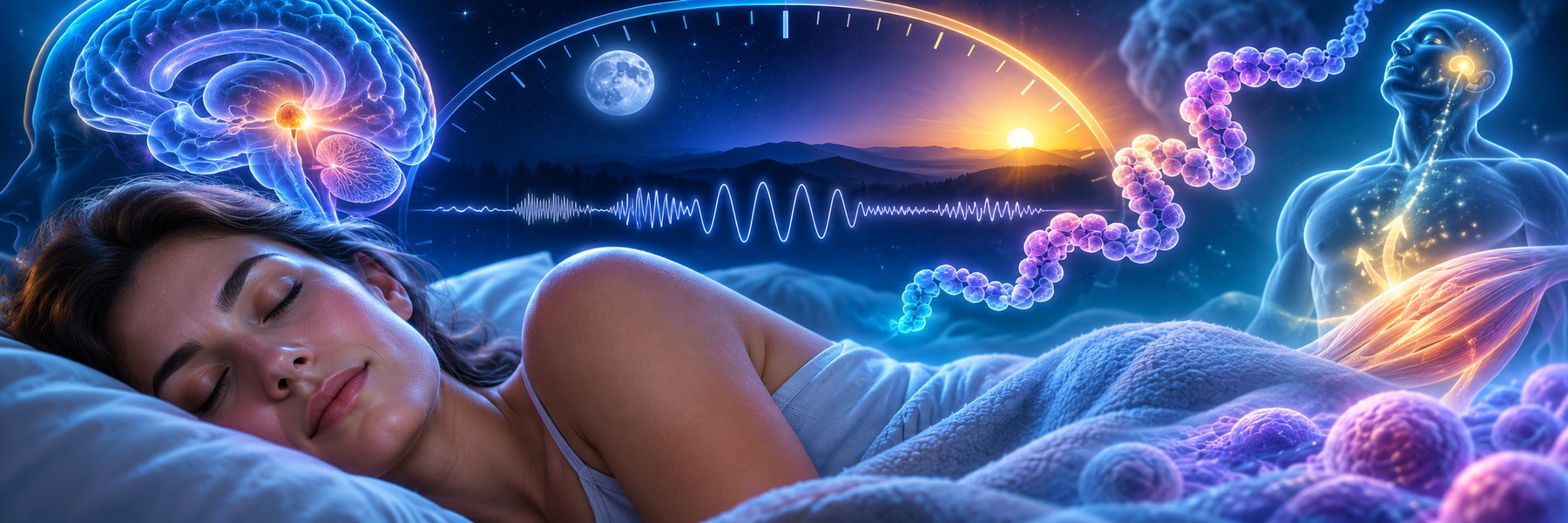
The next generation of sleep research is increasingly focused on how sleep is organized, not merely whether a person can fall asleep faster. A treatment that supports continuity while preserving normal NREM and REM patterns may be more useful than one that indiscriminately suppresses brain activity.
Researchers need reproducible polysomnography, validated patient-reported outcomes, and daytime performance measures. Tiny changes in percentages of sleep stages are not enough by themselves.
Separating Circadian Timing from Insomnia
A person whose internal clock is shifted late is not necessarily experiencing the same disorder as someone whose sleep is repeatedly interrupted by pain or airway obstruction. Circadian interventions, including timed light and melatonin in appropriate circumstances, address timing; they do not solve every sleep disturbance.
Epitalon’s early pineal and melatonin findings could inspire more focused circadian research, but Pinealon and Epitalon are not established clock-resetting treatments.
Mapping Hormones Without Confusing Markers for Benefits
The GH–GHRH–ghrelin system is an appealing area of study because endocrine events cluster around sleep onset and deep NREM sleep. But the direction of causality matters: better sleep can affect hormone release, and changing hormone signaling may or may not improve sleep.
Clinical studies of sermorelin, ipamorelin, or CJC-related compounds would need direct sleep assessments and monitoring of glucose, fluid retention, and other adverse effects rather than relying only on GH or IGF-1 increases.
Precision Neurobiology: The Orexin Example
The orexin pathway offers a particularly hopeful model for future discovery. Understanding a naturally occurring neuropeptide led to a new class of approved insomnia medicines with a mechanism different from traditional sedatives.
Future work may similarly distinguish different causes of sleep disruption and identify well-defined populations who benefit from targeted signaling approaches.
Questions the Next Studies Must Answer
- Which patients have a genuinely disrupted peptide-related sleep pathway?
- Can a compound improve both objective sleep measurements and how people feel and function the next day?
- Are reported benefits sustainable beyond a few nights or weeks?
- Are formulations sufficiently standardized to compare research across trials?
- Do hormonal interventions create unwanted effects on metabolism, fluid balance, or breathing during sleep?
For chronic insomnia, CBT-I remains a strongly recommended evidence-based treatment. Suspected sleep apnea and other medical contributors warrant appropriate evaluation. Peptide research is an emerging field, not a reason to bypass proven care.
6. Explore the Compounds and the Research
Direct Peptide Perspectives profiles
- DSIP: Experimental sleep and stress-related signaling
- Pinealon: Neural signaling and bioregulator research
- Epitalon: Pineal signaling and circadian biology
- Sermorelin: GHRH and growth hormone release
- Ipamorelin: Ghrelin-receptor signaling and GH secretion
- CJC-1295 (No DAC): Short-acting GHRH analogue research
- MK-677: Growth hormone and human sleep research
Research and clinical context
- Orexin neuropeptides and approved sleep treatments: NIH
- 2026 research review of Epitalon and Epithalamin
- Human DSIP insomnia trial
- 1997 human MK-677 sleep study
- American Academy of Sleep Medicine guidance on CBT-I
The Bigger Possibility
Sleep is not an empty interval between productive days. It is an orchestrated biological state that supports learning, metabolism, immune function, and physical recovery.
Peptide research is helping scientists explore how that state is initiated, timed, maintained, and coordinated with hormone secretion. DSIP asks whether a small peptide can influence sleep directly. Epitalon and Pinealon point toward still-uncertain connections with neural and circadian biology. Growth hormone-related compounds highlight the interaction between deep sleep and endocrine signaling. Orexin shows that carefully targeted peptide-pathway science can eventually produce real medicines.
The opportunity is not simply to sleep harder. It is to understand sleep precisely enough to help people recover more effectively and consistently.
Peptide Perspectives provides research education, not individual medical advice. DSIP, Pinealon, Epitalon, sermorelin, ipamorelin, CJC-1295 (No DAC), and MK-677 are not FDA-approved treatments for insomnia. Products sold for research use may not have verified identity, purity, or human safety data. Persistent insomnia, heavy snoring, witnessed breathing pauses, or substantial daytime sleepiness warrant clinical evaluation.