
From calming excessive inflammation to guiding new cells and rebuilding collagen, peptide science is opening new possibilities for how injured tissues might heal.
1. The Big Picture: Can We Help the Body Heal More Effectively?
The human body is remarkably good at repair. A scraped knee closes, muscles recover after exercise, and damaged tendons slowly rebuild themselves. But healing is not always simple. Injuries can linger, scar tissue can limit movement, and chronic inflammation or poor circulation can interfere with the process. For people recovering from surgery, managing a stubborn tendon injury, or living with a difficult-to-heal wound, restoring function, not just reducing pain, is the real goal.
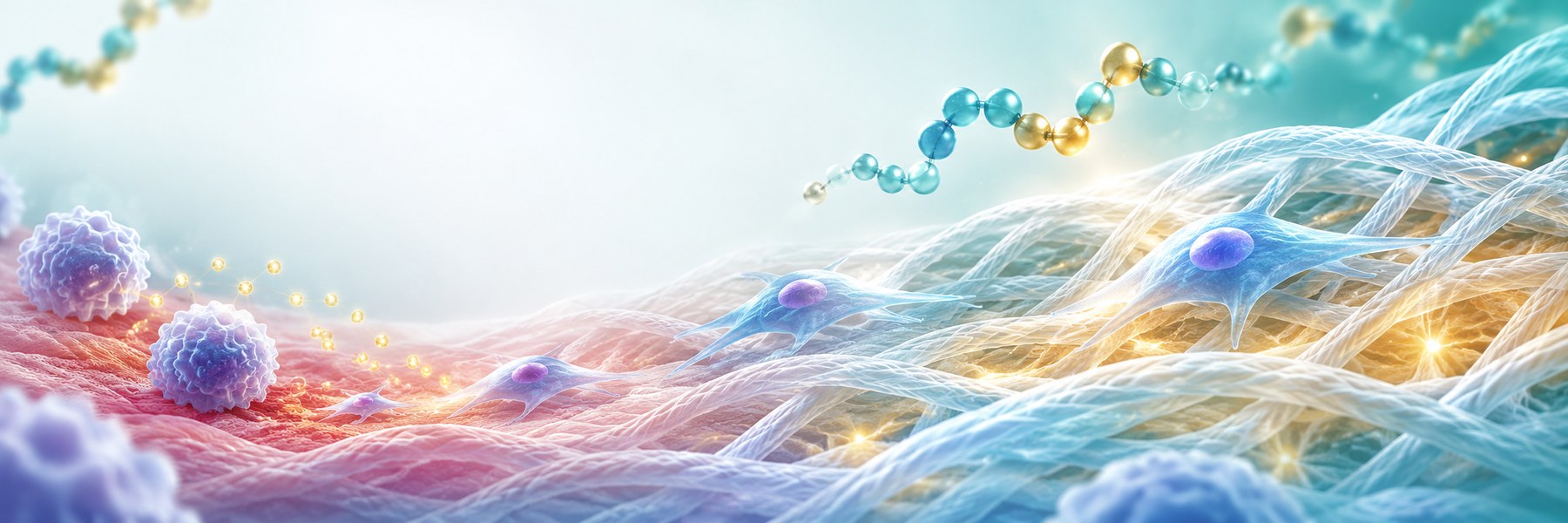
That is why researchers are investigating peptides, short chains of amino acids that may influence some of the body’s own repair signals. Rather than viewing healing as one switch that needs to be turned on, scientists are studying a sequence of coordinated jobs: containing damage, recruiting the right cells, producing new tissue, and strengthening that tissue over time.
The opportunity is exciting. A future regenerative treatment might help a wound close more reliably, encourage better-organized collagen, protect vulnerable nerves, or reduce the kind of persistent inflammation that slows recovery. Most experimental peptides have not yet demonstrated those benefits in well-controlled human trials, but their mechanisms give researchers valuable starting points.
2. The Biological Pathways: Four Jobs the Body Must Get Right
Healing happens through overlapping phases, not perfectly separated stages. Four processes help explain why different peptides attract attention.
Inflammation: Start the Repair, Then Restore Balance
Inflammation is an essential first response to injury. Immune cells remove damaged material, respond to microbes, and release chemical messages that begin rebuilding. Problems can arise when this response is excessive, prolonged, or poorly regulated.
KPV is being studied for its ability to influence inflammatory signals such as NF-κB in cell and animal models. ARA-290, also called cibinetide, has been investigated for tissue-protective signaling and inflammatory nerve injury. LL-37, part of the body’s antimicrobial defense system, illustrates another side of this process: the immune response must protect tissue while making room for repair. The goal is not to eliminate inflammation, but to understand how to keep it productive.
Cell Migration: Bring the Repair Crew to the Right Place
A wound cannot close unless cells move. Surface cells cross the injured area, blood-vessel cells help restore circulation, and fibroblasts move in to build supporting tissue.
Full-length thymosin beta-4 is especially interesting because it interacts with actin, a structural protein cells use to change shape and move. BPC-157 has also shown effects on fibroblast migration and blood-vessel-related signaling in laboratory and animal studies. TB-500, often described as a short fragment of thymosin beta-4, is investigated in relation to similar themes, but it is not scientifically interchangeable with the full-length peptide.
Collagen and the Extracellular Matrix: Build a Stronger Framework
Collagen forms part of the framework that gives skin, tendons, ligaments, and other connective tissues their structure. Fibroblasts produce collagen, but high-quality healing also requires careful organization and controlled removal of old or damaged matrix.
GHK-Cu, a naturally occurring copper-binding peptide, is studied for effects on fibroblast activity, collagen and elastin-related signaling, and enzymes involved in matrix turnover. BPC-157 and thymosin beta-4 are also being investigated for ways they influence the surrounding repair environment. More collagen is not automatically better. Researchers want tissue that is organized, appropriately flexible, and resilient.
Tissue Remodeling: Turn New Tissue into Useful Tissue
After an injury closes, the work continues. Collagen fibers reorganize, scar tissue matures, blood vessels adapt, and recovering muscles must regain strength and coordination. This process can take weeks to months or longer, depending on the injury.
Mechano Growth Factor (MGF) research examines how muscle responds to loading and injury, especially signals associated with satellite cells, which help maintain and repair muscle. The naturally expressed IGF-1Ec splice variant and experimental synthetic MGF-derived peptides are not the same thing, and no clinical trial has established that injecting a synthetic MGF peptide improves human muscle recovery. Still, this line of research highlights how physical rehabilitation and cellular signaling meet.
3. Compounds Researchers Are Exploring
The following eight research subjects approach healing from different directions. Their evidence is not equal, and none is FDA-approved in the United States as a general treatment for tissue repair or sports-injury recovery.
BPC-157: A Broad Preclinical Repair Signal
BPC-157 is a synthetic 15-amino-acid peptide studied in models of tendon, ligament, muscle, gastrointestinal, and nerve injury. Animal experiments have reported encouraging changes in tissue organization, repair-associated signaling, and some functional measures. This breadth makes BPC-157 one of the most discussed candidates in regenerative peptide research.
The human evidence is much narrower. An October 2026 systematic review identified three small studies involving 30 people in total and rated certainty very low. The next major step is controlled trials showing whether changes seen in animals translate into improved healing, strength, and function in people.
Thymosin Beta-4: Helping Cells Move and Rebuild
Full-length thymosin beta-4 (Tβ4) is a naturally occurring 43-amino-acid peptide closely connected to actin and cell movement. Its influence on cell migration, surface repair, and blood-vessel-related processes gives it a broad regenerative research profile.
Importantly, the research has reached humans in specific settings. A small randomized Phase 3 trial tested a thymosin beta-4 eye-drop formulation for persistent corneal defects, with encouraging healing signals, although its primary comparison did not meet conventional statistical significance. Those results are promising for ophthalmic research, not proof that systemic injections heal muscle or tendon injuries.
TB-500: A Fragment with an Important Identity Question
TB-500 is often used commercially to describe a short, seven-amino-acid fragment associated with thymosin beta-4, frequently called LKKTETQ or Ac-LKKTETQ. Some sellers also use TB-500 to refer to full-length thymosin beta-4, creating confusion between molecules that are not identical.
Researchers are interested in actin-related cellular movement and tissue-repair signaling, but direct human clinical evidence for the short TB-500 fragment is absent. Even when full-length Tβ4 performs well in a study, that finding cannot automatically be transferred to the fragment. For the key molecular differences, see the Thymosin Beta-4 research profile.
GHK-Cu: The Collagen and Matrix Remodeling Candidate
GHK-Cu is a naturally occurring copper-binding tripeptide whose research spans skin biology, fibroblast activity, collagen organization, and extracellular matrix regulation. Its potential goes beyond the cosmetic appearance of skin: scientists are interested in whether signaling involved in healthier dermal structure could inform future wound-repair technologies.
Small human cosmetic studies and laboratory research provide a foundation for continued investigation. However, evidence for topical skin appearance cannot be assumed to establish healing of deep wounds, tendons, or ligaments, and injectable GHK-Cu has not been validated as a regenerative treatment. Its strongest opportunity may be in well-designed local delivery systems and measurable skin-repair outcomes.
KPV: Understanding the Inflammatory Environment
KPV is a three-amino-acid fragment of alpha-melanocyte-stimulating hormone. Its interest lies primarily in inflammation-related biology, particularly intestinal and epithelial tissues. Laboratory experiments and animal models suggest that KPV-derived approaches can affect inflammatory signaling, immune-cell recruitment, and barrier integrity.
That makes KPV intriguing for research into conditions where inflammation interferes with healing. A 2026 study of an experimental KPV delivery system reported improvements in inflammation and epithelial barrier measures in mouse models. Human clinical efficacy, optimal formulations, and long-term safety remain unknown.
LL-37: Antimicrobial Defense Meets Wound Repair
LL-37 is part of the human innate immune system. Researchers study how it interacts with microbes, immune cells, and repair processes in skin and other epithelial tissues. It offers an especially interesting example of the balance between antimicrobial protection and healthy tissue remodeling.
Unlike many experimental repair peptides, LL-37 has been studied in a small human wound trial. A randomized study involving 34 people with difficult-to-heal venous leg ulcers found encouraging healing measures at two lower topical concentrations, while a higher concentration did not outperform placebo. Those results support further controlled research, not routine or unsupervised use, especially because immune and growth-related effects can be context-dependent.
ARA-290 (Cibinetide): Protecting Vulnerable Nerves
ARA-290 was designed to investigate tissue-protective signaling associated with the erythropoietin system, without simply aiming to increase red blood cell production. It has attracted attention for inflammatory nerve injury and small-fiber neuropathy.
In a small placebo-controlled human study involving sarcoidosis-associated small nerve fiber damage, investigators reported improvements in symptoms and corneal nerve fiber density. The findings are particularly interesting for the possibility of nerve-focused repair. They do not establish that ARA-290 accelerates healing of ordinary skin wounds, ligament tears, or surgical incisions.
Mechano Growth Factor (MGF): Muscle’s Response to Repair
Mechano Growth Factor (MGF) relates to an IGF-1 splice variant associated with the muscle response to loading or injury. Researchers have explored its connection to satellite-cell activity, muscle-cell growth, and recovery-related signaling.
Experiments using cultured human muscle cells have produced intriguing results, but cell-culture findings are not clinical proof. Important questions remain about whether a distinct MGF E-domain peptide is normally produced and secreted in the body, how synthetic versions behave, and whether they improve actual strength or injury recovery in humans. For now, this remains an early research direction rather than an established therapy.
4. Comparing the Compounds
| Compound | Primary mechanism being studied | Main repair interest | Evidence level | Key limitation |
|---|---|---|---|---|
| BPC-157 | Angiogenesis, fibroblast and repair signaling | Tendon, ligament, muscle, gut | Extensive animal studies; very limited uncontrolled human studies | No confirmed human healing benefit or validated safety regimen |
| Thymosin beta-4 | Actin regulation and cell migration | Surface wounds, corneal repair, tissue remodeling | Preclinical studies; small human ophthalmic trials | Eye-drop findings do not establish systemic injury recovery |
| TB-500 fragment | Proposed actin-associated fragment activity | Cell movement, experimental soft-tissue repair | Mechanistic and limited fragment-specific preclinical work | Fragment is not equivalent to full-length Tβ4; no validated human trials |
| GHK-Cu | Fibroblasts, collagen, matrix turnover | Skin and extracellular matrix | Preclinical; limited human topical/cosmetic data | Deep-tissue healing and injectable safety unproven |
| KPV | Inflammatory and epithelial signaling | Mucosal and inflammatory tissue environments | Cell and animal studies | No established human therapeutic benefit |
| LL-37 | Antimicrobial and innate immune signaling | Chronic wound biology | Preclinical; small human topical wound trial | Dose-dependent effects; complex immune and safety concerns |
| ARA-290 | Tissue-protective and inflammatory signaling | Small nerve fiber injury | Small controlled human studies in selected neuropathies | General wound and musculoskeletal healing unproven |
| MGF | IGF-1 splice-variant and muscle-cell signaling | Muscle satellite-cell biology | Laboratory and animal research; human-derived cell studies | No human trials of synthetic MGF therapy; disputed independent peptide biology |
How to read the evidence: A human trial involving eye drops, leg ulcers, or neuropathy answers a specific clinical question. It does not validate a peptide for every type of injury. Likewise, exciting animal findings are reasons to investigate further, not assurances of human benefit. None of the eight compounds has FDA approval for general tissue regeneration. Different formulations and routes of administration may also carry very different risks.
5. Where the Science Is Heading
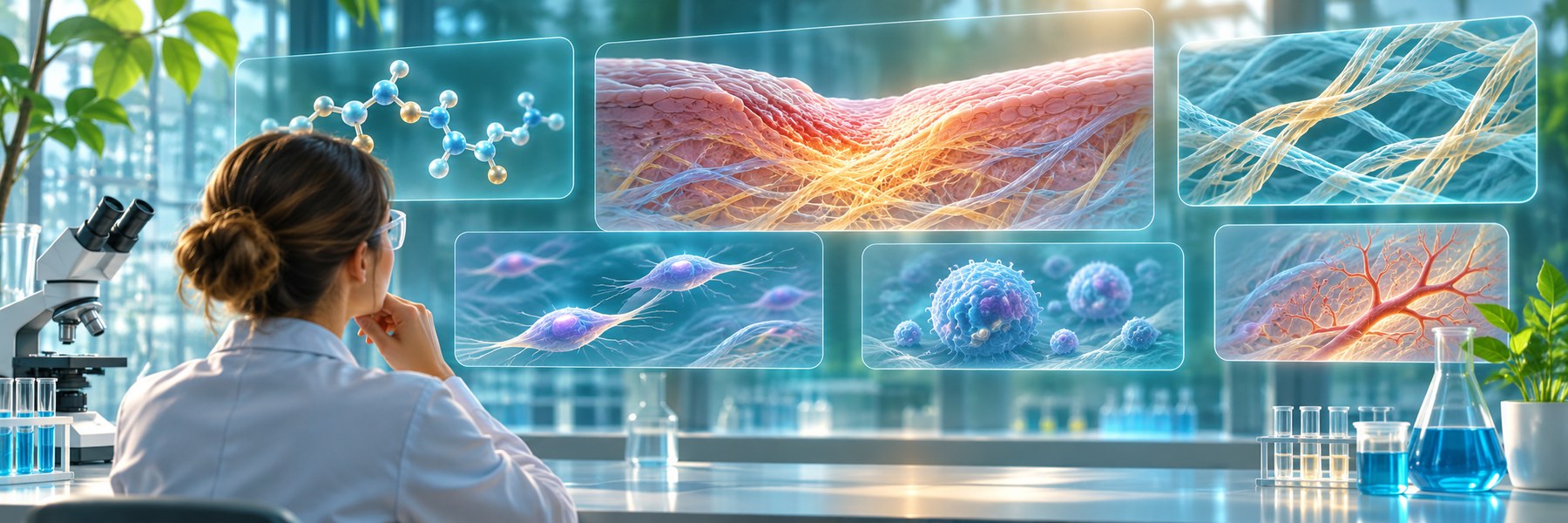
The next frontier may be less about finding one universal healing compound and more about matching a biological pathway to the particular tissue, stage of injury, and patient need.
Promising opportunities include:
- More precise inflammation control. Researchers are exploring whether targeting specific inflammatory signals can protect healing tissue while preserving the immune response needed to fight infection.
- Better local delivery. Hydrogels, wound dressings, and other controlled-release technologies may eventually help deliver a molecule where it is needed while limiting unwanted systemic exposure.
- Stronger functional outcomes. The most meaningful trials will test mobility, tissue strength, durable wound closure, nerve function, and return to activity, not only changes in laboratory markers.
- Smarter tissue remodeling. Understanding when to promote collagen formation and when to encourage matrix reorganization may help researchers address scarring, adhesions, and prolonged recovery.
- More tailored regenerative medicine. A corneal defect, muscle tear, diabetic ulcer, and inflamed intestine all need different forms of healing. Future approaches may be designed around those differences.
Several unanswered questions remain. Which compounds truly improve patient outcomes? What routes and formulations are safe? Could a signal that helps one type of tissue create unwanted effects elsewhere? How do investigators distinguish genuine regeneration from short-term pain relief or cosmetic change? And which findings can be independently reproduced in large clinical trials?
Those questions are not reasons to dismiss the field. They are the research agenda that can turn compelling biology into dependable medicine.
6. Explore the Compounds
Continue with the individual Peptide Perspectives research profiles:
- BPC-157: Tendon, ligament, and gastrointestinal repair research
- Thymosin Beta-4: Actin, cell migration, and wound repair
- TB-500: Fragment identity and differences from full-length Tβ4 (see the full-length profile’s TB-500 comparison)
- GHK-Cu: Collagen, fibroblasts, and skin remodeling
- KPV: Inflammatory signaling and epithelial health
- LL-37: Antimicrobial defenses and wound research
- ARA-290: Nerve protection and tissue-protective signaling
- MGF: Muscle repair and satellite-cell biology
The bigger possibility: Regenerative peptide science is beginning to map the body’s repair process at a remarkable level of detail. The most exciting future is not simply faster healing. It is healing that produces stronger tissue, preserves healthy movement, and supports lasting recovery. Reaching that future will require careful clinical trials, trustworthy formulations, and the same scientific curiosity that makes these compounds so interesting today.
Peptide Perspectives shares research for education, not individual medical advice. Investigational compounds should not replace evaluation of serious injuries, infected or nonhealing wounds, established wound care, surgery when needed, or evidence-based rehabilitation. Products labeled “research use only” are not approved medicines for personal treatment.