
Understanding the differences in tissue repair, recovery, skin rejuvenation, inflammation, and joint-health research.
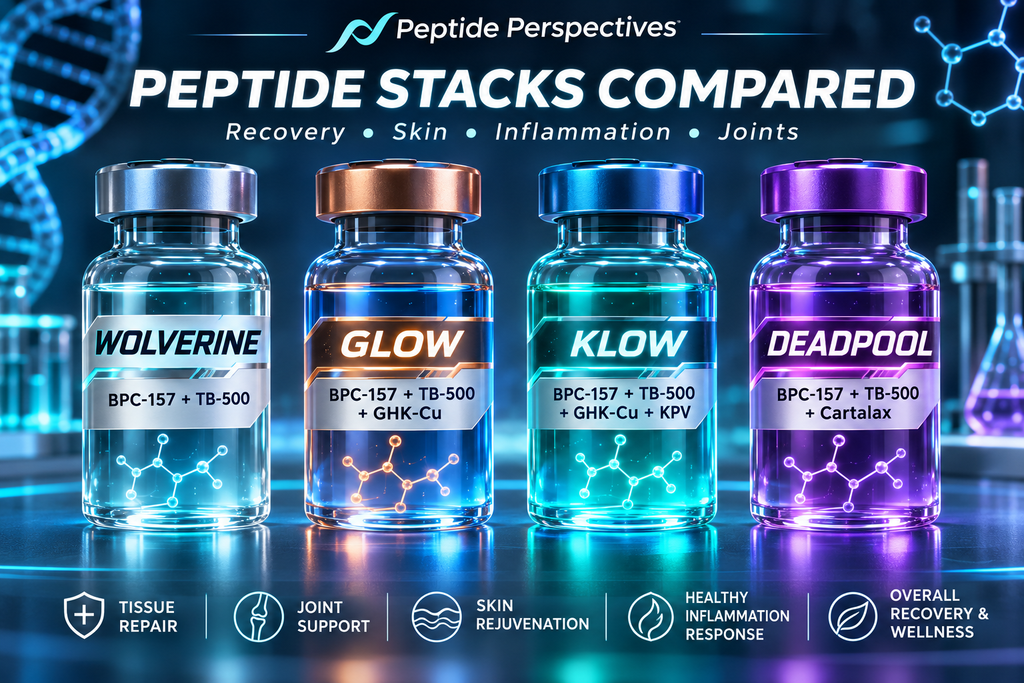
AI-generated Peptide Perspectives graphic featuring the Wolverine, GLOW, KLOW and Deadpool peptide stacks
The future of regenerative medicine is full of exciting possibilities. Scientists are investigating how peptides influence cellular repair, connective tissues, collagen production, inflammation, and healthy aging.
Four combinations generating particular interest are the Wolverine Stack, GLOW, KLOW, and Deadpool Stack.
While these blends share certain ingredients, each represents a different area of research. Wolverine concentrates on tissue repair, GLOW expands into collagen and skin biology, KLOW adds inflammatory signaling, and certain Deadpool formulations introduce cartilage-related research.
Understanding those distinctions can help researchers and readers evaluate the potential of each combination without assuming that adding more peptides automatically produces better results.
At a Glance: Comparing the Four Stacks
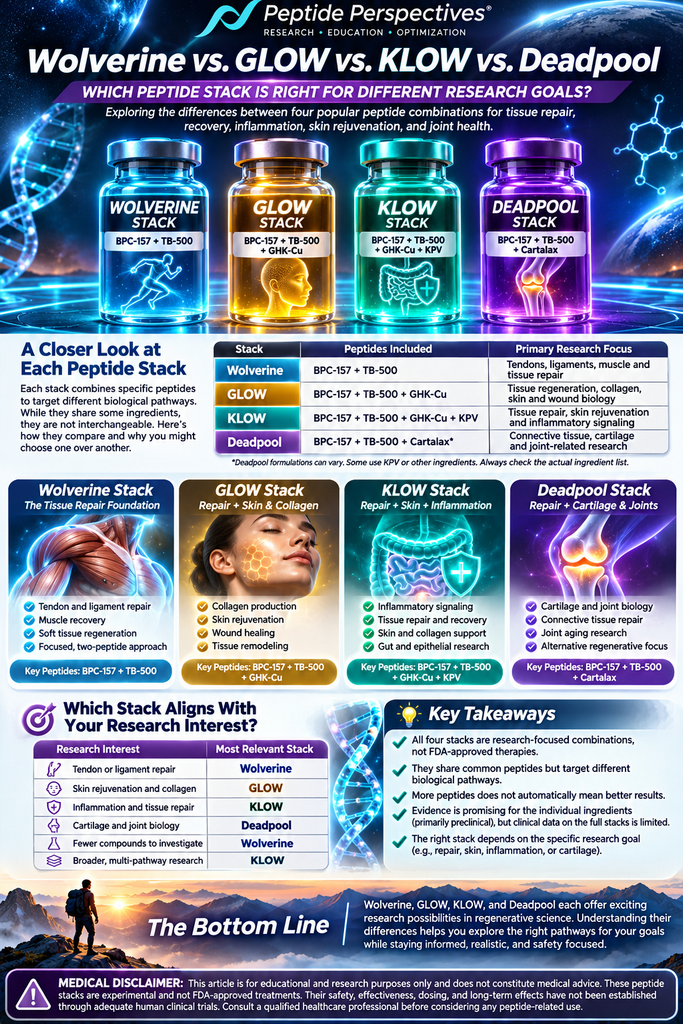
Original AI-generated Peptide Perspectives comparison infographic showing four peptide stacks, their ingredients, research interests and safety disclaimer
| Stack | Common Ingredients | Main Research Focus |
|---|---|---|
| Wolverine | BPC-157 + TB-500 | Tendon, ligament and muscle repair |
| GLOW | BPC-157 + TB-500 + GHK-Cu | Tissue repair, collagen and skin health |
| KLOW | BPC-157 + TB-500 + GHK-Cu + KPV | Repair, skin and inflammation pathways |
| Deadpool | BPC-157 + TB-500 + Cartalax* | Cartilage, joint and connective tissue research |
Deadpool is not a standardized formula. Some versions include KPV or different ingredients instead of Cartalax. These are experimental research blends, not FDA-approved treatments.
1. Wolverine Stack: The Tissue Repair Foundation
Ingredients: BPC-157 + TB-500
The Wolverine Stack has become popular in regenerative peptide discussions because of its focus on soft tissue recovery.
BPC-157 is investigated for its influence on cellular repair signaling, blood vessel formation, and responses to tissue damage.
TB-500 is associated with thymosin beta-4-related research involving cell migration and tissue remodeling, although TB-500 fragments are not necessarily equivalent to full-length thymosin beta-4.
Together, they present an intriguing hypothesis for studying complementary repair pathways.
Why researchers are interested:
- Tendon and ligament recovery
- Muscle repair and regeneration
- Connective tissue remodeling
- Cellular responses to injury
What makes it different? Wolverine is a focused two-peptide combination. It offers fewer variables than larger stacks, making it conceptually useful for studying tissue repair mechanisms.
Research outlook: Preclinical findings are promising enough to warrant further investigation, but human evidence has not established that the Wolverine combination accelerates injury recovery.
2. GLOW Stack: Tissue Regeneration Meets Skin Rejuvenation
Ingredients: BPC-157 + TB-500 + GHK-Cu
GLOW builds on Wolverine by introducing GHK-Cu, a naturally occurring copper-binding peptide.
GHK-Cu has attracted attention for its potential influence on collagen production, extracellular matrix remodeling, and skin repair.
This makes GLOW particularly interesting at the intersection of regenerative medicine and dermatologic research.
Why researchers are interested:
- Collagen and elastin biology
- Skin texture and elasticity
- Tissue remodeling
- Wound repair mechanisms
- Skin aging and hair-related pathways
What makes it different? Adding GHK-Cu expands the research emphasis beyond musculoskeletal repair into skin and connective-tissue biology.
Research outlook: Certain topical GHK-Cu formulations have been investigated in humans, but those findings do not establish the effectiveness or safety of injectable GLOW blends.
3. KLOW Stack: Bringing Inflammatory Signaling Into the Picture
Ingredients: BPC-157 + TB-500 + GHK-Cu + KPV
KLOW expands the GLOW combination by adding KPV, a three-amino-acid peptide associated with anti-inflammatory research.
KPV is being investigated for its effects on inflammatory signaling pathways, including NF-κB, and its role in experimental models of intestinal and epithelial inflammation.
Because inflammation and tissue repair are closely interconnected, KLOW offers a research opportunity to explore multiple biological processes together.
Why researchers are interested:
- Inflammatory signaling regulation
- Tissue repair and skin biology
- Gut and epithelial inflammation
- Collagen-related pathways
- Interactions between inflammation and healing
What makes it different? KLOW adds KPV, broadening the research hypothesis to include inflammatory pathways that are not the primary focus of Wolverine or GLOW.
Research outlook: Although the underlying mechanisms are scientifically interesting, there are no adequate human clinical trials showing that the four-peptide KLOW combination improves recovery or inflammatory conditions.
4. Deadpool Stack: Exploring Cartilage and Joint Research
One discussed formulation: BPC-157 + TB-500 + Cartalax
The Deadpool Stack is sometimes described as an alternative regenerative blend, but its ingredients vary considerably across sellers.
One formulation incorporates Cartalax, a short peptide bioregulator investigated for its possible relationship to cartilage and connective-tissue biology.
Cartilage regeneration is an especially compelling research area because cartilage has limited intrinsic healing capacity.
Why researchers are interested:
- Cartilage biology and degeneration
- Joint and connective tissue research
- Age-related tissue changes
- Cellular signaling associated with cartilage
- Experimental regenerative strategies
What makes it different? A Cartalax-containing version introduces cartilage-associated research rather than GHK-Cu’s skin focus or KPV’s inflammatory signaling focus.
Research outlook: Cartalax remains highly experimental, with very limited high-quality clinical evidence demonstrating efficacy or safety in people.
Which Stack Aligns With Different Research Goals?
| Research Priority | Most Relevant Stack to Study |
|---|---|
| Tendon, ligament and muscle repair | Wolverine |
| Skin and collagen rejuvenation | GLOW |
| Repair combined with inflammatory signaling | KLOW |
| Cartilage and joint biology | Deadpool with Cartalax |
| Simpler research formulation | Wolverine |
| Broad multi-pathway research | KLOW |
These distinctions reflect the research interests associated with the ingredients, not evidence that a particular blend is clinically superior for any condition.
Does More Always Mean Better?
Not necessarily.
One of the most exciting concepts behind peptide stacking is the possibility of biological synergy. The idea is that several peptides acting on different pathways might complement one another.
For example, one compound may influence cell migration while another affects collagen signaling or inflammatory pathways.
However, complementary mechanisms do not automatically establish synergy.
Adding peptides also increases the number of potential interactions, safety questions, and experimental variables.
The future of effective peptide combinations will depend on controlled clinical research identifying which compounds, if any, produce meaningful added benefits when combined.
What Does the Evidence Actually Show?
Most evidence supporting these popular stacks comes from studying their ingredients separately.
BPC-157 and TB-500 are primarily supported by preclinical and mechanistic research, with important distinctions between TB-500 formulations and full-length thymosin beta-4.
GHK-Cu has a broader research history, including certain human dermatologic applications, but that evidence does not validate injectable GLOW.
KPV has encouraging preclinical findings related to inflammatory signaling, while Cartalax remains an early experimental compound.
None of the four complete stacks has established clinical efficacy or an evidence-based human dosing protocol.
This distinction matters. Laboratory research, animal studies, biological mechanisms, and individual experiences can generate valuable scientific hypotheses, but they are not substitutes for controlled human trials.
The Future of Regenerative Peptide Research
Perhaps the most exciting opportunity is understanding how targeted molecular signaling could influence the body’s existing systems of repair and regeneration.
Future research may clarify whether specific peptide combinations can produce measurable improvements in tissue recovery, collagen production, inflammatory regulation, or cartilage health.
Better delivery methods, carefully controlled clinical trials, and improved understanding of molecular interactions may eventually help researchers identify meaningful therapeutic applications.
The goal is not simply to develop larger stacks. It is to identify compounds and combinations with reproducible benefits and acceptable safety profiles.
Final Thoughts
Wolverine, GLOW, KLOW, and Deadpool each represent a different direction within regenerative peptide research.
Wolverine focuses on tissue repair. GLOW expands into skin and collagen biology. KLOW introduces inflammatory signaling, while certain Deadpool formulations explore cartilage and joint-associated mechanisms.
Their potential makes them worthy of scientific investigation, but their clinical benefits remain uncertain.
At Peptide Perspectives, we’re excited about the future of peptide science and committed to exploring emerging research while distinguishing promising findings from established medical treatments.
Medical Disclaimer
This article is for educational and research purposes only and does not constitute medical advice.
The Wolverine, GLOW, KLOW, and Deadpool stacks are experimental peptide combinations and are not FDA-approved medical treatments. Their safety, effectiveness, dosing, potential interactions, and long-term effects have not been established through adequate human clinical trials.
Experimental peptides may carry risks involving contamination, allergic or immune reactions, inaccurate concentrations, and unknown biological effects. Research-use-only labeling does not establish that a product is suitable for human administration.
Consult a qualified healthcare professional regarding any health condition or proposed peptide-related treatment. Experimental combinations should not replace evidence-based medical care.