
Peptide Perspectives | Stacking & Synergy Series | Research goal: Cardiovascular & Circulatory Health
1. The Big Picture: Protecting More Than One Part of the Cardiovascular System
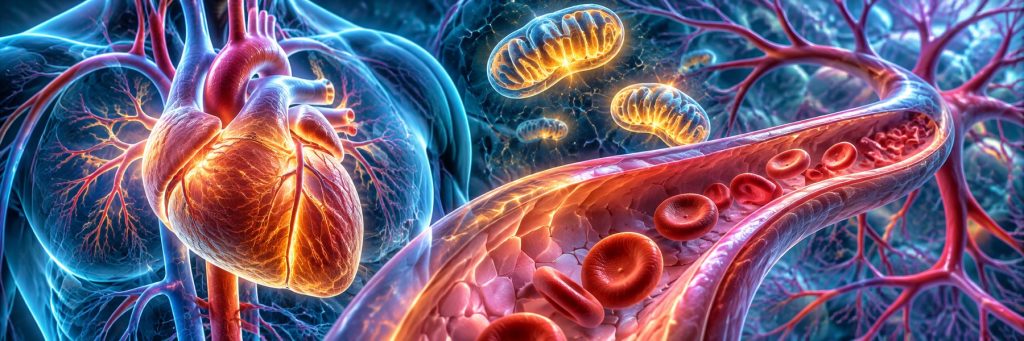
A healthy cardiovascular system depends on more than the strength of the heart. Arteries need to widen and narrow appropriately, blood vessels need a functioning inner lining, cells need reliable energy, and the body must manage cholesterol, blood pressure, glucose, inflammation, and clotting.
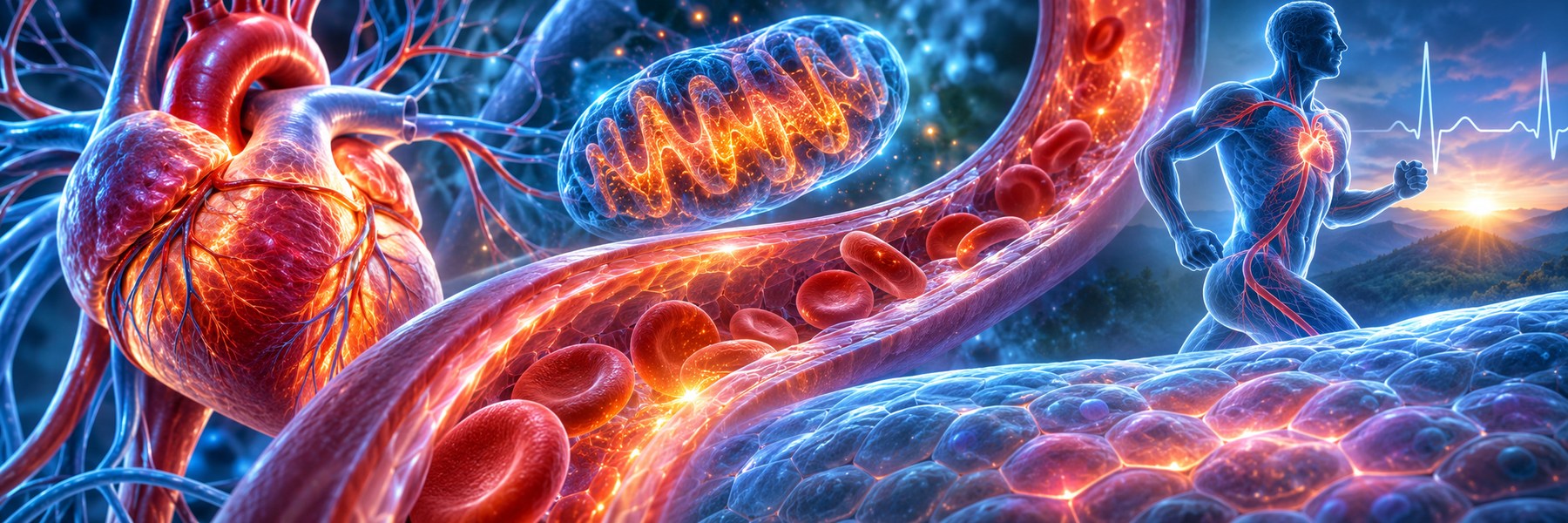
That complexity explains why researchers are interested in peptide combinations targeting different aspects of cardiovascular biology. Some experimental molecules are associated with mitochondrial stress responses, while others are marketed as short cardiac or vascular bioregulators. The prospect of combining distinct mechanisms is intriguing: one compound might influence metabolic stress, another vascular cell behavior, and a third mitochondrial membranes.
However, a stack that changes several pathways is not automatically a treatment that prevents heart attacks, strokes, or heart failure. Cardiovascular research offers unusually clear benchmarks: effective interventions can be tested for hospitalization, heart attack, stroke, cardiovascular death, and day-to-day physical function. Many investigational peptides have not reached that stage.
The strongest near-term strategy remains treating established risk factors with proven therapies, supported by appropriate activity, nutrition, and smoking cessation. This article compares experimental combinations against that clinical standard rather than assuming more compounds are better.
2. Understanding the Pathways: Endothelium, Mitochondria, and Metabolic Risk
Endothelial function and vascular flexibility
The endothelium is the thin cellular lining inside blood vessels. It regulates vascular tone, helps balance clotting, and participates in inflammatory signaling. Endothelial dysfunction can contribute to atherosclerosis and impaired circulation. Nitric oxide is one important signaling molecule, but increasing a nitric-oxide marker alone does not establish fewer cardiovascular events.
Mitochondrial energy and oxidative stress
Heart muscle is energy intensive. Mitochondria supply ATP to support contraction, electrical activity, and cellular maintenance. Under metabolic stress, mitochondrial membranes and reactive-oxygen signaling can become disrupted. SS-31, also known as elamipretide, is of interest because it interacts with cardiolipin-associated mitochondrial membrane biology. MOTS-C and Humanin belong to a different class: mitochondria-derived signaling peptides investigated for metabolism and cellular stress responses.
Inflammatory signaling and vascular aging
Atherosclerosis is not simply cholesterol collecting inside a pipe. Lipoprotein retention, immune-cell activity, endothelial changes, and fibrous plaque formation all contribute. Aging-related senescent cells and altered inflammatory responses may also influence vascular disease. Experimental anti-inflammatory effects cannot be assumed to stabilize plaques or reduce strokes without appropriate human trials.
Metabolic risks compound one another
High LDL cholesterol, hypertension, diabetes, smoking, sleep disruption, inactivity, and excess visceral fat may interact. Lowering a measurable risk factor is useful, but it differs from demonstrating fewer cardiovascular events. This distinction will recur throughout the article.
3. Peptide Stacks Researchers Are Exploring
Stack 1: SS-31 + MOTS-C
The proposed complementarity: SS-31 is designed to interact with mitochondrial membrane structures, whereas MOTS-C has been studied for metabolic adaptation, cellular stress responses, and AMPK-associated signaling. In theory, membrane-focused support and broader metabolic signaling could address different dimensions of cardiac energetic stress.
What the evidence shows: SS-31 has a genuine clinical milestone. The FDA approved elamipretide, branded Forzinity, in September 2025 for improving muscle strength in eligible adults and children with Barth syndrome weighing at least 30 kg. This rare mitochondrial disorder does not serve as a model for every form of cardiovascular aging. The approval does not establish benefits for coronary artery disease, routine heart failure care, or healthy aging. FDA Forzinity trial snapshot.
MOTS-C has intriguing animal and cell studies, including exercise and metabolic-stress models. Exercise also influences endogenous MOTS-C in humans. But human evidence that administered MOTS-C prevents cardiovascular events is missing. MOTS-C and exercise research.
What remains unknown: No adequately controlled human trial has demonstrated that SS-31 plus MOTS-C improves ejection fraction, exercise capacity, coronary outcomes, or cardiovascular survival better than either compound alone. The safety of the combination is not established. Research assessment: compelling mechanistic contrast, unvalidated clinical stack.
Stack 2: Cardiogen + Vesugen
The proposed complementarity: Cardiogen is discussed as a cardiac tissue bioregulator, while Vesugen is associated with vascular endothelial research. The theoretical attraction is the distinction between myocardium and vessel walls, two tissues exposed to different stresses.
Compound identity matters: In Peptide Perspectives, Cardiogen is identified as the tetrapeptide AEDR (Ala-Glu-Asp-Arg), whereas Vesugen is associated with KED (Lys-Glu-Asp). Some outside summaries ambiguously call Cardiogen AED, a different sequence. Sequence, formulation, and identity should be confirmed before comparing studies or interpreting vendor claims.
What the evidence shows: Cardiogen has organ-culture, cellular, and biochemical research involving proliferative and apoptosis-associated signals, but there are no robust randomized human cardiovascular-outcome trials. Vesugen has cell-culture and limited observational research involving vascular biology without independently replicated randomized clinical efficacy. Claims that this pairing regenerates heart muscle or restores aging arteries exceed the evidence.
What remains unknown: Specificity, pharmacokinetics, long-term cell-proliferation safety, human dosing, and interaction effects. Altering proliferation or apoptosis markers is not synonymous with repairing cardiovascular tissue. Research assessment: very early, with unusually large evidence and identity gaps.
Stack 3: SS-31 + Vesugen
The proposed complementarity: Elamipretide’s mitochondrial membrane research could be considered alongside Vesugen’s proposed endothelial and gene-regulatory effects. This separates cellular energy handling from vascular-lining biology.
What the evidence shows: The evidence resides almost entirely in studies of the individual compounds, which differ sharply in clinical maturity. SS-31 has an approved rare-disease use, whereas Vesugen lacks controlled human cardiovascular-outcome evidence. There are no convincing combination trials demonstrating benefit for blood-vessel stiffness, coronary microvascular function, or cardiovascular aging.
Potential concern: Vascular symptoms might originate from obstructive coronary disease, abnormal blood pressure, thrombosis, anemia, or other conditions that cannot be safely managed by an experimental mitochondrial-vascular stack. Research assessment: mechanistic hypothesis only.
Stack 4: MOTS-C + Humanin
The proposed complementarity: Both are mitochondrial-derived peptides, but their research focuses are not identical. MOTS-C is associated with metabolic adaptation; Humanin has been studied for cytoprotective, cell-survival, and stress-response signaling.
What the evidence shows: Human studies have found relationships between endogenous mitochondrial-derived peptides and physiological conditions. Those correlations do not establish that administering Humanin restores vascular health. Some Humanin experiments involve apoptosis and cell-survival mechanisms, which require attention to context, including malignancy-related concerns. There are no adequate controlled human trials of the combination for heart disease prevention.
Why stacking may not be additive: Two peptides that interact with stress responses may affect overlapping downstream networks. Even if different receptors are proposed, their combined physiological effect cannot be calculated from separate animal experiments. Research assessment: exploratory and unvalidated.
Stack 5: Cardiogen + SS-31
An additional research comparison pairs Cardiogen’s proposed cardiac structural and gene-regulatory effects with SS-31’s mitochondrial membrane biology. This could provide a useful experimental model for exploring whether mitochondrial changes correlate with tissue remodeling markers. Yet no controlled trial demonstrates improved human myocardial recovery from this pairing. Its rationale should not be confused with an evidence-based clinical recommendation.
Stack 6: MOTS-C + a Proven Cardiovascular Care Plan
This is better understood as a research comparator, not a suggested peptide regimen. Researchers could test whether an experimental mitochondrial intervention adds anything after people already receive evidence-based blood-pressure, lipid, glucose, exercise, and heart-failure care. That design matters because without an optimized standard-care control group, improvements may come from treatment people should have been receiving anyway.
Clinical outcomes, adverse events, and patient-centered function would need to be measured over time before added peptide value could be claimed.
4. Important Comparators: Semaglutide and Tirzepatide Individually
These medicines should be evaluated as separate clinical options, not combined with each other. Both already affect metabolic and cardiovascular risk through established hormone pathways, and cardiovascular trials provide stronger evidence than the proposed experimental stacks.
Semaglutide: Prevention of major cardiovascular events
Semaglutide is a GLP-1 receptor agonist. In the SELECT trial, once-weekly semaglutide reduced the composite risk of cardiovascular death, nonfatal myocardial infarction, or nonfatal stroke in adults with established cardiovascular disease and overweight or obesity who did not have diabetes. The relative reduction was approximately 20%. In March 2024, the FDA expanded Wegovy’s indication to include reducing major adverse cardiovascular events in eligible adults with established cardiovascular disease and overweight or obesity. FDA announcement.
This is an outcome, not simply a change in inflammatory biomarkers. It also does not mean every person using semaglutide receives the same cardiovascular benefit regardless of health history.
Tirzepatide: Heart failure and diabetes-related cardiovascular research
Tirzepatide activates GIP and GLP-1 receptors. In the randomized SUMMIT trial involving obesity-related heart failure with preserved ejection fraction (HFpEF), the composite of cardiovascular death or worsening heart failure occurred in 9.9% taking tirzepatide versus 15.3% taking placebo over the study follow-up. Symptoms and health-status measures also improved. The trial was not powered to establish a separate reduction in cardiovascular death. SUMMIT primary report.
In SURPASS-CVOT, involving people with type 2 diabetes and atherosclerotic cardiovascular disease, tirzepatide was noninferior to dulaglutide for major adverse cardiovascular events; superiority was not established. SURPASS-CVOT.
Why the comparison matters: Semaglutide and tirzepatide illustrate that distinct patient groups and outcomes matter. Neither should be casually substituted for a proven cardiac therapy, and combining multiple GLP-1-based medicines is not an established cardiovascular strategy.
5. Comparing the Research Options
| Option | Primary research pathway | Evidence maturity | Demonstrated cardiovascular outcome benefit? | Key limitation |
|---|---|---|---|---|
| SS-31 + MOTS-C | Mitochondrial membranes + metabolic signaling | Combination hypothetical | No | No validated stack trials |
| Cardiogen + Vesugen | Myocardial + endothelial bioregulator hypotheses | Primarily laboratory / limited observational | No | Identity, efficacy and safety gaps |
| SS-31 + Vesugen | Mitochondrial + vascular biology | Combination hypothetical | No | Cannot generalize rare-disease approval |
| MOTS-C + Humanin | Mitochondrial-derived stress signaling | Preclinical / observational biology | No | Unknown combined cell-survival effects |
| Cardiogen + SS-31 | Cellular structural signaling + mitochondrial membrane | Highly speculative | No | No direct combination efficacy trials |
| Semaglutide alone | GLP-1 and metabolic risk | Large human outcome trials | Yes, in selected populations | Eligibility and tolerability matter |
| Tirzepatide alone | GIP + GLP-1 metabolic pathways | Large human outcome trials | Yes, for selected HFpEF outcomes; noninferior in diabetes CVOT | Not all cardiac outcomes show superiority |
A strong mechanistic story is an invitation to test a hypothesis. It is not a substitute for validated clinical outcomes.
6. Complementary Supplements: What Fits, and What Does Not?

CoQ10
Coenzyme Q10 participates in mitochondrial electron transport. It has been studied in heart failure and statin-associated symptoms, with some encouraging but heterogeneous results. Evidence is insufficient to treat ordinary CoQ10 supplementation as a replacement for guideline-directed heart-failure medicines or as a broadly proven method of preventing heart attacks. Product formulations and absorption differ.
Omega-3 fatty acids: distinguish food, supplements, and prescription EPA
Eating fish and other cardioprotective foods can be part of a heart-healthy dietary pattern. Ordinary over-the-counter fish-oil supplements, however, have not consistently prevented cardiovascular events in broad populations. In selected statin-treated adults with elevated triglycerides and other qualifying risk factors, prescription icosapent ethyl (purified EPA) reduced cardiovascular events in REDUCE-IT. This benefit should not be generalized to mixed EPA/DHA fish oils. Prescription EPA has its own bleeding and atrial-fibrillation considerations. FDA Vascepa label.
Soluble fiber
Oat beta-glucan, psyllium, and other viscous soluble fibers can reduce LDL cholesterol by interfering with intestinal cholesterol and bile-acid handling. The benefit depends on the specific fiber, adequate intake, and dietary context. Fiber may also improve bowel regularity and some glycemic measures, but LDL lowering alone should not be described as proof of fewer clinical cardiac events from a particular supplement. Hydration and medication timing deserve attention.
Magnesium
Magnesium supports normal cardiac electrical activity and muscle function. Correcting deficiency can be important, particularly with certain medications or inadequate intake. Routine high-dose supplementation in people with adequate magnesium levels has not been demonstrated to prevent cardiovascular events. Excess intake can produce diarrhea and, with reduced kidney function, dangerous accumulation.
Plant sterols and stanols
Plant sterols compete with intestinal cholesterol absorption. A 2026 umbrella review found modest LDL reductions across randomized trials, and European cardiology guidance notes that plant sterols can lower LDL without direct evidence of fewer cardiovascular events. They are LDL-lowering tools, not replacements for statins or other proven therapies. 2026 umbrella review and ESC/EAS guideline update.
Other relevant nutrition and lifestyle supports
- Potassium-rich foods can support blood-pressure management in suitable individuals, but supplemental potassium may be dangerous with kidney disease or potassium-raising medicines.
- Dietary nitrate-containing vegetables such as beets and leafy greens can influence vascular physiology, although changes in nitric-oxide markers do not establish prevention of heart attacks.
- Adequate protein and resistance exercise help maintain muscle and function, especially during substantial weight loss.
- A Mediterranean-style dietary pattern, aerobic activity, sleep, and tobacco avoidance address multiple established risk factors without relying on poorly characterized experimental combinations.
7. What Would Prove True Cardiovascular Synergy?
The central question is not whether a proposed combination changes two biomarkers. It is whether the combination improves meaningful outcomes beyond a well-matched single agent and optimized standard care.
A credible research program would first establish compound identity, pharmacokinetics, reproducible manufacturing quality, and early safety. Next, a randomized, blinded trial could compare standard care alone, each experimental component added separately, and the actual combination. That would allow an interaction analysis rather than assuming two positive single-agent results equal synergy.
Useful intermediate measures might include blood pressure, LDL-C and apoB, endothelial function, cardiac MRI, exercise capacity, natriuretic peptides, and quality of life. Yet the strongest cardiovascular claims require longer-term assessment of heart-failure hospitalization, myocardial infarction, stroke, cardiovascular death, and serious adverse events.
Combining interventions also risks treatment overlap. Some effects on blood pressure, glucose, vascular tone, or fluid balance may interact with prescription medicines. Careful trial designs would need to identify both improved outcomes and unexpected adverse effects.
8. Safety: Why Cardiac Research Requires a Higher Bar
Heart disease is not an appropriate setting for substituting unregulated peptide stacks for proven treatment. A person with chest pain, severe breathlessness, fainting, or stroke-like symptoms needs urgent medical assessment, not a trial of research compounds.
Unapproved experimental peptides: Cardiogen, Vesugen, MOTS-C, and Humanin lack established cardiovascular indications, validated combination dosing, and adequate long-term human safety data. In research-grade products, sequence uncertainty, contaminants, aggregation, sterility, and mislabeled quantities can further complicate safety. No human cardiovascular benefit from their proposed stacks has been established.
SS-31 nuance: FDA approval for Barth syndrome applies to the specific prescription product and eligible population. It does not validate gray-market elamipretide preparations or combination use for general vascular aging. Injection-site reactions and hypersensitivity remain relevant considerations.
Cardiac and vascular drug interactions: Blood-pressure medications, anticoagulants, antiplatelet medicines, diuretics, antiarrhythmics, diabetes medicines, and lipid-lowering drugs all have clinically important effects. Even dietary supplements may interact with anticoagulation or increase potassium and magnesium exposure. Monitoring should be guided by the person’s diagnoses and medications.
Unexpected biology: Attempts to reduce apoptosis or change proliferation in cardiac or endothelial cells may have consequences in other tissues. Preclinical cytoprotection is not evidence that long-term stimulation is safe, particularly for people with cancer histories or complex medical conditions.
Avoid misleading surrogate outcomes: Feeling more energetic, observing a lower inflammatory marker, or recording improved vascular ultrasound data is not equivalent to demonstrating fewer heart attacks or longer life. Cardiovascular education should keep these distinctions explicit.
9. Where the Science Is Heading
Cardiovascular research is increasingly interested in the intersection of mitochondrial biology, metabolism, inflammation, endothelial function, and aging. Well-characterized mitochondria-directed compounds may eventually have roles in carefully defined diseases where cellular energetics contribute to pathology.
The opportunity is particularly interesting in conditions with unmet needs, including selected cardiomyopathies, microvascular dysfunction, and persistent exercise limitations. But broad anti-aging claims will require far more than cellular assays and uncontrolled case reports.
For now, the most scientifically grounded approach is to combine proven cardiovascular prevention and treatment with targeted, well-designed research, rather than combine experimental peptides in hopes that additional pathways guarantee additional benefit.
10. Explore the Compounds
Continue exploring individual profiles in the Peptide Perspectives directory:
- SS-31 / Elamipretide – mitochondrial membrane research and a specific approved rare-disease use.
- MOTS-C – mitochondrial-derived metabolic and exercise-response signaling.
- Humanin – mitochondrial-derived cell-survival and stress-response research.
- Cardiogen – AEDR cardiac bioregulator research.
- Vesugen – KED vascular bioregulator research.
- Semaglutide – GLP-1 receptor biology and clinical metabolic outcomes.
- Tirzepatide – dual GIP/GLP-1 biology and relevant human outcome trials.
Selected further reading
- FDA: Wegovy cardiovascular risk-reduction indication
- SUMMIT: Tirzepatide in obesity-related HFpEF
- SURPASS-CVOT: Tirzepatide versus dulaglutide
- FDA: Elamipretide clinical-trial snapshot
- MOTS-C and exercise-response research
- Plant sterol umbrella review, 2026
- 2025 ESC/EAS lipid-management guideline update
Peptide Perspectives Research Disclaimer: This article is educational and is not personalized medical advice, a dosing protocol, or an endorsement of combining investigational compounds. None of the proposed experimental peptide stacks has demonstrated prevention of heart attack, stroke, or cardiovascular death in controlled human combination trials. Approved medicines should be used only for appropriate indications with qualified clinical care. Experimental products labeled for research use are not substitutes for approved therapies.