
Peptide Perspectives | Peptide Stacking & Synergy Series | Research goal: Joint & Cartilage Health
Can a combination of tissue-repair peptides, matrix-support nutrients, and rehabilitation help people maintain healthier joints? The biology offers intriguing hypotheses, but real cartilage restoration is far more difficult than reducing pain or helping an injured tendon recover.
1. The Big Picture: Joint Recovery Is Not One Biological Problem
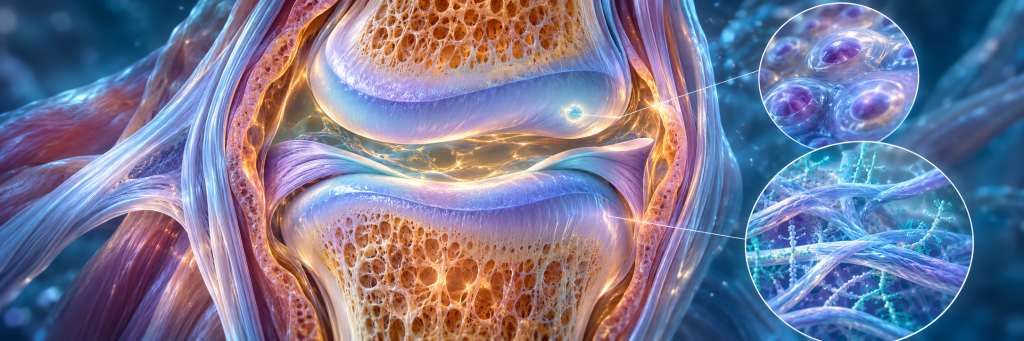
A healthy joint depends on smooth articular cartilage, stable ligaments, functioning tendons, synovial fluid, supporting muscle, and well-coordinated immune signaling. Loss of comfort or mobility can reflect osteoarthritis, tendon injury, ligament instability, synovitis, autoimmune inflammation, or multiple problems at once. Each has a different biology and requires a different treatment strategy.
Peptides such as BPC-157, full-length thymosin beta-4, GHK-Cu, Cartalax, and KPV are discussed because they are associated with cell movement, extracellular-matrix maintenance, and inflammatory pathways. They are appealing research candidates, not established joint-restoration medications. A 2026 orthopaedic evidence review found that controlled human evidence for musculoskeletal benefits from BPC-157 and thymosin beta-4/TB-500 remains absent; a separate sports-medicine review found human evidence for GHK-Cu in musculoskeletal indications lacking too. Orthopaedic review | Sports-medicine review.
A reasonable scientific goal is not simply “more collagen” or “less inflammation.” It is better tissue structure, reduced symptoms, improved strength, and durable mobility. These are different outcomes and must be tested separately.
2. The Biological Pathways: Why Cartilage, Tendons, and Ligaments Heal Differently
Cartilage: A difficult place to rebuild tissue
Articular cartilage contains specialized cells called chondrocytes, embedded within a dense matrix rich in type II collagen and aggrecan. It has very limited blood supply and low cell turnover. Damage that extends through its matrix often fails to regenerate normal hyaline cartilage spontaneously. Even a treatment that increases cartilage thickness does not necessarily improve pain, and pain relief does not establish cartilage regrowth.
Tendons and ligaments: Collagen organization matters
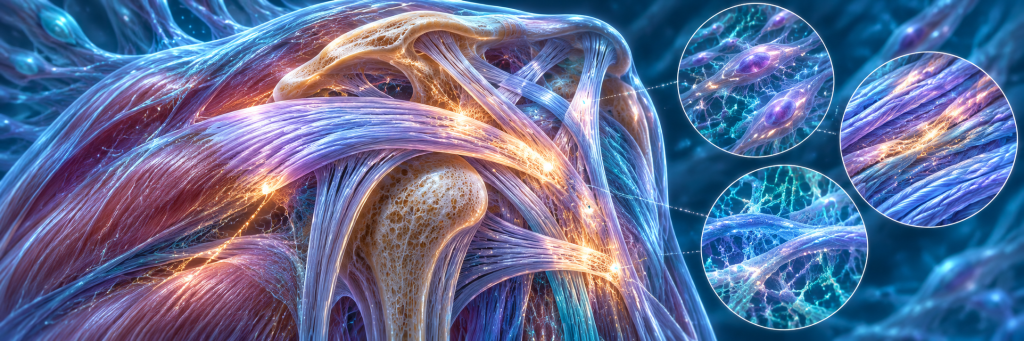
Tendons transfer force from muscle to bone, whereas ligaments stabilize joints by connecting bones. Both rely primarily on aligned type I collagen. They have some repair capability, but healing can produce disorganized scar tissue. The tissue must gradually tolerate mechanical loading, so appropriate progressive rehabilitation remains central to recovery.
Synovium and inflammation: A different target
The synovial lining helps maintain joint fluid and can become inflamed. Inflammatory cytokines and enzymes may increase pain and contribute to matrix breakdown. Yet inflammation is also part of normal injury repair. Suppressing it indiscriminately may not help tissue restoration. A compound that lowers inflammatory signals in laboratory experiments may not improve mobility in people.
Strength, weight, and movement
Muscles act as dynamic shock absorbers and stabilizers. Exercise, strength work, appropriate weight management when indicated, and condition-specific rehabilitation have clearer clinical support than experimental peptide stacks for common osteoarthritis symptoms. AAOS knee osteoarthritis recommendations.
3. The Peptide Stacks Researchers Are Discussing
Stack 1. BPC-157 + Thymosin Beta-4: Tissue-repair signaling and cell movement
Explore BPC-157 | Explore full-length Thymosin Beta-4
Research logic. BPC-157 has been investigated in animal models of tendon, ligament, muscle, and other tissue injury. Proposed effects include changes in repair-associated signaling, vascular responses, and cell behavior. Full-length thymosin beta-4 (Tβ4) is a 43-amino-acid peptide associated with actin regulation and cell migration. Their mechanisms offer a plausible reason to study the two together in soft-tissue recovery.
Evidence. Published musculoskeletal findings are overwhelmingly cellular and animal-based. There are no controlled human trials showing that this pairing repairs a meniscus, restores cartilage, or accelerates tendon healing. 2026 orthopaedic review.
Important identity warning. The name TB-500 can refer to a shorter seven-amino-acid fragment rather than full-length Tβ4. A fragment is not automatically interchangeable with the 43-amino-acid parent molecule. Research conducted with one cannot simply be applied to the other. Products must be identified by sequence and composition.
Research outlook. Among community-discussed stacks, this has a clearer soft-tissue mechanistic story than a cartilage-regrowth story. The two peptides may also overlap in cell migration and remodeling pathways. No standardized, safe human stack protocol exists.
Stack 2. GHK-Cu + BPC-157: Extracellular-matrix support and injury biology
Explore GHK-Cu | Explore BPC-157
Research logic. GHK-Cu is a copper-binding tripeptide investigated in skin and wound-related research for fibroblast behavior and extracellular-matrix remodeling. BPC-157 has broader preclinical injury-model work. Together they suggest a research question about combining matrix biology and tissue-response signaling.
Evidence. No controlled human trial demonstrates benefits from this pair for knee arthritis, tendon damage, ligament injury, or cartilage regeneration. Skin collagen research cannot establish type II cartilage matrix repair or mechanically competent tendon formation. Sports-medicine peptide review.
Risks. Injectable GHK-Cu is not equivalent to topical cosmetic exposure. Systemic copper handling, impurity exposure, immune reactions, and dose-related safety remain insufficiently characterized for combination use. More overlap in matrix pathways does not necessarily create stronger tissue.
Stack 3. Cartalax + GHK-Cu: Cartilage-associated cell signals and matrix maintenance
Explore Cartalax | Explore GHK-Cu
Research logic. Cartalax, also called AED (Ala-Glu-Asp), is an ultrashort synthetic peptide explored in bioregulator research. Preliminary cell experiments report changes in cartilage-associated markers such as SOX9, aggrecan and type II collagen. GHK-Cu is associated with broader extracellular-matrix pathways. The pairing asks whether these separate signals might influence how cartilage-forming cells produce and maintain matrix.
Evidence. This is highly speculative. Cell-marker responses do not prove that administered Cartalax regrows joint cartilage in humans. Independent replication, exposure and delivery studies, controlled animal cartilage-defect studies, and ultimately randomized human trials are needed. Human benefit, dosing, and safety for the combination are unestablished.
Research outlook. Interesting for future cartilage-cell research, but the weakest basis here for expecting a practical improvement in pain or mobility.
Stack 4. BPC-157 + KPV: Experimental injury and inflammatory signaling
Research logic. BPC-157 is investigated for injury-related pathways. KPV, a small alpha-MSH-derived tripeptide, has cellular and animal evidence involving inflammatory signaling, especially in intestinal and epithelial research. It is plausible to ask whether influencing injury biology and inflammatory responses together could improve joint recovery.
Evidence. Neither the combination nor KPV alone has established human benefit for osteoarthritis, inflammatory arthritis, tendon injury, or cartilage restoration. Reductions in inflammatory markers from non-joint models are not proof of joint disease modification. KPV research overview.
Risks. The immune consequences of sustained anti-inflammatory signaling in an injured joint are uncertain. Overlap with other anti-inflammatory treatments and possible interference with normal repair responses need investigation.
Stack 5. GHK-Cu + full-length Thymosin Beta-4: Cell migration meets matrix remodeling
Explore GHK-Cu | Explore full-length Thymosin Beta-4
This combination extends the experimental logic of the GLOW blend, without automatically adding BPC-157. A controlled research program could ask whether Tβ4-associated migration responses and GHK-Cu-associated matrix regulation interact. However, both pathways have roles far beyond joint tissue, and there is no clinical evidence of synergy, optimal ratio, or systemic safety. As with other pairs, claims of cartilage regrowth would require imaging and function outcomes, not only laboratory collagen markers.
A more clinically grounded comparator: Cartilage-directed drug development
Rather than adding another experimental peptide, it is useful to compare these stacks with agents studied directly for cartilage outcomes. Sprifermin (recombinant FGF18) has been evaluated in randomized knee osteoarthritis trials with cartilage-thickness endpoints; TPX-100 has been studied for knee symptoms and structural outcomes. These programs demonstrate how difficult it is to connect tissue structure with pain and mobility. Neither establishes that the community peptide stacks above work. Peptide Perspectives joint-health overview.
4. Comparing the Stacks
| Stack | Proposed complementary mechanisms | Evidence for the combination | Principal uncertainty |
|---|---|---|---|
| BPC-157 + full-length Tβ4 | Injury response + actin/cell migration | Preclinical component evidence; no controlled human stack data | No tendon, ligament, or cartilage efficacy established; TB-500 naming ambiguity |
| GHK-Cu + BPC-157 | Matrix remodeling + experimental tissue protection | Mechanistic, not clinical combination evidence | Injectable copper-peptide safety; no demonstrated joint benefit |
| Cartalax + GHK-Cu | Cartilage-cell markers + matrix biology | Preliminary cell evidence; no verified human stack trial | Uncertain delivery, replication, and actual cartilage regeneration |
| BPC-157 + KPV | Injury signaling + inflammatory modulation | Separate preclinical pathways only | Human anti-inflammatory and repair effects unknown |
| GHK-Cu + full-length Tβ4 | Matrix signaling + cell migration | No controlled human combination evidence | Overlapping repair pathways and systemic safety unknown |
The strongest practical strategy is not currently a peptide stack. For many common joint problems, an individualized combination of diagnosis, appropriate strengthening or rehabilitation, activity modification, and selected symptom-oriented treatments has better clinical grounding. Evidence for a supplement is not evidence that it improves an untested peptide combination.
5. Complementary Supplements: What Could Realistically Help?
Collagen peptides
Oral collagen peptides provide amino acids and peptides that may influence collagen-related biology. An analysis of 11 randomized trials with 870 participants found improvements in knee osteoarthritis pain and function, although studies differed in products, methods, and risk of bias. These are symptom findings, not proof of cartilage regrowth. 2024 meta-analysis.
Vitamin C
Vitamin C is required for normal collagen synthesis. Correcting inadequate intake supports ordinary connective-tissue biology, but high-dose supplementation has not been shown to regenerate cartilage or produce peptide synergy. Food sources include citrus, peppers, and berries.
Glucosamine and chondroitin
Both are commonly marketed for joint support, but trials and guidelines disagree. The ACR/Arthritis Foundation advises against routine glucosamine use in knee, hip, and hand osteoarthritis; AAOS describes inconsistent evidence and allows that some preparations may offer symptom benefit. Glucosamine formulations and prescription-grade products should not be assumed equivalent. Chondroitin can interact with anticoagulants, and both may cause digestive upset. NIH NCCIH overview.
Omega-3 fatty acids
EPA and DHA influence inflammatory lipid mediator pathways and have established roles in nutrition. Evidence for improving common osteoarthritis symptoms is weaker and less consistent than their marketing implies. They are not proven cartilage regenerators; discuss concentrated products when using anticoagulants or preparing for surgery.
Curcumin
Some randomized studies report modest improvements in osteoarthritis pain and function with particular curcumin formulations, but product bioavailability, study quality, and comparability vary. Concentrated supplements can cause adverse effects, including rare liver injury, and may interact with medicines. An improvement in symptoms is not evidence of structural cartilage repair.
Protein, creatine, and vitamin D when indicated
Adequate protein helps maintain the muscles that stabilize joints. Creatine can improve strength-training capacity in suitable adults, but does not rebuild cartilage. Vitamin D is important when deficiency is present; routine high-dose supplementation has not shown reliable osteoarthritis benefit. Physiotherapy and progressive loading remain the context in which these nutritional tools are most relevant.

| Support option | What the evidence may support | What it does not establish |
|---|---|---|
| Collagen peptides | Possible modest reduction in osteoarthritis pain and improved function | Hyaline cartilage regeneration |
| Vitamin C | Normal collagen synthesis when nutrition is adequate | Additional joint healing from megadoses |
| Glucosamine/chondroitin | Mixed, formulation-specific symptom findings | Reliable disease modification |
| Omega-3 | General nutritional and inflammatory physiology | Consistent osteoarthritis benefit |
| Curcumin | Possible modest symptom improvements in some trials | Structural restoration or universal safety |
| Protein + rehabilitation | Muscle maintenance and strength | Direct reversal of cartilage loss |
| Creatine + training | Strength and exercise performance | Cartilage repair |
| Vitamin D if deficient | Correction of deficiency and bone-health support | Routine OA improvement without deficiency |
6. Where the Science Is Heading
The next wave of musculoskeletal research will need to answer more precise questions than whether a compound “helps joints.” Cartilage studies should use quantitative MRI, structural measures, pain scores, movement tests, and longer follow-up. Tendon and ligament trials require force tolerance, re-injury rates, functional assessment, and imaging appropriate to those tissues. Inflammatory conditions need diagnostic and immune markers alongside outcomes that matter to patients.
For peptide stacks, the critical research design is combination versus each component versus placebo or established care, with rigorous verification of the peptide sequence, purity, route, and adverse events. Monitoring only pain after an injection cannot determine whether a peptide regenerated cartilage. Similarly, a favorable change in chondrocyte gene expression is a starting signal for research, not a finished therapy.
There is a compelling opportunity in combining precision regenerative biology with personalized rehabilitation. Researchers may eventually identify approaches for improving cartilage-cell function, supporting matrix maintenance, or reducing destructive inflammation without interrupting useful repair. But more compounds do not automatically produce stronger or safer outcomes.
Explore the Compounds
- BPC-157: Experimental injury and connective-tissue pathways
- Thymosin Beta-4, full length: Actin, cell migration, and remodeling
- GHK-Cu: Copper peptide and extracellular matrix biology
- Cartalax: AED and experimental cartilage-associated signaling
- KPV: Preclinical inflammatory signaling
The Bigger Possibility
Joint health is ultimately about being able to move. The most exciting future treatments will not merely change a laboratory marker or reduce a pain score for a few days. They will protect tissue, restore useful movement, and help people stay active over time. Experimental peptides suggest worthwhile questions about repair and regulation, while established exercise and rehabilitation provide a practical foundation today.
Peptide Perspectives provides educational research information, not individualized treatment instructions. The peptide combinations discussed here are not FDA-approved for cartilage restoration, joint disease, or injury recovery, and their human safety and effectiveness as stacks are unestablished. Investigational products can carry identity, sterility, purity, and immune risks. Persistent joint swelling, locking, inability to bear weight, fever, sudden injury, or worsening pain requires appropriate medical evaluation. Do not replace evidence-based treatment with research-use peptide products.